Boeing 737-700
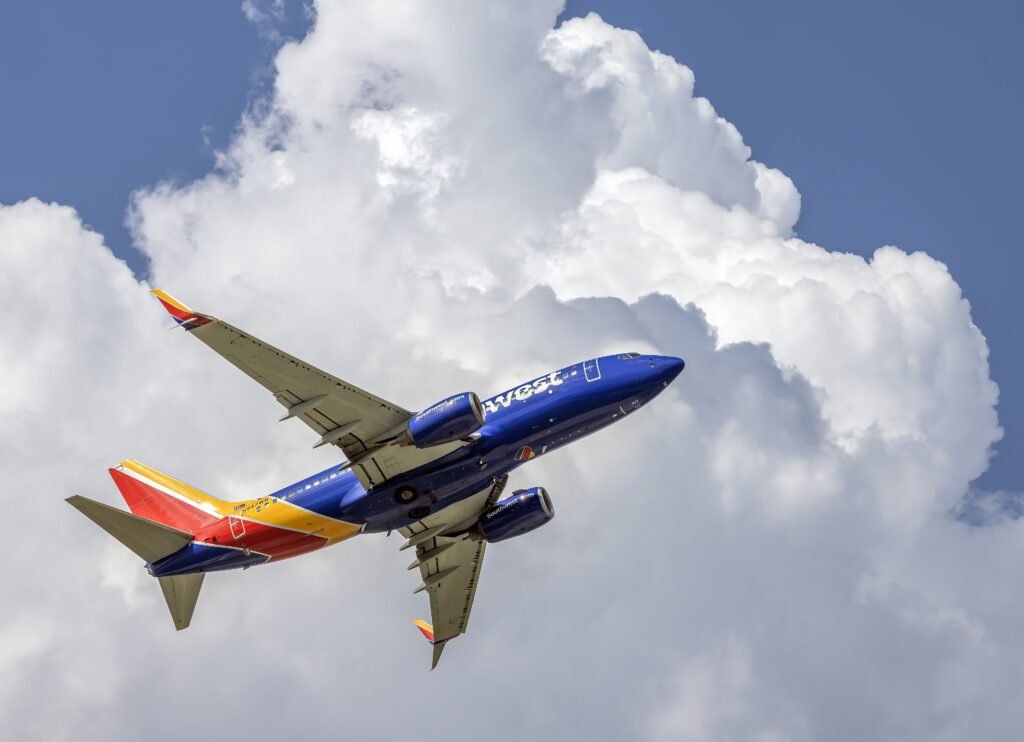
The Boeing 737-700 was the first member of the 737 Next Generation family. Launched by Southwest Airlines and seating 126 to 149 passengers, it became one of the most common narrow-body airliners and the basis for military and business jet versions.
| General Characteristics | |
| Type | Narrow-body airliner, Civil and Commercial Aircraft |
|---|---|
| National Origin | United States |
| Manufacturer | Boeing |
| Variants | 737-700ER, 737-700C convertible, Boeing Business Jet (BBJ), C-40 Clipper, E-7 Wedgetail (based on the 737-700 airframe) |
| Status | In service (production ended) |
| First Flight | 9 February 1997 |
| Introduction | January 1998, with Southwest Airlines |
| Primary Users | Southwest Airlines, WestJet, United Airlines |
| Number Built | About 1,280 including BBJ and military versions |
| Developed From | Boeing 737-300 (737 Classic) |
| Capacity & Dimensions | |
| Cockpit Crew | Two |
| Typical Seating | 126 (two-class) |
| Max Seating | 149 (exit limit) |
| Overall Length | 33.63 m (110 ft 4 in) |
| Wing Span | 34.32 m (112 ft 7 in); 35.79 m (117 ft 5 in) with winglets |
| Wing Sweep | 25° |
| Wing Area | 124.6 m² (1,341 sq ft) |
| Overall Height | 12.57 m (41 ft 3 in) |
| Weights, Powerplant & Performance | |
| MTOW | 70,080 kg (154,500 lb) |
| OEW | 37,648 kg (83,000 lb) |
| Fuel Capacity | 26,020 L (6,875 US gal) |
| Engines | 2 × CFM International CFM56-7B turbofans |
| Max. Thrust | 89–117 kN (20,000–26,300 lbf) each, depending on rating |
| Typical Cruise Speed | Mach 0.785 |
| Max. Speed | Mach 0.82 |
| Range | 5,570 km (3,010 nmi) |
| Takeoff Distance | 6,699 ft (2,042 m) |
| Service Ceiling | 41,000 ft (12,500 m) |
The Boeing 737-700 was the first member of the 737 Next Generation (NG) family, the version of the 737 that dominated short-haul flying from the late 1990s until the arrival of the 737 MAX. It replaced the 737-300 at airlines around the world, and its launch customer, Southwest Airlines, built much of its network around it. The 737-700 also became the basis of Boeing’s first business jet and of several military aircraft.
Boeing 737-700 General Characteristics
Southwest launched the Next Generation programme in November 1993 with an order for 63 737-700s. Compared with the 737 Classic, the NG had a new, larger wing with more fuel, more efficient CFM56-7B engines, a higher cruise speed and a modern glass cockpit. The first 737-700 was rolled out in December 1996 and flew on 9 February 1997. Southwest received the first aircraft in December 1997 and put it into service in January 1998. About 1,280 737-700s were delivered, including about 120 Boeing Business Jets and the -700C convertible version.
Boeing 737-700 Cabin and Seating
The 737-700 typically seats 126 passengers in two classes, or up to 149 in a single class, which is the exit limit. Its size made it a natural replacement for the 737-300 and a direct competitor to the Airbus A319. Most aircraft now have the Boeing Sky Interior or retrofitted cabins.
Boeing 737-700 Versions
Boeing built several versions of the -700. The 737-700ER combined the short fuselage with the wing and landing gear of the larger 737-800 and extra fuel tanks, giving a range of about 10,000 km; All Nippon Airways was its launch customer in 2007. The 737-700C convertible has a large cargo door on the left side and can be switched between passenger and freight work, and the US Navy flies it as the C-40A Clipper. The original Boeing Business Jet used the same airframe with auxiliary tanks for long private flights, while Australia, Turkey and South Korea use the -700 airframe for their E-7 airborne early warning aircraft.
Boeing 737-700 Dimensions
The 737-700 is 33.63 m (110 ft 4 in) long and 12.57 m (41 ft 3 in) high. Its wing spans 34.32 m (112 ft 7 in), or 35.79 m (117 ft 5 in) with the blended winglets that many airlines added to save fuel.
Boeing 737-700 Engines and Performance
Two CFM International CFM56-7B engines produce between about 89 and 117 kN (20,000–26,300 lbf) of thrust each, depending on the rating chosen by the airline. The aircraft cruises at about Mach 0.785 and has a range of about 5,570 km (3,010 nmi). The maximum take-off weight is 70,080 kg (154,500 lb). Its short-field performance lets it use smaller airports than many larger jets.
Operational Role
Southwest Airlines has flown more 737-700s than anyone else, and the type has also been a mainstay at WestJet and United Airlines. Beyond the airlines, the 737-700 airframe is the basis of the original Boeing Business Jet, the US Navy’s C-40 Clipper transport and the E-7 Wedgetail airborne early warning aircraft used by Australia, Turkey and South Korea. Many airlines are now replacing their 737-700s with the 737 MAX 7 and MAX 8.
Frequently Asked Questions
How many seats does a 737-700 have? Typically 126 in two classes, up to 149.
What is the difference between the 737-700 and the 737-800? The -800 is about 6 metres longer and seats around 30 more passengers.
Is the 737-700 still built? No; it has been replaced in production by the 737 MAX 7.
Boeing 737-700 Summary
The 737-700 opened the Next Generation era and became one of the most useful airliners of its time. Compare it with the larger 737-800, its successor the 737 MAX 7 and the original 737-100.
Sources
- Boeing, 737 airport compatibility documents and product data
- Boeing Commercial Airplanes orders and deliveries data
Start the discussion
Commenting on this aircraft: Boeing 737-700