ATR 72-600 Regional Turboprop
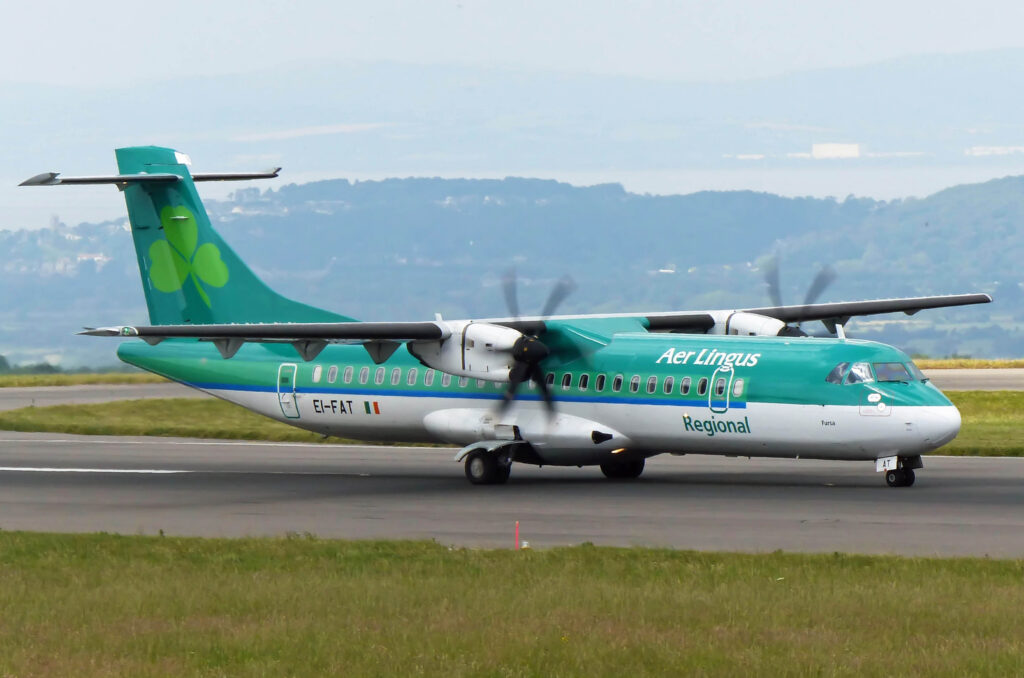
The ATR 72-600 is the current production version of the Franco-Italian ATR 72 regional turboprop. Launched in 2007, it carries around 70 passengers on short routes with much lower fuel burn than a regional jet.
| General Characteristics | |
| Type | Regional aircraft, Civil and Commercial Aircraft |
|---|---|
| National Origin | Multi-national |
| Manufacturer | ATR |
| Variants | ATR 72-200, ATR 72-210, ATR 72-500, ATR 72-600, ATR 72-600F |
| Status | In production |
| First Flight | 27 October 1988 (ATR 72) |
| Introduction | 2011 (ATR 72-600) |
| Primary Users | IndiGo, Azul Brazilian Airlines, FedEx Feeder, Binter |
| Developed From | ATR 42 |
| Capacity & Dimensions | |
| Cockpit Crew | Two |
| Typical Seating | 70–72 (one-class) |
| Max Seating | 78 |
| Overall Length | 27.17 m (89 ft 2 in) |
| Wing Span | 27.05 m (88 ft 9 in) |
| Wing Area | 61.0 m² (657 sq ft) |
| Overall Height | 7.65 m (25 ft 1 in) |
| Weights, Powerplant & Performance | |
| MTOW | 23,000 kg (50,706 lb) |
| OEW | 13,010 kg (28,682 lb) |
| Fuel Capacity | 5,000 kg (11,023 lb) |
| Engines | 2 × Pratt & Whitney Canada PW127M (later PW127XT-M) |
| Max. Thrust | 2,051 kW (2,750 shp) each |
| Typical Cruise Speed | 510 km/h (275 kn) |
| Range | 1,404 km (758 nmi) with maximum passengers |
| Service Ceiling | 7,600 m (25,000 ft) |
The ATR 72-600 is the current version of the ATR 72, the best-selling regional turboprop of recent decades. Built by ATR, a joint company of Airbus and Italy’s Leonardo, it carries around 70 passengers on routes of up to about an hour and a half, where its propellers burn far less fuel than a regional jet of the same size.
ATR 72-600 General Characteristics
The ATR 72 is a stretched version of the 48-seat ATR 42. It first flew on 27 October 1988, and Finnair introduced it in 1989. On 2 October 2007, ATR launched the -600 series of both aircraft, and deliveries of the ATR 72-600 began in 2011. The aircraft is assembled in Toulouse, France, while the fuselage is built by Leonardo in Italy.
The -600 kept the airframe of the earlier ATR 72-500 but brought a new glass cockpit designed with Thales, with five large LCD screens, a flight management system and better navigation equipment. The engines were upgraded to the Pratt & Whitney Canada PW127M, which gives more power for take-off from short or hot and high runways. In 2015, EASA approved a high-density cabin that raised maximum seating from 74 to 78.
ATR 72-600 Cabin and Seating
The cabin is four seats across in a 2-2 layout. A typical one-class layout has 70 to 72 seats, and the maximum is 78. Passengers usually board through a door at the rear, while the forward area is used for cargo, because the propellers are close to the front of the cabin.
ATR 72-600 Dimensions
The ATR 72-600 is 27.17 m (89 ft 2 in) long, with a span of 27.05 m (88 ft 9 in) and a height of 7.65 m (25 ft 1 in). The high wing has an area of 61 m² and a high aspect ratio of 12, which gives good lift at low speeds. The high wing also keeps the propellers well above the ground and makes it easier to load the aircraft at small airports.
ATR 72-600 Engines and Performance
Two PW127M turboprops, each rated at 2,051 kW (2,750 shp), drive six-blade Hamilton Sundstrand propellers. The aircraft cruises at about 510 km/h (275 knots) and can climb to 25,000 ft. With a full load of passengers its range is about 1,404 km (758 nmi). Maximum take-off weight is 23 tonnes (50,706 lb). On short routes, a turboprop of this size burns much less fuel than a regional jet with the same number of seats, which is why the type is popular with airlines facing high fuel prices. In flight, the aircraft relies on rubber de-icing boots on the leading edges of the wing and tail.
Operational Role
The ATR 72-600 flies island routes, short domestic hops and feeder flights to large hubs in every part of the world. India’s IndiGo, Brazil’s Azul and Spain’s Binter all operate large fleets. FedEx was the launch customer for the purpose-built ATR 72-600F freighter, which first flew on 16 September 2020. Turboprops like the ATR are slower than jets, but on a flight of less than an hour the difference in block time is only a few minutes, while the savings in fuel and maintenance are large. ATR is also working on the PW127XT engine, which needs less maintenance, and on further fuel-saving versions.
Frequently Asked Questions
How many seats does the ATR 72-600 have? Typically 70 to 72, with a maximum of 78.
How fast does the ATR 72-600 fly? It cruises at about 510 km/h (275 knots).
What is the range of the ATR 72-600? About 1,404 km (758 nmi) with a full load of passengers.
ATR 72-600 Summary
The ATR 72-600 combines an efficient turboprop design with a modern glass cockpit, and it remains the standard choice for short regional routes. Compare it with the regional jets Embraer E175 and Embraer E195-E2.
Start the discussion
Commenting on this aircraft: ATR 72-600 Regional Turboprop