Lockheed Martin C-130J Super Hercules
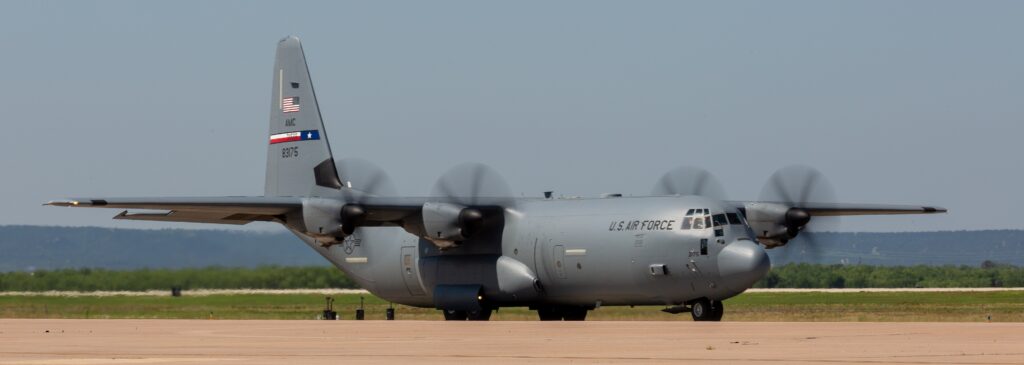
The Lockheed Martin C-130J Super Hercules is the latest version of the C-130 tactical transport. It first flew in 1996 and has been delivered to more than 20 countries, with new engines, six-blade propellers and a two-pilot glass cockpit.
| General Characteristics | |
| Type | Cargo Aircraft, Military Aircraft |
|---|---|
| National Origin | United States |
| Manufacturer | Lockheed Martin |
| Variants | C-130J, C-130J-30, KC-130J, HC-130J, MC-130J, AC-130J, WC-130J, EC-130J, LM-100J |
| Status | In production and in service |
| First Flight | 5 April 1996 |
| Introduction | 1999 with the Royal Air Force |
| Primary Users | United States Air Force, United States Marine Corps, Royal Australian Air Force, Indian Air Force |
| Number Built | More than 500 (500 delivered by March 2022) |
| Developed From | Lockheed C-130 Hercules |
| Capacity & Dimensions | |
| Cockpit Crew | Two pilots and one loadmaster (minimum crew) |
| Typical Seating | 92 passengers or 64 paratroopers (C-130J-30: 128 or 92) |
| Overall Length | 29.79 m (97 ft 9 in) |
| Wing Span | 40.41 m (132 ft 7 in) |
| Wing Area | 162.1 m² (1,745 sq ft) |
| Overall Height | 11.84 m (38 ft 10 in) |
| Weights, Powerplant & Performance | |
| MTOW | 74,389 kg (164,000 lb) |
| OEW | 34,274 kg (75,562 lb) |
| Engines | 4 × Rolls-Royce AE 2100D3 turboprops |
| Max. Thrust | 3,458 kW (4,637 shp) each |
| Typical Cruise Speed | 644 km/h (348 kn) |
| Max. Speed | 670 km/h (362 kn) |
| Range | 3,334 km (1,800 nmi) with 15,422 kg (34,000 lb) payload |
| Takeoff Distance | 945 m (3,100 ft) maximum-effort take-off roll |
| Service Ceiling | 8,534 m (28,000 ft) with 19,051 kg (42,000 lb) payload |
The C-130J Super Hercules is the latest version of the Lockheed C-130 Hercules, the four-engine tactical transport that first flew in 1954 and has been in production longer than any other military aircraft. Built by Lockheed Martin at Marietta, Georgia, the C-130J looks much like earlier Hercules models from the outside, but it has new engines, six-blade composite propellers and a modern two-pilot glass cockpit. It first flew on 5 April 1996, and by March 2022 Lockheed Martin had delivered 500 to 26 operators in 22 countries.
Development
Lockheed began the C-130J as a private venture in the early 1990s, aiming to replace thousands of ageing C-130s around the world. The launch order came from the United Kingdom’s Royal Air Force on 16 December 1994, and the RAF received its first aircraft in 1999 as the Hercules C4 (the long C-130J-30) and Hercules C5 (the standard-length C-130J). Development took longer than planned, partly because of problems with the new software and with ice build-up affecting directional control, but the aircraft went on to become the standard tactical airlifter of many Western air forces.
What Changed From Earlier Hercules Models
- Engines and propellers: four Rolls-Royce AE 2100D3 turboprop engines of 3,458 kW (4,637 shp) each, turning six-blade Dowty R391 composite propellers. They give about 29% more thrust than the engines of the C-130H while burning around 15% less fuel.
- Glass cockpit: two pilots fly the aircraft using multifunction displays and head-up displays. Older Hercules models needed a navigator and a flight engineer as well; the C-130J’s minimum crew is two pilots and a loadmaster.
- Performance: a maximum speed of 670 km/h (362 kn), a cruise speed of 644 km/h (348 kn), and a range of about 3,334 km (1,800 nmi) with a payload of 15.4 tonnes.
C-130J and C-130J-30
The standard C-130J is 29.79 m (97 ft 9 in) long. The C-130J-30 adds 4.57 m (15 ft) of fuselage, which increases capacity from 92 to 128 troops, from 64 to 92 paratroopers, from 72 to 97 stretchers, and from six to eight standard 463L cargo pallets. Most air forces now order the longer version. Both versions can operate from short and unprepared airstrips: the maximum-effort take-off roll is about 945 m (3,100 ft), and the landing roll can be as short as about 500 m (1,630 ft).
Special Versions
The C-130J airframe is the basis for many specialised aircraft, especially in the United States:
- KC-130J: an air-to-air refuelling tanker and transport for the US Marine Corps, also used by Italy, Kuwait and others.
- HC-130J Combat King II: personnel recovery and search and rescue for the US Air Force; the Coast Guard flies a maritime patrol version.
- MC-130J Commando II: special operations transport and tanker.
- AC-130J Ghostrider: a heavily armed gunship for close air support.
- WC-130J: the “Hurricane Hunter”, flown into tropical storms by the US Air Force Reserve to collect weather data.
- LM-100J: a civil freighter version of the C-130J-30.
Operators
The US Air Force, Marine Corps and Coast Guard are the largest users. Other operators include the air forces of Australia, Canada, Denmark, France, Germany, India, Israel, Italy, Kuwait, Norway, Oman, Qatar, Saudi Arabia, South Korea and the United Kingdom, among others. Australia agreed in 2022 to buy 24 more C-130J-30s, and France and Germany operate a joint squadron from Évreux in France. In Europe the C-130J often works alongside the larger Airbus A400M, which carries heavier loads but needs longer runways.
Why It Matters
Few aircraft can do as much as the Hercules: it can carry troops and vehicles into short dirt strips, drop paratroopers and supplies, refuel helicopters and fighters, fight fires and deliver humanitarian aid after disasters. The C-130J keeps that flexibility while cutting crew numbers and fuel burn. For a larger strategic tanker built on an airliner design, see the Boeing KC-135 Stratotanker, and for a modern turboprop airliner with a very different mission, the ATR 72-600.
Frequently Asked Questions
How many troops can a C-130J carry? 92 passengers or 64 paratroopers in the standard version, and 128 or 92 in the stretched C-130J-30.
What engines does the C-130J use? Four Rolls-Royce AE 2100D3 turboprops driving six-blade propellers.
When did the C-130J first fly? On 5 April 1996.
Start the discussion
Commenting on this aircraft: Lockheed Martin C-130J Super Hercules