Boeing 747-8
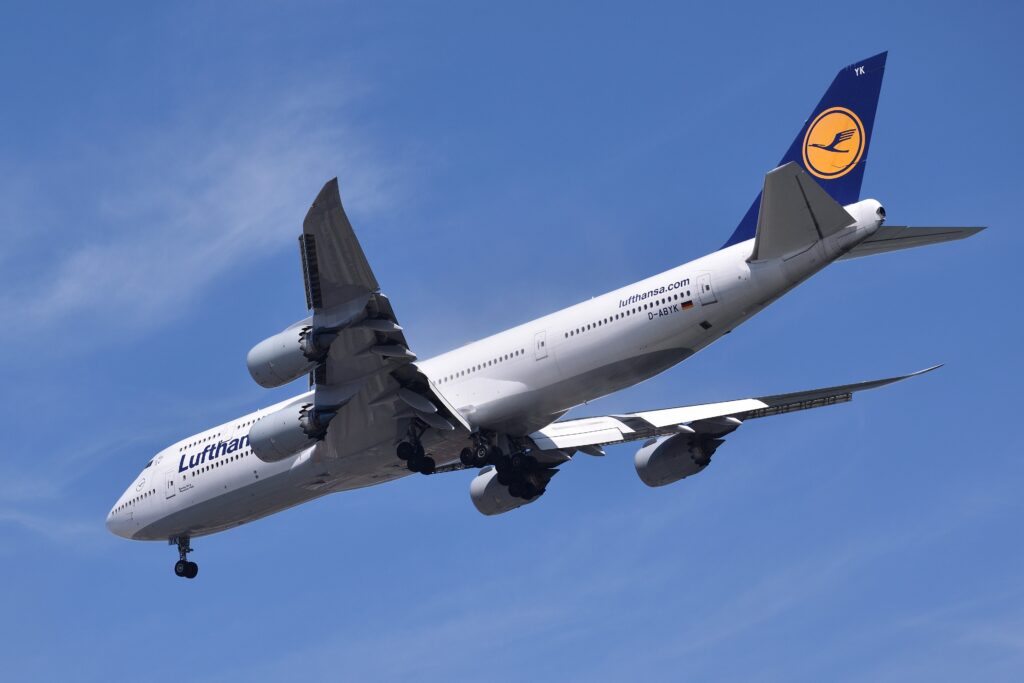
The Boeing 747-8 is the longest and final version of the Queen of the Skies. Built as the 747-8 Intercontinental passenger jet and the 747-8F freighter, it ended 747 production when the last aircraft was delivered in January 2023.
| General Characteristics | |
| Type | Wide-body jet airliner, Civil and Commercial Aircraft |
|---|---|
| National Origin | United States |
| Manufacturer | Boeing |
| Variants | 747-8 Intercontinental (passenger), 747-8F (freighter), BBJ 747-8, VC-25B |
| Status | In service (production ended in 2023) |
| First Flight | 8 February 2010 (747-8F); 20 March 2011 (747-8I) |
| Introduction | 12 October 2011 with Cargolux (747-8F); 1 June 2012 with Lufthansa (747-8I) |
| Primary Users | Lufthansa, Korean Air, Air China (passenger); UPS Airlines, Cargolux, Cathay Cargo, Atlas Air (freighter) |
| Number Built | 155 (107 747-8F and 48 747-8I, including business jets) |
| Developed From | Boeing 747-400 |
| Capacity & Dimensions | |
| Cockpit Crew | Two |
| Typical Seating | 410–467 (three-class) |
| Max Seating | 605 (exit limit) |
| Overall Length | 76.25 m (250 ft 2 in) |
| Wing Span | 68.4 m (224 ft 5 in) |
| Wing Sweep | 37.5° |
| Wing Area | 554 m² (5,960 sq ft) |
| Overall Height | 19.4 m (64 ft 0 in) |
| Weights, Powerplant & Performance | |
| MTOW | 447,700 kg (987,000 lb) |
| OEW | 220,128 kg (485,300 lb) |
| Fuel Capacity | 238,610 L (63,034 US gal) |
| Engines | 4 × General Electric GEnx-2B67 turbofans |
| Max. Thrust | 296 kN (66,500 lbf) each |
| Typical Cruise Speed | Mach 0.855 |
| Max. Speed | Mach 0.90 |
| Range | 14,310 km (7,730 nmi) |
| Service Ceiling | 43,100 ft (13,100 m) |
The Boeing 747-8 is the last and largest member of the 747 family, the airliner that made long-haul flying affordable for millions after 1970. Boeing launched it in 2005 to compete with the Airbus A380, stretching the fuselage, fitting a new wing and borrowing engines and systems from the 787 Dreamliner. It was built in two versions, the 747-8 Intercontinental for passengers and the 747-8F freighter, and when Boeing delivered the final aircraft to Atlas Air on 31 January 2023, more than half a century of 747 production came to an end.
Boeing 747-8 General Characteristics
The freighter came first: the 747-8F flew on 8 February 2010 and entered service with Cargolux in October 2011. The passenger 747-8I followed, first flying on 20 March 2011 and starting service with Lufthansa in June 2012. Airlines bought far more freighters than passenger jets, because four-engine aircraft had become hard to justify on passenger routes once twins such as the 777 and A350 could fly just as far. In all, 155 747-8s were built: 107 freighters and 48 Intercontinentals, several of them as private and government jets. Two specially modified 747-8Is are being converted into the next Air Force One, the VC-25B, a programme that has suffered long delays.
Boeing 747-8 Cabin and Seating
The 747-8I is 5.6 metres longer than the 747-400 and seats about 410 to 467 passengers in three classes. Its upper deck, the 747’s famous hump, is longer than before, and the cabin borrowed the 787’s style of curved ceilings and larger overhead bins. Lufthansa, the largest 747-8I operator, fits first class in the nose of the main deck, a feature unique to the 747.
Boeing 747-8 Dimensions
At 76.25 m (250 ft 2 in), the 747-8 is one of the longest airliners ever built, slightly longer than the Airbus A380. Its new wing spans 68.4 m (224 ft 5 in) and ends in raked wingtips instead of the 747-400’s winglets. The aircraft stands 19.4 m (64 ft) tall.
Boeing 747-8 Wing and Flight Deck
The 747-8 received a new wing, about 4 m wider than the 747-400’s and able to hold more fuel. Raked wingtips replaced the winglets, and fly-by-wire spoilers and outboard ailerons saved weight and reduced drag. The flight deck stayed close to the 747-400’s, and the two types share a common type rating, so pilots can move between them after a short differences course. For cargo airlines, the longer fuselage gave the 747-8F about 16 per cent more cargo volume than the 747-400F, with room for four more pallets on the main deck and three more below.
Boeing 747-8 Engines and Performance
Four General Electric GEnx-2B67 engines, a version of the 787’s GEnx, each deliver about 296 kN (66,500 lbf) of thrust. Together with the new wing, Boeing said they made the 747-8I more efficient and quieter than the 747-400. The aircraft cruises at about Mach 0.855 and can fly about 14,310 km (7,730 nmi). The maximum take-off weight is 447.7 tonnes (987,000 lb), and the freighter can carry about 134 tonnes of cargo through its swing-up nose door.
Operational Role
The 747-8F is the backbone of many cargo fleets, including UPS, Cargolux, Cathay Cargo and Atlas Air, because its nose door lets it carry outsize loads that no twin-engine freighter can. The passenger version flies with Lufthansa, Korean Air and Air China, and as VIP and government transport.
Frequently Asked Questions
Is the Boeing 747-8 still in production? No. The last 747, a 747-8F for Atlas Air, was delivered in January 2023.
Which is bigger, the 747-8 or the A380? The 747-8 is slightly longer, but the double-deck A380 is much heavier and carries more passengers.
How many 747-8s were built? 155, including 107 freighters.
Boeing 747-8 Summary
The 747-8 brought the Queen of the Skies into the 21st century and closed her story. Compare it with its rival the Airbus A380 and with the twin that replaced many 747s, the Boeing 777-300ER, and read about the delays to the new Air Force One.
Sources
- Boeing, 747-8 airport compatibility and product data
- Boeing press release on the final 747 delivery to Atlas Air, 31 January 2023
Start the discussion
Commenting on this aircraft: Boeing 747-8