Airbus A340-300
The Airbus A340-300 was the first member of Airbus's four-engine long-haul family. It first flew on 25 October 1991, entered service with Lufthansa and Air France in March 1993, and with 218 delivered it was the best-selling A340.
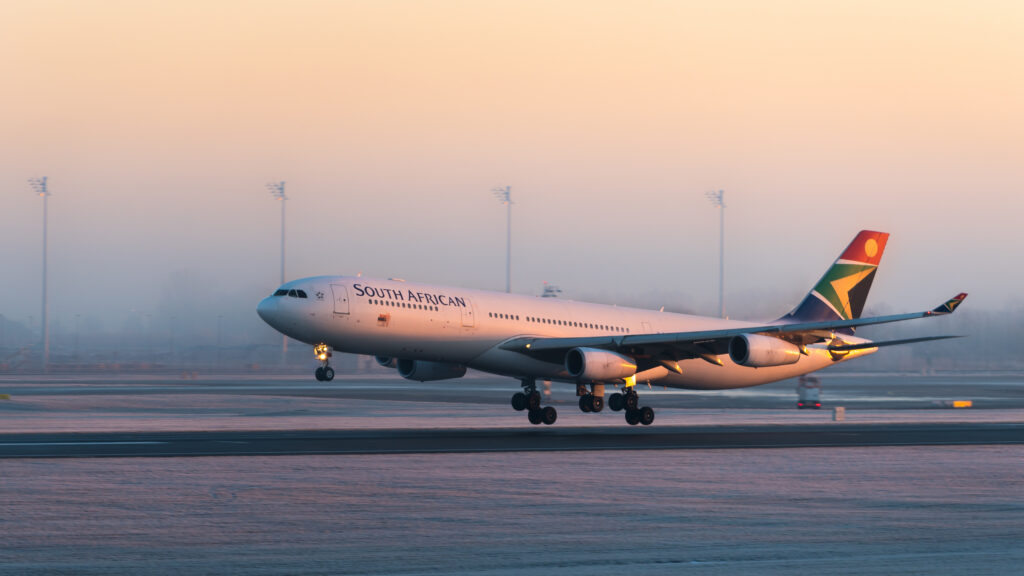
| General Characteristics | |
| Type | Wide-body jet airliner, Civil and Commercial Aircraft |
|---|---|
| National Origin | Multi-national |
| Manufacturer | Airbus |
| Variants | A340-300, A340-300E (Enhanced), ACJ340 VIP conversions |
| Status | Out of production (1991–2011); in limited airline and government service |
| First Flight | 25 October 1991 |
| Introduction | March 1993 with Lufthansa and Air France |
| Primary Users | Lufthansa, Swiss International Air Lines, Edelweiss Air, Mahan Air |
| Number Built | 218 delivered |
| Capacity & Dimensions | |
| Cockpit Crew | Two |
| Typical Seating | 250–290 (three classes) |
| Max Seating | 440 (exit limit) |
| Overall Length | 63.69 m (208 ft 11 in) |
| Wing Span | 60.3 m (197 ft 10 in) |
| Wing Sweep | 29.7° |
| Wing Area | 363.1 m² (3,908 sq ft) |
| Overall Height | 16.99 m (55 ft 9 in) |
| Weights, Powerplant & Performance | |
| MTOW | 276,500 kg (609,600 lb) |
| OEW | 131,000 kg (288,800 lb) |
| Fuel Capacity | 110,400 kg (243,400 lb) |
| Engines | 4 × CFM International CFM56-5C turbofans |
| Max. Thrust | 138.8–151.2 kN (31,200–34,000 lbf) each |
| Typical Cruise Speed | Mach 0.82 at 11,900 m (39,000 ft) |
| Max. Speed | Mach 0.86 |
| Range | 12,408 km (6,700 nmi) with three-class seating |
| Takeoff Distance | 3,050 m (10,000 ft) at MTOW, sea level, ISA |
| Service Ceiling | 12,634 m (41,450 ft) |
The Airbus A340-300 was the first aircraft of Airbus’s four-engine long-haul family and by far its most successful model. It first flew from Toulouse on 25 October 1991, was certified together with the shorter A340-200 on 22 December 1992, and entered service in March 1993 with its launch customers Lufthansa and Air France. Airbus delivered 218 of them before A340 production ended in 2011, more than half of all A340s ever built.
Why Four Engines?
Airbus developed the A340 alongside the twin-engine A330, and the two programmes were launched together on 5 June 1987. They share the same fuselage cross-section, a very similar wing, the same fly-by-wire controls and almost the same glass cockpit, so pilots can fly both types with a common type rating.
The difference was the number of engines. At the end of the 1980s, twin-engine airliners were still limited by the rules for flying long distances from the nearest diversion airport, which kept them off many ocean and polar routes. Four engines freed the A340 from those limits, which made it attractive to airlines flying long, thin routes across the Pacific, to Africa and to South America. Four smaller engines also allowed Airbus to use the CFM56, a proven engine already flying on the A320 and Boeing 737, rather than waiting for a new high-thrust engine.
Design
The A340-300 has the A330’s wide-body fuselage, with a cabin 5.28 m (17 ft 4 in) wide, usually laid out eight-abreast in economy. It is 63.69 m (208 ft 11 in) long, the same length as the A330-300. To carry the extra weight of fuel for longer flights, the A340 has a third main landing gear leg on the fuselage centreline, between the two wing gears.
The wing, swept back at 29.7 degrees, carries four CFM International CFM56-5C turbofans of between 138.8 and 151.2 kN (31,200 and 34,000 lbf) of thrust each. In service, the A340-300 typically carried around 295 passengers in three classes on routes of up to about 12,400 km (6,700 nmi).
Improved Versions
Airbus raised the A340-300’s weights several times. The A340-300E (often called the -300X) has a maximum take-off weight of up to 275 tonnes and the more powerful CFM56-5C4 engines, stretching the typical range to about 13,300–13,700 km (7,200–7,400 nmi). The final A340-300 Enhanced, first delivered to South African Airways in 2003, added updated engines, avionics and flight-control software developed for the larger A340-500 and A340-600.
In Service
The A340-300 competed with the McDonnell Douglas MD-11 and later the Boeing 777-200ER. Its biggest operator was Lufthansa, with 30 aircraft; Swiss, Iberia, Air France, Cathay Pacific, Singapore Airlines and many others also flew it. The type built a reputation for reliability and comfort, but four engines burn more fuel than two. Once twin-engine aircraft were allowed to fly almost any long-haul route, the A340-300 became expensive to operate, especially when fuel prices rose in the late 2000s.
Airbus announced the end of A340 production on 10 November 2011, with 377 aircraft delivered across the family. Its successor is the A350-900. Many A340-300s have since been retired or converted to VIP and government transports, but some still fly with airlines such as Lufthansa, which has said it plans to keep the type until about 2028, and Swiss, as well as with charter operators.
The A340 Family
| Model | Length | Span | Typical seats (3-class) | Range | Built |
|---|---|---|---|---|---|
| A340-200 | 59.4 m (194 ft 11 in) | 60.3 m (197 ft 10 in) | 210–250 | 13,500 km (7,300 nmi) | 28 |
| A340-300 | 63.69 m (208 ft 11 in) | 60.3 m (197 ft 10 in) | 250–290 | 12,408 km (6,700 nmi) | 218 |
| A340-500 | 67.93 m (222 ft 10 in) | 63.45 m (208 ft 2 in) | 270–310 | 16,670 km (9,000 nmi) | 34 |
| A340-600 | 75.36 m (247 ft 3 in) | 63.45 m (208 ft 2 in) | 320–370 | 14,450 km (7,800 nmi) | 97 |
Sources
- Airbus: A340 aircraft characteristics for airport planning
- Wikipedia: Airbus A340 (used to check dates, delivery totals and the specification table)
Start the discussion
Commenting on this aircraft: Airbus A340-300