Boeing 777-300ER
The Boeing 777-300ER is the extended-range version of the stretched 777-300. Powered by the GE90-115B, the most powerful jet engine of its time, it became the best-selling 777 and the backbone of many long-haul fleets.
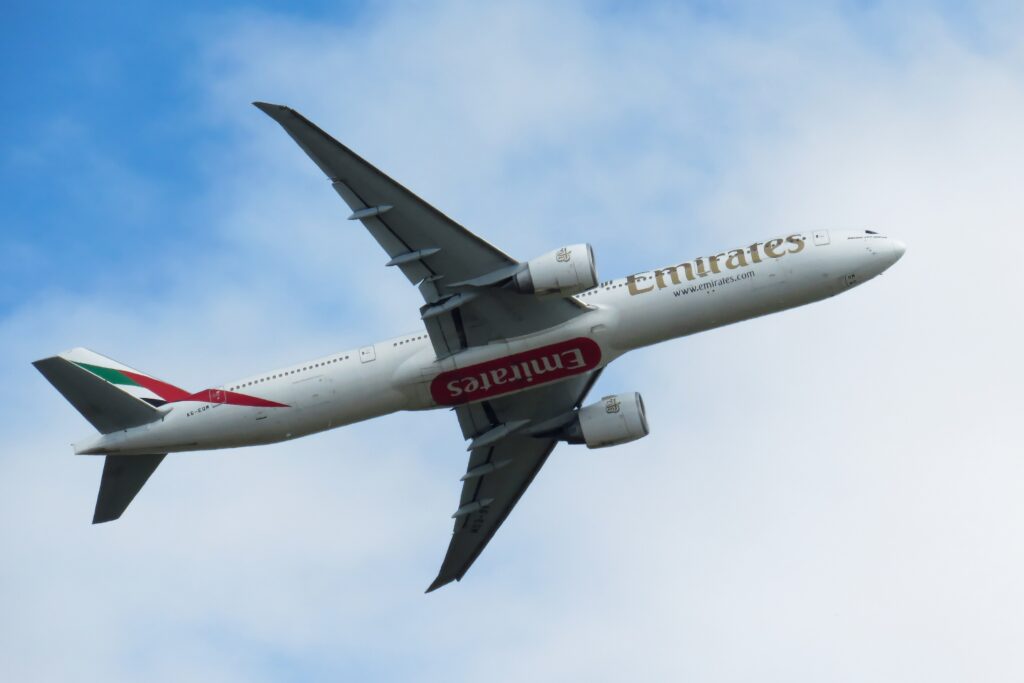
| General Characteristics | |
| Type | Wide-body jet airliner, Civil and Commercial Aircraft |
|---|---|
| National Origin | United States |
| Manufacturer | Boeing |
| Variants | 777-200, 777-200ER, 777-200LR, 777-300, 777-300ER, 777F, 777X |
| Status | In service |
| First Flight | 24 February 2003 |
| Introduction | 2004, with Air France |
| Primary Users | Emirates, Cathay Pacific, Air France, United Airlines |
| Number Built | 833 777-300ERs delivered; 1,781 777s of all versions (February 2026) |
| Developed From | Boeing 777-300 |
| Capacity & Dimensions | |
| Cockpit Crew | Two |
| Typical Seating | 365 (three-class) or 396 (two-class) |
| Max Seating | 550 (exit limit) |
| Overall Length | 73.86 m (242 ft 4 in) |
| Wing Span | 64.80 m (212 ft 7 in) |
| Wing Sweep | 31.6° |
| Wing Area | 436.8 m² (4,702 sq ft) |
| Overall Height | 18.85 m (61 ft 10 in) |
| Weights, Powerplant & Performance | |
| MTOW | 351,535 kg (775,000 lb) |
| OEW | 167,829 kg (370,000 lb) |
| Fuel Capacity | 181,283 L (47,890 US gal) |
| Engines | 2 × General Electric GE90-115B turbofans |
| Max. Thrust | 513 kN (115,300 lbf) each |
| Typical Cruise Speed | Mach 0.84 (892 km/h, 482 kn) |
| Max. Speed | Mach 0.89 |
| Range | 13,650 km (7,370 nmi) |
| Takeoff Distance | 3,050 m (10,000 ft) |
| Service Ceiling | 43,100 ft (13,100 m) |
The Boeing 777-300ER is the extended-range version of the stretched 777-300 and the most successful member of the 777 family, with 833 delivered. Powered by two General Electric GE90-115B engines, for years the most powerful jet engines in airline service, it can carry more than 350 passengers on flights of over 13,000 km. For two decades it has been the backbone of long-haul fleets from Dubai to Hong Kong.
Boeing 777-300ER General Characteristics
The 777 entered service in 1995 with United Airlines, and the longer 777-300 followed in 1998. Airlines wanted that capacity with more range, and Boeing launched the 777-300ER in 2000 with an order from Air France. The first aircraft flew on 24 February 2003, was certified by the FAA and EASA in March 2004, and entered service with Air France later that year. Compared with the 777-300, it has a stronger structure, a longer, raked wingtip, new landing gear and much more powerful engines.
Boeing 777-300ER Cabin and Seating
A typical layout seats 365 passengers in three classes or 396 in two; the exit limit is 550. Economy is usually ten abreast. The large cabin has allowed airlines to install premium products such as private first-class suites, and the lower deck can carry 44 LD3 cargo containers.
Boeing 777-300ER Dimensions
At 73.86 m (242 ft 4 in), the 777-300ER is one of the longest airliners ever built. It is 18.85 m (61 ft 10 in) high and spans 64.80 m (212 ft 7 in), with a wing area of 436.8 m².
Boeing 777-300ER Engines and Performance
The GE90-115B produces 513 kN (115,300 lbf) of thrust; its fan measures 3.25 m (128 in) across. The aircraft cruises at about Mach 0.84 and has a range of about 13,650 km (7,370 nmi). The maximum take-off weight is 351,535 kg (775,000 lb), and take-off at that weight needs about 3,050 m of runway at sea level.
The Boeing 777 Family
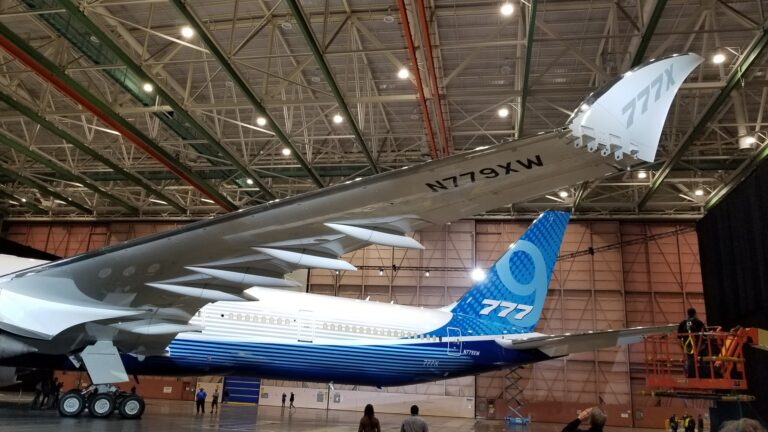
The 777 was Boeing’s first fly-by-wire airliner and was designed with airline input from the start. The original 777-200 entered service in 1995, followed by the longer-range 777-200ER and the stretched 777-300 in 1998. The 777-300ER arrived in 2004, the ultra-long-range 777-200LR in 2006 and the 777F freighter in 2009. Boeing’s next generation, the 777X, adds new GE9X engines and a larger composite wing with folding tips; its certification has been delayed several times. Meanwhile, conversion companies have begun turning retired 777-300ERs into large freighters, giving the type a long second career.
Operational Role
The 777-300ER made twin-engine long-haul flying on high-capacity routes the norm, replacing many Boeing 747s. Its range allows non-stop flights of up to about 16 hours. Emirates is the largest operator, alongside Cathay Pacific, Air France, United Airlines and many others. Its size makes it valuable on busy trunk routes between major hubs, where airport slots are limited and each departure has to carry as many passengers as possible. Many airlines have refitted their 777-300ERs with new business-class seats to keep them competitive alongside newer aircraft. Older aircraft are now being converted into freighters, while Boeing’s next-generation 777X is being developed to replace it.
Frequently Asked Questions
How many passengers does a 777-300ER carry? Usually 365 in three classes or 396 in two, up to 550 at the exit limit.
What is the range of the 777-300ER? About 7,370 nautical miles (13,650 km).
What engine powers the 777-300ER? Only the General Electric GE90-115B, rated at 115,300 lbf.
Boeing 777-300ER Summary
The 777-300ER combined capacity, range and twin-engine economics better than any aircraft of its time. Compare it with the Airbus A350-900 and the four-engine Airbus A380.
Sources
- Boeing, 777 airport compatibility documents and product data
- FAA and EASA certification of the 777-300ER, 16 March 2004
Start the discussion
Commenting on this aircraft: Boeing 777-300ER