Bombardier CRJ900 Regional Jet
The Bombardier CRJ900 is a stretched CRJ700 regional jet with up to 90 seats. It first flew in 2001, entered service with Mesa in 2003, and a CRJ900 delivered to SkyWest in February 2021 was the last CRJ ever built.
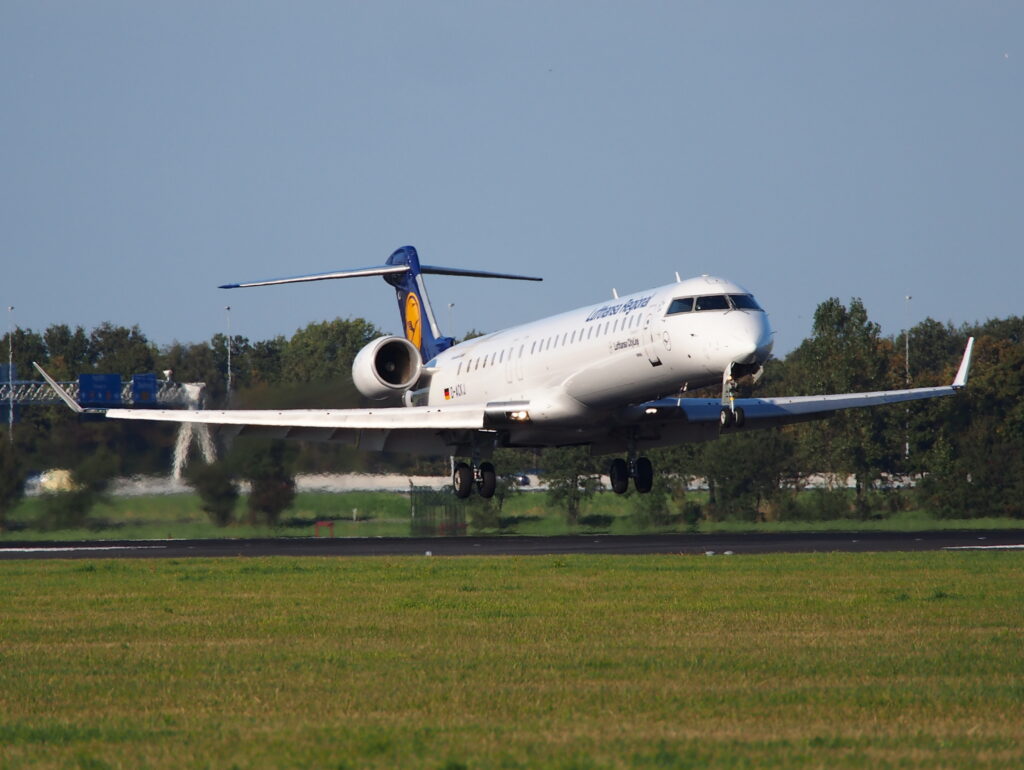
| General Characteristics | |
| Type | Regional aircraft, Civil and Commercial Aircraft |
|---|---|
| National Origin | Canada |
| Manufacturer | Bombardier |
| Variants | CRJ900, CRJ900ER, CRJ900LR, CRJ900 NextGen |
| Status | In service (production ended 2020) |
| First Flight | 21 February 2001 |
| Introduction | 2003 with Mesa Airlines |
| Primary Users | Endeavor Air, SkyWest Airlines, PSA Airlines, GoJet Airlines |
| Number Built | 487 (as of January 2021) |
| Developed From | Bombardier CRJ700 |
| Capacity & Dimensions | |
| Cockpit Crew | Two |
| Typical Seating | 76–90 |
| Max Seating | 90 |
| Overall Length | 36.2 m (118 ft 11 in) |
| Wing Span | 24.9 m (81 ft 7 in) |
| Wing Area | 71.1 m² (765 sq ft) |
| Overall Height | 7.5 m (24 ft 7 in) |
| Weights, Powerplant & Performance | |
| MTOW | 36,514 kg (80,500 lb); LR 38,330 kg (84,500 lb) |
| OEW | 21,845 kg (48,160 lb) |
| Fuel Capacity | 8,888 kg (19,595 lb) |
| Engines | 2 × General Electric CF34-8C5 |
| Max. Thrust | 64.5 kN (14,510 lbf) each |
| Typical Cruise Speed | 829 km/h (447 kn) |
| Max. Speed | 871 km/h (470 kn), Mach 0.82 |
| Range | 2,500 km (1,350 nmi); LR 3,385 km (1,828 nmi) |
| Service Ceiling | 12,497 m (41,000 ft) |
The Bombardier CRJ900 is a 76- to 90-seat regional jet and the most successful stretch of the Canadair Regional Jet family. It first flew on 21 February 2001, and the launch customer, Mesa Air Group, received the first aircraft in April 2003, painted for America West. Bombardier built 487 CRJ900s, and a CRJ900 delivered to SkyWest Airlines on 28 February 2021 was the very last CRJ of any type to leave the factory.
From Business Jet to Regional Airliner
The CRJ family began with the Canadair Challenger business jet. Canadair stretched it into the 50-seat CRJ100 and CRJ200, which entered service in 1992 and created the market for small regional jets. Bombardier, which had bought Canadair in 1986, then developed the larger CRJ700 with a new wing, a longer fuselage and more powerful engines. The CRJ900 is a further stretch of the CRJ700, about 3.9 m longer, with stronger landing gear and uprated engines.
Design
The CRJ900 is 36.2 m (118 ft 11 in) long but only 24.9 m (81 ft 7 in) across the wing, which gives it a long, narrow look. It has a T-tail, two rear-mounted engines and a four-abreast cabin in a 2-2 layout. In the US, most aircraft are flown with 76 seats because of airline scope clauses, the union agreements that limit the size of jets regional partners may fly. Elsewhere airlines fit up to 90 seats. The CRJ900 NextGen, introduced in 2007, brought a new cabin with larger windows and bins, and lower fuel burn. Bombardier later added the Atmosphère cabin, with bins large enough for full-size carry-on bags.
Engines and Performance
Two General Electric CF34-8C5 turbofans each produce 64.5 kN (14,510 lbf) of thrust. The CRJ900 cruises at about 829 km/h (447 knots) and its maximum speed is Mach 0.82. The standard version has a range of about 2,500 km (1,350 nmi), while the long-range CRJ900LR, with a maximum take-off weight of 38,330 kg (84,500 lb), flies about 3,385 km (1,828 nmi). Its service ceiling is 41,000 ft, higher than most regional aircraft, which helps it climb above weather.
In Service
The CRJ900 is used mostly as a feeder for large airlines. Endeavor Air (Delta Connection), SkyWest, PSA Airlines (American Eagle) and GoJet have flown large fleets, and in Europe Lufthansa CityLine and SAS both operated the type. It competed directly with the Embraer E175, which has a wider cabin and has outsold it in recent years.
End of the CRJ Programme
In June 2019 Bombardier agreed to sell the CRJ programme to Mitsubishi Heavy Industries, and the deal closed on 1 June 2020. Bombardier finished the remaining orders at its Mirabel plant near Montreal, and the last aircraft was delivered in February 2021. Mitsubishi now provides support and spare parts for the fleet. Some airlines are retiring older CRJs, but the CRJ900 is expected to fly with US regional carriers for years to come. Its larger cousin in the turboprop world is the Dash 8-400, also built in Canada.
Flight Deck and Systems
The CRJ900 flight deck uses Rockwell Collins Pro Line 4 avionics with six large displays. Pilots qualified on the CRJ700 and CRJ900 share a common type rating, and the step from the smaller CRJ200 is a short differences course. For airlines this means the same crews and much of the same maintenance training cover the whole fleet, which is one reason US regional carriers kept the type for so long.
Frequently Asked Questions
How many seats does a CRJ900 have? Between 76 and 90, depending on the airline.
Is the CRJ900 still in production? No. The last CRJ was delivered in February 2021.
Who owns the CRJ programme now? Mitsubishi Heavy Industries, since June 2020.
Start the discussion
Commenting on this aircraft: Bombardier CRJ900 Regional Jet