Airbus A330-300
The Airbus A330-300 is the original and longest version of the A330. Since Air Inter introduced it in 1994, it has flown with more than a hundred airlines on medium and long-haul routes.
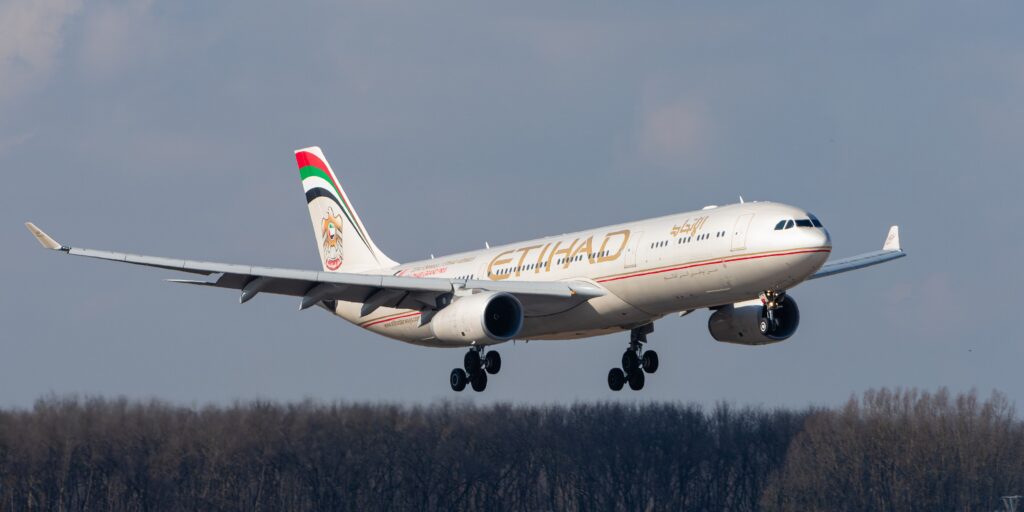
| General Characteristics | |
| Type | Wide-body jet airliner, Civil and Commercial Aircraft |
|---|---|
| National Origin | Multi-national |
| Manufacturer | Airbus |
| Variants | A330-200, A330-200F, A330-300, A330 MRTT, A330neo (-800, -900) |
| Status | In service |
| First Flight | 2 November 1992 |
| Introduction | 17 January 1994 with Air Inter |
| Primary Users | Turkish Airlines, Cathay Pacific, Delta Air Lines, China Eastern Airlines, Lufthansa |
| Capacity & Dimensions | |
| Cockpit Crew | Two |
| Typical Seating | 250–300 (two-class) |
| Max Seating | 440 (exit limit) |
| Overall Length | 63.66 m (208 ft 10 in) |
| Wing Span | 60.30 m (197 ft 10 in) |
| Wing Sweep | 30° |
| Wing Area | 361.6 m² (3,892 sq ft) |
| Overall Height | 16.79 m (55 ft 1 in) |
| Weights, Powerplant & Performance | |
| MTOW | 242,000 kg (533,500 lb) |
| OEW | 129,400 kg (285,300 lb) |
| Fuel Capacity | 139,090 L (36,744 US gal) |
| Engines | 2 × General Electric CF6-80E1, Pratt & Whitney PW4000 or Rolls-Royce Trent 700 |
| Max. Thrust | 287–316 kN (64,500–71,100 lbf) each |
| Typical Cruise Speed | Mach 0.82 |
| Max. Speed | Mach 0.86 (MMO) |
| Range | 11,750 km (6,340 nmi) |
| Takeoff Distance | 2,770 m (9,090 ft) |
| Service Ceiling | 12,527 m (41,100 ft) |
The Airbus A330-300 is the first and longest version of the A330, a twin-engine wide-body that Airbus developed alongside the four-engine A340. Sharing a wing, cockpit and fuselage with its four-engine sister kept development costs low, and the A330 went on to outsell the A340 many times over. More than three decades after its first flight, the A330-300 is still flying with major airlines around the world.
Airbus A330-300 General Characteristics
Airbus launched the A330 and A340 together in June 1987. The A330 was designed for medium and long routes where two engines were enough, while the A340 covered the longest routes. The first A330-300 was rolled out on 14 October 1992 and made its first flight on 2 November 1992. The French domestic airline Air Inter put it into service on 17 January 1994.
The A330 has the same fly-by-wire controls and side-stick cockpit as the A320 and A340, so pilots can move between these types with short “cross-crew qualification” courses instead of a full new type rating. Its large wing, with a sweep of 30 degrees and an area of 361.6 m², gives good field performance and efficient cruise. Read how the side-stick system works in our article on fly-by-wire and fly-by-light.
Airbus A330-300 Cabin and Seating
The fuselage has a diameter of 5.64 m and a cabin width of 5.26 m, the same as the A300 and A310. Most airlines fit eight seats across in economy in a 2-4-2 layout, which many passengers like because few seats are far from an aisle or window. A typical two-class cabin seats between about 250 and 300 passengers, and the exit limit is 440. The lower deck takes LD3 containers and pallets side by side, which makes the A330 a valuable cargo carrier for passenger airlines.
Airbus A330-300 Dimensions
The A330-300 is 63.66 m (208 ft 10 in) long, 4.84 m longer than the A330-200. Its wingspan is 60.30 m (197 ft 10 in) and its height 16.79 m (55 ft 1 in). The wing ends in large winglets. Like other wide-bodies of this size, it needs ICAO Code E gates.
Airbus A330-300 Engines and Performance
Airlines can choose between three engines: the General Electric CF6-80E1, the Pratt & Whitney PW4000 and the Rolls-Royce Trent 700, giving between 287 and 316 kN (64,500 to 71,100 lbf) of thrust each. Maximum take-off weight has risen over the years to 242 tonnes (533,500 lb), which gives the A330-300 a range of about 11,750 km (6,340 nmi) with 277 passengers. It cruises at about Mach 0.82 and can climb to 41,100 ft.
Operational Role
The A330-300 is used on routes from busy regional trunk lines in Asia to transatlantic flights. Its twin-engine economics made it a natural replacement for older three- and four-engine wide-bodies. Since 2018, Airbus has delivered the re-engined A330-900, part of the A330neo family, as the successor.
Cargo is an important part of the A330-300 story. Its large lower deck lets airlines carry several tonnes of freight on passenger flights, and many retired A330-300s are now being converted into dedicated freighters.
Frequently Asked Questions
How many passengers does the A330-300 carry? Typically between 250 and 300 in two classes, with an exit limit of 440.
What is the range of the A330-300? About 11,750 km (6,340 nmi).
What is the difference between the A330-200 and the A330-300? The -300 is 4.84 m longer and carries more passengers, while the shorter -200 flies farther.
Airbus A330-300 Summary
The A330-300 gave airlines a wide-body with twin-engine economics and Airbus’s common cockpit, and it remains a workhorse of medium and long-haul fleets. Compare it with the newer Airbus A350-900, Boeing’s 787-9 and the larger Boeing 777-300ER.
Start the discussion
Commenting on this aircraft: Airbus A330-300