






Last Updated: 4 days ago
← Back to Aircraft Database| General Characteristics | |
| Type | Military Aircraft, Multirole fighter |
|---|---|
| National Origin | United States |
| Manufacturer | McDonnell Douglas Aircraft Company |
| Variants | McDonnell Douglas Phantom FG.1 |
| Status | In limited service |
| First Flight | May 27, 1958 |
| Introduction | December 30, 1960 |
| Primary Users | United States Air Force, United States Navy, United States Marine Corps, Hellenic Air Force |
| Number Built | 5,195 |
| Capacity & Dimensions | |
| Cockpit Crew | Two (Pilot and Radar Intercept Officer/Weapon Systems Officer) |
| Overall Length | 63 ft 0 in (19.2 m) |
| Wing Span | 38 ft 5 in (11.7 m) |
| Wing Area | 530 sq ft. |
| Overall Height | 16 ft 6 in (5.0 m) |
| Weights, Powerplant & Performance | |
| MTOW | 61,795 lbs. |
| Fuel Capacity | 1,994 U.S. gallons internally, up to 3,335 U.S. gallons with external tanks. |
| Engines | Two General Electric J79-GE-17A turbojets |
| Max. Speed | Mach 2.23 (~1,472 mph) at 40,000 ft. |
| Range | 1,750 to 2,300 miles (approx. 2,800–3,700 km) |
The F-4 Phantom II is one of the most famous supersonic military aircraft of the Cold War era. McDonnell originally developed the aircraft for the United States Navy, but the design quickly proved useful far beyond carrier operations. As a result, the U.S. Marine Corps and the U.S. Air Force also adopted the type.
The aircraft combined two powerful General Electric J79 turbojet engines, a two-seat tandem cockpit and a large weapons load. Therefore, it could perform several demanding missions, including fleet defense, interception, fighter-bomber operations, reconnaissance and air defense suppression.
Although later fighters offered more modern avionics and better maneuverability, the Phantom II built its reputation on speed, power and adaptability. It could fly at more than twice the speed of sound, carry a heavy external weapons load and operate in both air-to-air and air-to-ground roles. Consequently, it became one of the most important Western combat aircraft of the twentieth century.
F-4 Phantom II General Characteristics
| Feature | Specification |
|---|---|
| Aircraft Type | Supersonic twin-engine military fighter-bomber |
| Main Category | Military Aircraft |
| Additional Category | Multirole fighter |
| Manufacturer | McDonnell Douglas Aircraft Company |
| Original Designer | McDonnell Aircraft |
| National Origin | United States |
| First Flight | May 27, 1958 |
| Introduction | 1960 with the U.S. Navy |
| Crew | Two, pilot and radar intercept officer / weapon systems officer |
| Primary Role | Fighter-bomber and interceptor |
| Number Built | 5,195 aircraft, including Japanese license-built aircraft |
| Status | Mostly retired, with limited remaining operation in some countries and heritage use |
McDonnell designed the Phantom II during a period when military planners expected missiles and radar-guided interception to dominate air combat. However, real combat experience later showed that close-range engagements still mattered. Because of that lesson, later versions such as the F-4E added an internal M61 Vulcan cannon.
Phantom II Design and Mission Role
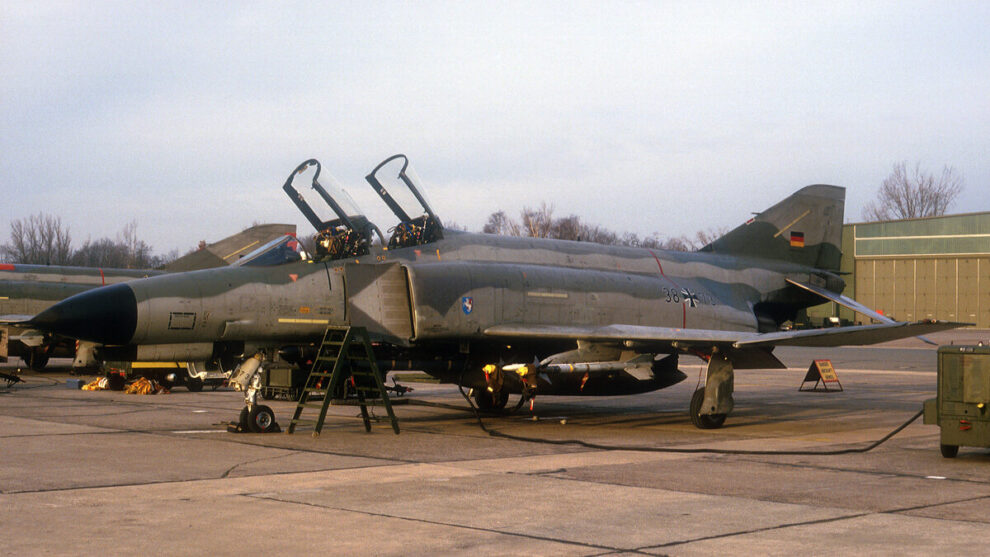
The aircraft has a distinctive layout. Its large side intakes feed the two J79 engines, while the swept wings and angled tail surfaces give the jet its aggressive profile. In addition, the tandem cockpit allows the front-seat pilot to fly the aircraft while the rear-seat crew member manages radar, navigation and weapons systems.
The F-4 Phantom II started as a fleet defense fighter, yet it soon became a true multirole aircraft. The Navy used it for carrier-based fighter operations. Meanwhile, the Air Force used its own versions for air superiority, strike missions and tactical reconnaissance. The Marine Corps also operated the aircraft in fighter and attack roles.
This flexibility helped the Phantom II serve with many countries. Operators used it in air defense, ground attack, reconnaissance and training roles. Therefore, the aircraft became more than a single-mission fighter; it became a powerful combat platform that could adapt to changing operational needs.
F-4 Phantom II Dimensions
| Feature | Specification |
|---|---|
| Length | 63 ft 0 in / 19.2 m |
| Wingspan | 38 ft 5 in / 11.7 m |
| Height | About 16 ft 6 in / 5.0 m |
| Wing Type | Swept low wing |
| Landing Gear | Tricycle landing gear |
| Cockpit Layout | Tandem two-seat cockpit |
The aircraft looks large for a fighter. However, that size helped it carry powerful engines, radar equipment, fuel and weapons. Its strong structure also allowed carrier-capable versions to handle demanding naval operations, including catapult launches and arrested landings.
F-4 Phantom II Engines and Performance
| Feature | Specification |
|---|---|
| Engines | 2 × General Electric J79 turbojets |
| Example Engine Variant | J79-GE-17 on the F-4E |
| Thrust | About 17,900 lbf per engine with afterburner |
| Maximum Takeoff Weight | About 61,795 lb / 28,030 kg |
| Maximum Speed | Over Mach 2 |
| Cruise Speed | About 504 knots in representative cruise profile |
| Range | About 1,401 nautical miles in ferry mission profile |
| Service Ceiling | About 58,750 ft |
| External Stores | Up to about 16,000 lb of ordnance, depending on variant and mission |
The Phantom II earned much of its reputation from its raw performance. Its two J79 engines gave it strong acceleration and high speed. Moreover, the aircraft could carry missiles, bombs, rockets, external fuel tanks and specialized mission equipment.
Early versions relied heavily on missiles. However, combat experience in Vietnam showed that gun capability still had value in close combat. Therefore, the F-4E added an internal 20 mm M61A1 Vulcan cannon, which made that version especially recognizable.
Weapons and Combat Capability
The aircraft could carry a wide range of weapons. Depending on the version and mission, it used AIM-7 Sparrow radar-guided missiles, AIM-9 Sidewinder heat-seeking missiles, bombs, rockets and later precision-guided weapons. In addition, reconnaissance versions carried camera equipment instead of a standard fighter weapons fit.
This weapons flexibility helped the F-4 Phantom II serve in several combat environments. It could intercept enemy aircraft, attack ground targets and support tactical reconnaissance missions. Meanwhile, specialized versions such as the F-4G Wild Weasel focused on suppressing enemy air defenses.
Although the aircraft had impressive speed and payload, it also had limitations. It was large, heavy and not as agile as some smaller fighters. Nevertheless, crews learned to use its strengths: speed, climb, radar capability, missile load and teamwork between the two cockpit positions.
Variants and Development
The Phantom II family included many important variants. The F-4B served the U.S. Navy and Marine Corps. The F-4C gave the U.S. Air Force its first major version. The F-4D improved Air Force capability, while the F-4E added the internal cannon and became one of the most widely used versions.
The Navy later operated variants such as the F-4J and F-4S. Meanwhile, reconnaissance versions such as the RF-4C and RF-4E carried cameras for tactical reconnaissance missions. In addition, the F-4G Wild Weasel became a specialized aircraft for attacking enemy radar and surface-to-air missile systems.
Because of these variants, exact specifications can change from one model to another. Therefore, the technical figures in this article should be understood as representative data, especially close to the F-4E family.
Operational Legacy
The F-4 Phantom II became a major combat aircraft during the Vietnam War and remained important for decades afterward. It served with the U.S. Navy, U.S. Marine Corps, U.S. Air Force and many international operators. In addition, it became one of the few aircraft associated with both the U.S. Navy Blue Angels and the U.S. Air Force Thunderbirds.
The aircraft also influenced later fighter design. Its multirole use, powerful radar, two-seat crew concept and heavy weapons load shaped how air forces thought about tactical aviation. Although newer aircraft eventually replaced it in U.S. frontline service, the Phantom II continued to fly in reserve, training, reconnaissance and target-drone roles for many years.
Today, the aircraft remains a legend among aviation enthusiasts. Its smoky engines, large fuselage, sharp nose and aggressive stance make it instantly recognizable. More importantly, its long service history shows how a strong design can adapt across different missions, operators and eras.
Frequently Asked Questions
Is the F-4 Phantom II a fighter or bomber?
It is both. The aircraft served as a fighter, interceptor and fighter-bomber, depending on the variant and mission.
How many crew members does it have?
The aircraft has two crew members in tandem seats. The front-seat pilot flies the jet, while the rear-seat crew member manages radar, navigation and weapons systems.
What engines does the Phantom II use?
Most versions use two General Electric J79 turbojet engines. The F-4E, for example, uses J79-GE-17 engines.
How fast is the F-4 Phantom II?
The aircraft can fly at more than Mach 2, depending on variant, configuration and flight conditions.
Why is the F-4E version important?
The F-4E added an internal 20 mm M61A1 Vulcan cannon. This change reflected combat lessons from Vietnam and made the E model one of the most recognized Phantom variants.
F-4 Phantom II Summary
The F-4 Phantom II is a twin-engine, two-seat, supersonic multirole fighter with a powerful place in aviation history. It combined speed, heavy weapons capacity, radar capability and mission flexibility in one large combat aircraft. Although newer fighters eventually replaced it, the Phantom II remains one of the most iconic military aircraft ever built.
Did you knowAviationStream.com has a YouTube channel? Check out TheAeroGraphyOfficial and subscribe to watch fun, highly engaging aviation Shorts!