Learjet: The Jet That Made Private Jets Famous
From a Swiss fighter design to the last Learjet 75 in 2022: the history of Learjet and how Bill Lear's jet made the private jet a household idea.
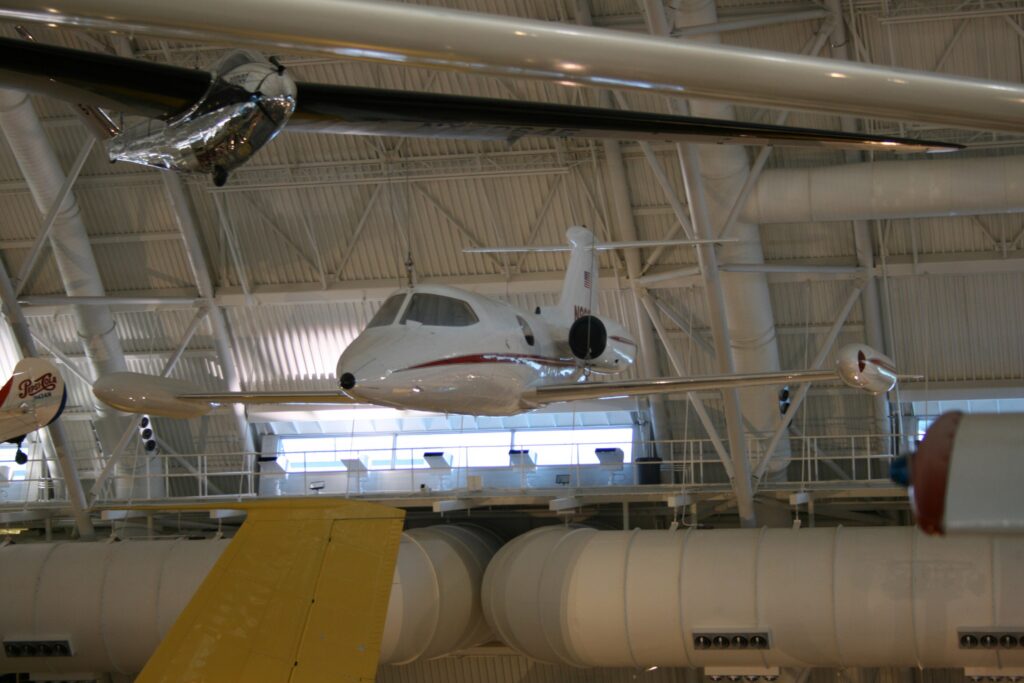
For decades, “Learjet” was the word people used for any private jet. Few aircraft names have entered everyday language like that. The story of Learjet history starts with a restless inventor, a cancelled Swiss fighter and a gamble that a small, fast jet could change how business people travel. It ends almost sixty years later, in March 2022, when the last new Learjet left the factory in Wichita, Kansas.
Bill Lear, the inventor
William Powell “Bill” Lear was already famous before he built an aircraft. Largely self-taught, he developed early car radios, aircraft radio and navigation equipment, and an autopilot that won him the Collier Trophy in 1950; later he popularised the eight-track tape player. A keen pilot himself, he had flown his own aircraft for years. In the late 1950s he decided that executives needed a jet that was as fast as an airliner but small enough to use regional airports.
A Swiss fighter becomes a business jet
Lear found his starting point in Switzerland. The FFA P-16 was a ground-attack fighter developed in the 1950s whose programme was cancelled after test crashes. Lear and his team saw that its strong wing, with fuel tanks at the tips, and its landing gear could become the basis of a fast business jet. He founded the Swiss American Aviation Corporation in St. Gallen-Altenrhein, but work in Switzerland moved too slowly. In 1962 the tooling was shipped to Wichita, the “Air Capital of the World”, and assembly of the first aircraft began there on 7 February 1963.
The Learjet 23 takes off
The Learjet 23 first flew on 7 October 1963. Powered by two General Electric CJ610 turbojets, it carried up to six passengers at more than 500 mph and climbed faster than most airliners of the time. The first customer aircraft was delivered in October 1964. The company was renamed Lear Jet Corporation and became a public company the same year. The 23 was followed by the improved Learjet 24 and the longer Learjet 25, both of which flew in 1966.
What made a Learjet a Learjet
The early Learjets set a pattern that stayed recognisable for decades. The two engines sat on the rear fuselage, below a T-tail, keeping the wing clean and the cabin quiet. The wing was small and thin for speed, and the fuel tanks at its tips, inherited from the P-16, gave the aircraft its unmistakable outline. The cabin was narrow and low: passengers could not stand up, but they could fly at airliner speeds and climb above most weather, up to 45,000 ft. Learjets were also known as demanding aircraft to fly, closer to a fighter than to a gentle airliner, and pilots took pride in being “Lear pilots”. Later models softened this character. The Learjet 28 and 55 introduced winglets, and the Learjet 55 brought a larger cabin, but the family resemblance remained.
Gates Learjet and the turbofan years
Rapid growth stretched the young company’s finances. In April 1967 Bill Lear sold his roughly 60% stake to the Gates Rubber Company of Denver for about US$27 million, and the company became Gates Learjet in 1969. Under Gates, Learjet adopted the quieter and more efficient Garrett TFE731 turbofan. The result was the Learjet 35, first flown in 1973, which became the most-built Learjet of all. In 1976 golfer Arnold Palmer flew a Learjet 36 around the world in 57 hours and 25 minutes, setting a speed record for its class. The US Air Force bought the 35A as the C-21A transport, and celebrities, executives and air ambulance services made the Learjet a familiar sight.
Bombardier’s Learjet
After further changes of ownership in the 1980s, the Canadian company Bombardier bought Learjet in 1990. Bombardier kept the Learjet name and the Wichita plant and developed new models: the larger Learjet 60, and the Learjet 45, the first clean-sheet Learjet design, which first flew on 7 October 1995, exactly 32 years after the Learjet 23. An ambitious all-composite Learjet 85 was launched in 2007 but later cancelled. In June 2017 Bombardier celebrated the delivery of the 3,000th Learjet.
The last Learjet
The final models were the Learjet 70 and the Learjet 75, modernised versions of the Learjet 45 family with new engines, winglets and Garmin avionics, certified in 2013. By then the light business jet market had become crowded, and Bombardier decided to concentrate on its larger Challenger and Global jets. On 11 February 2021 it announced the end of Learjet production. The last new Learjet 75 was delivered on 28 March 2022, ending a run of almost sixty years. By then more than 3,000 Learjets had been built since the first Learjet 23 rolled out in Wichita.
The Learjet legacy
Learjet did not invent the idea of a business jet, but it made it fast, stylish and desirable, and gave it a name. Before the Learjet, executives who wanted to fly privately mostly used piston aircraft or converted airliners. Afterwards, a small jet that could take a handful of people across a continent in a few hours became a normal business tool, and competitors such as Cessna, Dassault and Embraer built whole product lines for that market.
Wichita also owes much to Learjet. The company helped turn the city into a centre of business jet manufacturing, and the Learjet site remains part of Bombardier’s operations, with flight testing and service work for its other jets. Thousands of Learjets still fly, many of them as air ambulances, and Bombardier continues to support them. Explore more famous designs in our aircraft database.
Sources
- FlightGlobal: Learjet production goes silent after six decades, 30 March 2022
- BBC News: Goodbye to the original celebrity private jet, 12 March 2021
- CBC News: Bombardier lays off another 1,600 people, scraps Learjet program, 11 February 2021
- Bombardier: Delivery of the 3,000th Learjet aircraft, 2 June 2017
- John Fricker, “Switzerland’s P-16: Father of the Learjet”, Air International, March 1991

Start the discussion
Commenting on this story: Learjet: The Jet That Made Private Jets Famous