Windshear Detection: How Airliners Learned to Escape Microbursts
Microbursts killed hundreds of airline passengers until the 1990s. How ground radar, onboard windshear detection and new training ended the run of crashes.
For two decades, a sudden blast of air beneath a thunderstorm was one of the deadliest hazards in airline flying. According to the US Federal Aviation Administration (FAA), more than 30 accidents and incidents between 1964 and 1985 involved windshear, with more than 500 people killed. Today such crashes are rare, thanks to windshear detection on the ground and in the cockpit, and to a completely different way of training pilots.
What a microburst does to an airliner
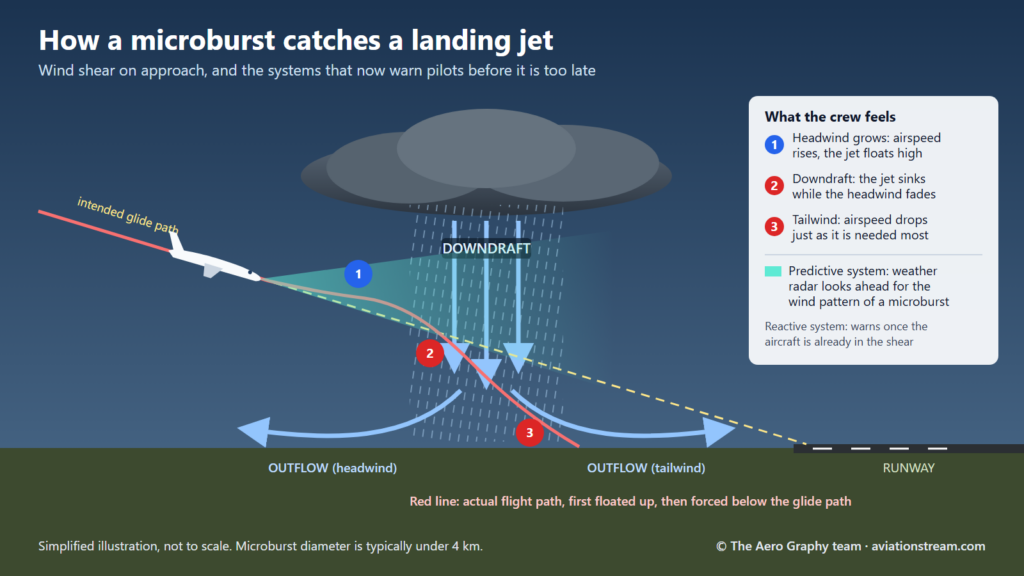
Wind shear is a sudden change in wind speed or direction. Its most dangerous form near the ground is the microburst: a column of cold air that falls out of a thunderstorm, hits the ground and spreads out in every direction, usually over an area less than about 4 km across.
An aircraft flying through one meets three things in quick succession, as our diagram shows:
- First a stronger headwind from the outflow. Airspeed rises and the aircraft floats above its glide path, so pilots tend to reduce power.
- Then the downdraft in the core, which pushes the aircraft down while the headwind fades.
- Finally a tailwind on the far side, which cuts airspeed just when the aircraft is low, slow and at low power.
The FAA notes that an aircraft may cross a microburst in only 20 to 40 seconds and that the change in wind across it often exceeds 50 knots. The microburst that brought down Delta Air Lines Flight 191 had a wind difference of 73 knots.
Three crashes that changed the rules
On 24 June 1975, Eastern Air Lines Flight 66, a Boeing 727, struck the approach lights at New York JFK during a thunderstorm, killing 113 of the 124 people on board. Meteorologist Ted Fujita, working with investigators, identified intense “downburst” cells as the cause. The idea was not widely accepted at first.
On 9 July 1982, Pan Am Flight 759, another 727, was forced down by a microburst just after take-off from New Orleans and crashed into houses in Kenner, Louisiana. All 145 people on board and eight on the ground were killed.
On 2 August 1985, Delta Air Lines Flight 191, a Lockheed L-1011 TriStar, flew into a microburst on approach to Dallas/Fort Worth and hit the ground about a mile short of the runway. In total 137 people died. The FAA calls the accident the catalyst that sped up airborne windshear detection, new avoidance procedures and early warning systems on the ground. Our video The Storm That Changed Aviation Forever tells the story of that flight.
Eyes on the ground: LLWAS and Doppler radar
The first ground system was the Low Level Windshear Alert System (LLWAS), a network of wind sensors on poles around an airport that alerted controllers when winds differed sharply. It was in use before 1985, but the FAA later concluded that the delay in detecting and passing on the information made it of little practical use to a crew in the final seconds of an approach. Later versions improved its sensor layout and alarm logic.
The bigger step was Terminal Doppler Weather Radar (TDWR), developed by the Massachusetts Institute of Technology’s Lincoln Laboratory. Doppler radar measures the movement of rain and other particles and can spot the outflow pattern of a microburst near the runway. TDWR has been in service since 1994; today 45 systems protect 46 high-capacity US airports. The FAA says no windshear accident has happened at any airport protected by TDWR since it was commissioned.
Eyes in the cockpit: reactive and predictive systems
Under US rule 14 CFR 121.358, turbine-powered airliners built after 2 January 1991 must carry an approved airborne windshear warning and flight guidance system, a windshear detection and avoidance system, or a combination of both. Older jets had to be fitted with at least a warning system.
The first generation was reactive. It uses the aircraft’s own air data and inertial sensors to recognise that the aircraft is already in windshear, sounds a “WINDSHEAR” warning and gives the pilots pitch guidance on their flight instruments to fly the best escape path.
The second generation is predictive. Predictive windshear systems, introduced into airline service in 1994, use the Doppler function of the weather radar to look ahead along the flight path for the wind pattern of a microburst. They warn the crew before the aircraft enters it, while there is still time to go around or delay a take-off. Like ground radar, they need rain or other particles to see the wind, so they work best against “wet” microbursts.
Escape, don’t recover
Technology was only half the answer. Before 1985, simulator training often taught pilots to cope with windshear and get back onto the approach path. After Delta 191 the philosophy changed: pilots now train in simulators to recognise windshear early and fly an escape manoeuvre straight away, with full thrust and the aircraft’s full climb performance, rather than trying to save the landing. Good crew resource management helps crews speak up early and act together.
The last US airliner windshear crash
The most recent windshear accident involving a US airliner happened on 2 July 1994, when USAir Flight 1016, a DC-9, crashed near Charlotte, North Carolina, during a go-around in a microburst. Thirty-seven of the 57 people on board died. Charlotte’s TDWR was not yet operational. The National Transportation Safety Board (NTSB) found that the crew had continued the approach into an area where a microburst was likely, and that an error in the aircraft’s windshear alert software meant the warning that should have sounded about 8 to 9 seconds before impact did not.
What is still hard to see
Windshear has not disappeared. “Dry” microbursts, which produce little or no rain, and clear-air phenomena such as mountain waves can still escape radar. The ground radar network is also ageing: the FAA is running a service life extension programme on TDWR until newer weather radar replaces it. For now, the most important rule remains a simple one: stay away from thunderstorms on take-off and landing.
Landing is already the busiest part of a flight; see why in our video Why Landing Is the Most Dangerous Part of Flying.
Start the discussion
Commenting on this story: Windshear Detection: How Airliners Learned to Escape Microbursts