Runway Overrun Prevention: The Systems That Stop Jets in Time
Runway excursions cause most runway accidents. How runway condition reports, onboard ROPS alerts, autobrakes and EMAS beds keep jets on the pavement.
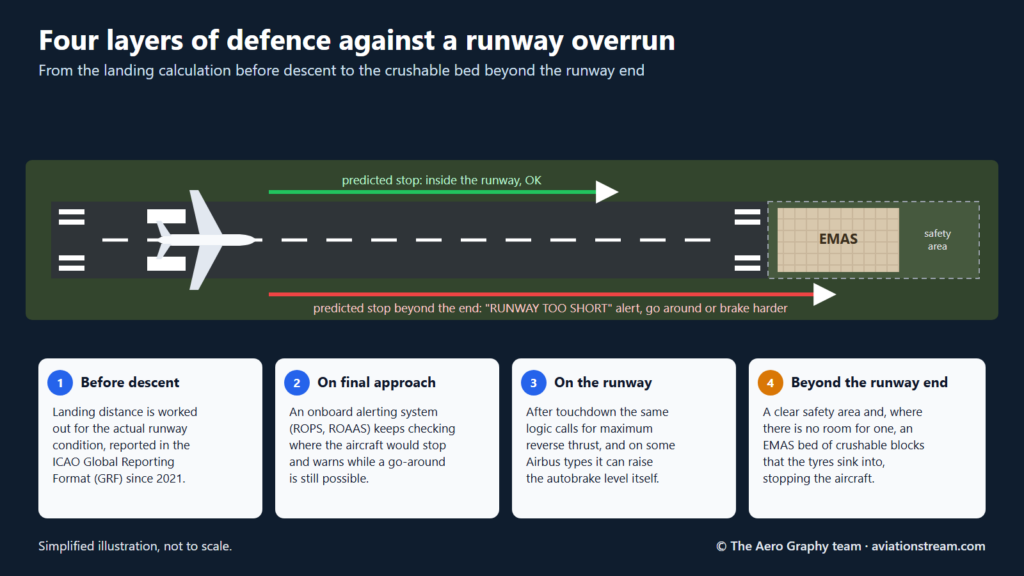
When people think of air accidents, they usually picture something dramatic in the air. In reality, one of the most common accident types happens on the ground: an aircraft that cannot stop before the end of the runway. Runway overrun prevention has become a major focus for regulators and manufacturers, and today it works in several layers, from the calculation the pilots make before descent to a bed of crushable blocks beyond the runway end.
A big share of accidents
When the Flight Safety Foundation’s Runway Safety Initiative studied 14 years of data, it found that 97 percent of runway accidents were excursions, in which an aircraft leaves the side or the end of the runway. Commercial aircraft had almost 30 excursions a year, more than a quarter of all their accidents. Most cause no deaths, but some are catastrophic, such as Air India Express Flight 812, which overran the tabletop runway at Mangalore in 2010.
Overruns rarely have a single cause. Typical factors include an unstable approach, touching down too fast or too far along the runway, a tailwind, a wet or contaminated surface, and late or reduced use of brakes and reverse thrust. Each layer of protection targets some of these.
Layer 1: knowing the runway before landing
Before descent, pilots calculate the landing distance they need for the aircraft’s weight, the wind, the flap setting and, crucially, the state of the runway. A runway covered in water, slush or snow can make the stopping distance much longer than on a dry one.
Since November 2021, airports in ICAO member states report runway surface conditions using the Global Reporting Format (GRF). Airport staff assess the runway in each third of its length and give it a runway condition code from 6 (dry) down to 0 (unsafe, such as wet ice). Crews use the code directly in their performance calculations, so the numbers in the cockpit match what is actually on the runway.
Layer 2: alerts on final approach
A calculation made 30 minutes before landing cannot account for a gust on short final or a touchdown far down the runway. That is why newer aircraft carry systems that keep checking during the approach whether the aircraft can still stop in the runway that remains.
Airbus’s Runway Overrun Prevention System (ROPS) was first approved by the European Union Aviation Safety Agency (EASA) on the A380 in 2009, and later on the A320 family, A330 and A350. It compares the predicted stopping point, based on the aircraft’s actual energy and the selected braking, with the runway length taken from the aircraft’s databases. If the runway is too short, it warns the crew while a go-around is still possible.
EASA has since made this kind of system a requirement: since CS-25 Amendment 24 (2020), new large aeroplane designs must have a runway overrun awareness and alerting system (ROAAS). Other manufacturers and avionics suppliers offer similar functions.
Layer 3: stopping on the runway
After touchdown, the aircraft relies on its spoilers, reverse thrust and wheel brakes. Anti-skid and autobrake systems let the brakes work as hard as the surface allows without locking the wheels. Airbus’s ROPS also has a ground phase: if the aircraft is still at risk of running off the end, it calls for maximum reverse thrust, and on some types it can raise the autobrake setting automatically.
Layer 4: a safety net beyond the runway end
The last layer is on the ground beyond the runway. In the United States, the FAA’s standard runway safety area can extend 1,000 feet beyond each runway end, giving an overrunning aircraft clear, graded ground to stop on. Many older airports, however, have no room for it because of water, roads or buildings.
For those airports, the FAA worked with industry to develop the Engineered Material Arresting System (EMAS): a bed of lightweight, crushable cellular cement blocks placed beyond the runway end. The tyres sink into the material and the aircraft slows quickly. A standard EMAS installation will stop most aircraft that overrun at up to 70 knots (about 80 mph). According to the FAA, EMAS beds have so far safely stopped 26 overrunning aircraft carrying 497 people, from a Saab 340 at New York JFK in May 1999 to a Boeing 737 at LaGuardia in October 2016 and an Embraer ERJ-145 at Roanoke in September 2025. EMAS beds are also in use outside the United States, from Europe to China and New Zealand.
The lesson of Toronto
On 2 August 2005, Air France Flight 358, an Airbus A340, landed in a thunderstorm at Toronto Pearson, overran the runway and ended up in a ravine. All 309 people on board survived, which was widely called a miracle and credited in large part to the cabin crew’s fast evacuation. The accident fed into much of the later work on runway excursions: better information on runway condition and tailwind, clearer decisions to go around, and onboard systems that tell crews when the runway ahead is no longer enough.
Why it works best together
None of these layers is perfect on its own. A runway condition report can be out of date, an alert can come late after a long touchdown, and an EMAS bed only helps at limited speeds. Together, though, they give pilots more chances to break the chain of events that leads to an overrun, ideally long before the aircraft reaches the end of the pavement.
Read how landings test pilots and aircraft in our video Why Landing Is the Most Dangerous Part of Flying.
Sources
- Flight Safety Foundation: Runway Excursion Risk Reduction (RERR) Toolkit
- ICAO: The Global Reporting Format for runway surface conditions
- EASA: ED Decision 2020/001/R, reduction of runway excursions (CS-25 Amendment 24)
- Aviation Week: Airbus Runway Overrun Prevention System certified on A320ceo family
- FAA: Engineered Material Arresting System (EMAS)

Start the discussion
Commenting on this story: Runway Overrun Prevention: The Systems That Stop Jets in Time