Storms, Fog, Ice: How Airliners Land in Bad Weather (and When They Don’t)
A 12-minute documentary on how airliners land in thunderstorms, fog, crosswinds and snow, told through four real accidents and the safety rules that came out of them.
Landing takes only a few minutes of a typical flight, yet according to Boeing’s worldwide accident statistics it is the phase in which a large share of fatal accidents happen. Add a thunderstorm, fog, a strong crosswind or a snow-covered runway, and every decision in the cockpit becomes harder. This 12-minute AviationStream documentary explains how airline pilots deal with landing in bad weather, using four real accidents and the rules that were written because of them.
What the video covers
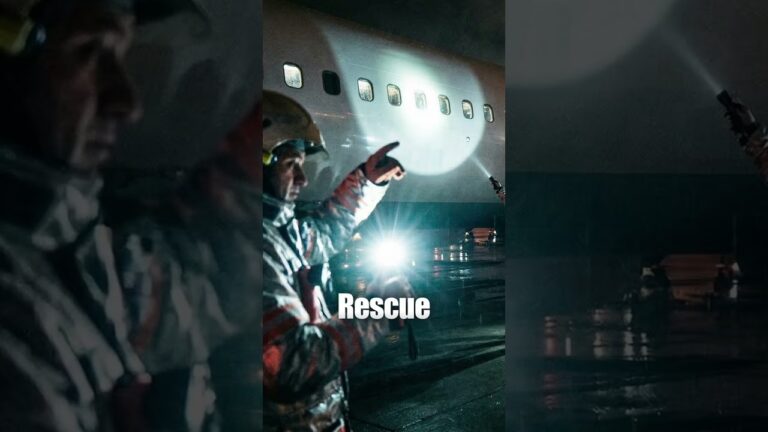
- 0:00 Toronto 2005: 309 people on board, 309 survivors
- 0:46 Why landing is the riskiest phase of flight
- 1:52 Thunderstorms and microbursts: Delta Air Lines Flight 191
- 3:19 Fog and the Instrument Landing System
- 4:33 Wind and water: Air France Flight 358 and American Airlines Flight 1420
- 6:18 Snow, ice and crosswind technique
- 8:33 The stabilized approach and the go-around
- 9:47 Fuel, alternates and Avianca Flight 52
- 11:46 The decision
Thunderstorms and microbursts
On 2 August 1985, Delta Air Lines Flight 191, a Lockheed L-1011 TriStar, flew into a microburst on final approach to Dallas/Fort Worth. A microburst is a powerful column of air falling out of a thunderstorm and spreading out at the ground. An aircraft flying through it first gets a sudden headwind that makes it float, then a downdraft, then a tailwind that robs it of airspeed close to the ground. The TriStar struck the ground short of the runway and 137 people died.
The US NTSB’s investigation of the accident (report NTSB/AAR-86/05) pushed forward three changes that are still with us: wind shear training for pilots, ground-based wind shear alerting systems at airports, and onboard wind shear warning systems, which US rules now require on airliners. Our glossary explains the phenomenon in more detail in wind shear.
Fog and the Instrument Landing System
In fog, pilots fly an instrument approach and need to see the runway environment by a set height, called the decision height, or they must go around. The Instrument Landing System (ILS) gives them precise lateral and vertical guidance down to that point. The lower the category, the lower the minimums:
- Category I: decision height usually 200 ft, with a runway visual range of about 550 m
- Category II: decision height around 100 ft, with better ground equipment and specially trained crews
- Category III: very low or no decision height; the autopilot flies the aircraft all the way to touchdown (autoland)
Each step down requires better airport lighting and equipment, certified aircraft systems and crews trained and current for that category.
Wind and water on the runway
On 2 August 2005, Air France Flight 358, an Airbus A340, landed long on a wet runway at Toronto Pearson during a thunderstorm, ran off the end and caught fire in a ravine. Everyone on board escaped. Canada’s Transportation Safety Board (report A05H0002) found that the aircraft touched down far down the runway with a tailwind component in heavy rain, leaving too little runway to stop, and recommended clearer rules on landing distances in such conditions.
Six years earlier, on 1 June 1999, American Airlines Flight 1420, an MD-82, overran the runway at Little Rock during a severe thunderstorm and 11 people died. The NTSB (report NTSB/AAR-01/02) found that the crew continued the approach as the storm moved over the airport and that the ground spoilers had not been armed, so the aircraft could not brake effectively. Fatigue and the pressure to land were part of the picture.
Snow, ice and crosswinds
Contaminated runways change everything. On 8 December 2005, Southwest Airlines Flight 1248, a Boeing 737-700, slid off the end of a snow-covered runway at Chicago Midway, killing a child in a car outside the airport (NTSB/AAR-07/06). The investigation helped lead to the US runway condition assessment system introduced in 2016, in which airports report a runway condition code from 6 (dry) to 0 (unsafe), so crews can calculate their stopping distance with real numbers (FAA SAFO 16009).
In a crosswind, pilots approach with the nose pointed into the wind, called crabbing, and straighten the aircraft just before touchdown, or fly the final part of the approach with one wing slightly low. Every airliner has a demonstrated crosswind value from its certification flight tests. Our article on how the Boeing 777 autopilot handles extreme crosswinds looks at the same problem from the automation side.
The stabilized approach and the go-around
Most airlines require an approach to be stabilized by a set height, usually 1,000 ft in cloud and 500 ft in clear weather: on the correct path, at the correct speed, with the landing configuration set and a normal rate of descent. If it is not, the rule is simple: go around. The Flight Safety Foundation’s research found that the great majority of unstabilized approaches are nevertheless continued to a landing, which is why the go-around is now taught as a normal, expected manoeuvre rather than a failure.
Fuel, alternates and the right words
On 25 January 1990, Avianca Flight 52, a Boeing 707, ran out of fuel and crashed on Long Island after long holding delays in bad weather near New York’s JFK; 73 people died. The NTSB (NTSB/AAR-91/04) found that the crew never clearly declared a fuel emergency to air traffic control. Since 2012, ICAO phraseology gives pilots two precise calls: “MINIMUM FUEL” when any change to their clearance could mean landing with less than the planned final reserve, and “MAYDAY FUEL” when the fuel they expect to have on landing is below that reserve. Airline flights also must carry fuel for an alternate airport and a reserve on top.
The decision
The common thread of all four accidents is a decision taken late, under pressure, with incomplete information. The rules shown in the video, from wind shear alerts to runway condition codes and fuel phraseology, exist to make the safe choice the easy one: wait, divert or go around.
Sources
- Boeing, Statistical Summary of Commercial Jet Airplane Accidents, Worldwide Operations 1959–2025
- NTSB, Delta Air Lines Flight 191, report NTSB/AAR-86/05
- NTSB, American Airlines Flight 1420, report NTSB/AAR-01/02
- NTSB, Southwest Airlines Flight 1248, report NTSB/AAR-07/06
- NTSB, Avianca Flight 52, report NTSB/AAR-91/04
- Transportation Safety Board of Canada, Air France Flight 358, report A05H0002
- FAA, SAFO 16009, Runway Assessment and Condition Reporting; 14 CFR 121.358, 25.237, 121.619, 121.639, 121.645
- Flight Safety Foundation, ALAR Briefing Note 7.1 and the Go-Around Decision-Making and Execution Project
- ICAO Annex 6, Amendment 36 (MINIMUM FUEL and MAYDAY FUEL)
This video and page are for education, not for operational use. Rules change; always consult current regulations. Watch more on The Aero Graphy on YouTube, our video partner.

Start the discussion
Commenting on this video: Storms, Fog, Ice: How Airliners Land in Bad Weather (and When They Don’t)