





Last Updated: 3 days ago
Picture a massive metal tube, weighing over 650,000 pounds, hurtling toward a runway at 140 knots. The wind is howling at 40 knots directly across the flight path. For passengers, it is a white-knuckle moment. For the Boeing 777 Autopilot and its sophisticated Fly-By-Wire (FBW) system, it is a masterclass in dynamic aerodynamics and continuous closed-loop feedback. Watching a Triple Seven crab into a fierce crosswind before effortlessly kicking straight just feet above the tarmac is nothing short of mechanical poetry. Let us dig into the guts of the Autopilot Flight Director System (AFDS) and see exactly what happens behind the radome when the weather refuses to cooperate.
The Digital Nervous System Behind the Boeing 777 Autopilot
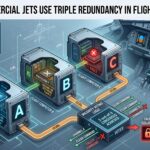
Before the 777, commercial Boeing aircraft relied on complex networks of steel cables, pulleys, and bellcranks. The 777 severed those physical tethers for the primary control surfaces, replacing them with copper wires and silicon. At the heart of this digital nervous system lie three Primary Flight Computers (PFCs). To ensure absolute redundancy and prevent common-mode software failures, Boeing designed these PFCs using three dissimilar processor architectures: an Intel 80486, a Motorola 68040, and an AMD 29050.
These computers do not just blindly pass commands to the control surfaces. They continuously evaluate airspeed, altitude, and aircraft attitude. Communication happens via the ARINC 629 data bus. Where older architectures operated at a sluggish 100 kilobits per second, the 629 screams at 2 megabits per second bidirectionally. This massive bandwidth is crucial for the Boeing 777 Autopilot when a sudden wind shear demands split-second corrections across multiple flight surfaces.
To translate digital code into brute physical force, the aircraft relies on a specific chain of command:
- Flight Deck Inputs: Commands originate from the AFDS or the yokes and pedals.
- Primary Flight Computers (PFCs): Calculate the exact surface deflection required.
- Actuator Control Electronics (ACEs): Four analog units receive digital signals and convert them into electrical currents.
- Power Control Units (PCUs): Servo valves open, sending 3,000 psi of Skydrol hydraulic fluid to move the actual surfaces.
Battling the Invisible Enemy: Crosswind Autoland Mechanics
When the wind tries to push the aircraft off the runway centerline, the system employs an aggressive crab angle. The nose points directly into the wind while the aircraft’s actual ground track remains perfectly aligned with the runway. During a Category IIIb autoland scenario, the Boeing 777 Autopilot takes complete control of this dynamic balancing act. It acts much like a highly advanced proportional-integral-derivative (PID) controller, instantly managing the error rates between the commanded localizer path and the actual ground track.
As the aircraft descends through 500 feet radio altitude, the AFDS works in tandem with the PFCs to command the ACEs. The system constantly deflects the outboard ailerons and inboard flaperons to keep the wings level, simultaneously managing the massive 41-foot-tall rudder to maintain the precise crab angle.
Hardware Comparison: Analog vs. Digital
| Feature | Legacy Airframes (Conventional) | Boeing 777 (Fly-By-Wire) |
| Primary Flight Controls | Cables, pulleys, hydraulic servos | ARINC 629, PFCs, ACEs, PCUs |
| Data Bus Speed | ARINC 429 (100 Kbps) | ARINC 629 (2 Mbps) |
| Flight Envelope Protection | None (Relies on stick shaker/nudger) | Soft limits (Tactile feedback, overridable) |
| Processor Redundancy | Dual-channel analog/digital | Triple-redundant, dissimilar architectures |
The Final Approach: Decrab and Touchdown
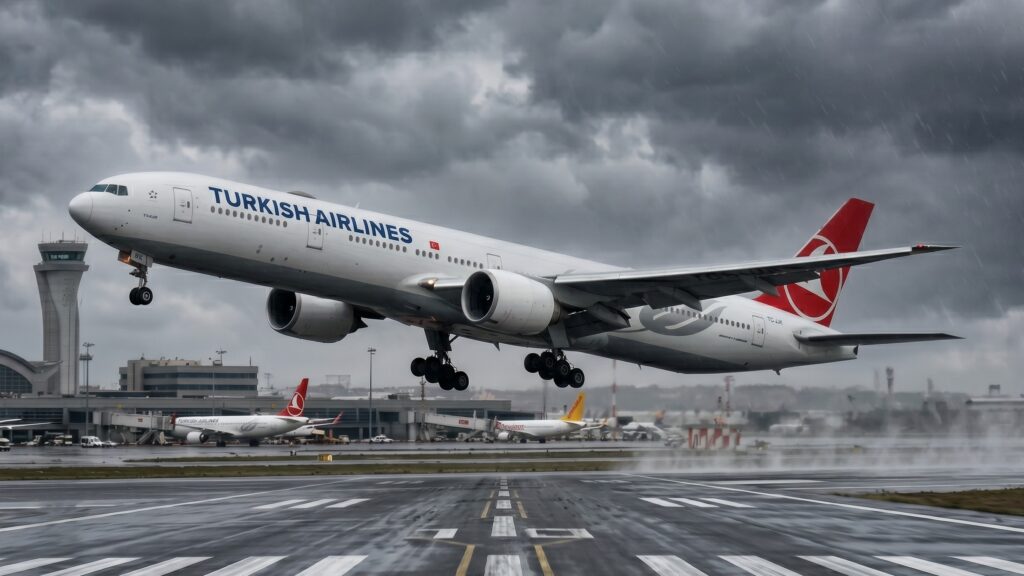
At roughly 200 feet above the ground, the magic happens. The aircraft cannot land sideways; the massive six-wheel main landing gear bogies would experience catastrophic side-loads. The system initiates the “decrab” phase. It commands a firm, calculated rudder input to align the nose directly with the runway centerline.
Pushing the nose straight creates a new aerodynamic problem: the upwind wing generates more lift and wants to rise. To counter this induced roll moment, the system instantly commands opposite aileron and spoiler deflection. This is known as a side-slip or “wing-low” maneuver. The digital interplay between the yaw damper network and the roll axis controllers ensures the 300-ton beast settles smoothly onto the concrete, upwind gear first.
Rollout Guidance and Asymmetry Mastery
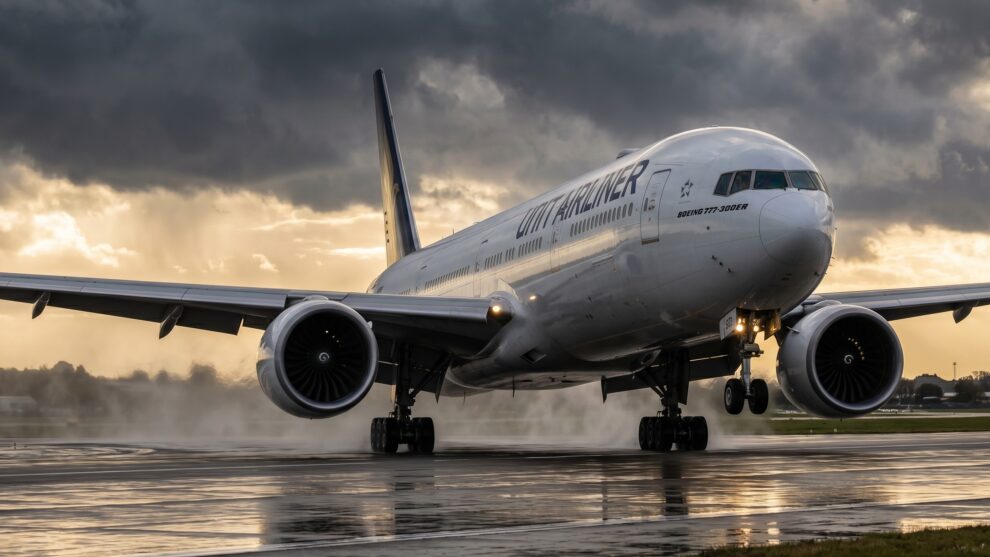
Touching down is only half the battle. A wet runway combined with a 35-knot crosswind turns the rollout into a high-stakes ice-skating routine. The Boeing 777 Autopilot utilizes three independent localizer receivers to track the runway centerline down to the inch. The PFCs command the rudder and the nose-wheel steering to keep the aircraft perfectly centered while the auto-brakes apply maximum safe deceleration.
If a sudden gust hits the vertical stabilizer, the yaw damper reacts independently, commanding the rudder PCUs within milliseconds. The aircraft also features Thrust Asymmetry Compensation (TAC). Any asymmetric engine force is instantly calculated, and the rudder counters it, drastically reducing the workload in the flight deck. It stands as a testament to the engineers who managed to tame the chaotic forces of nature with pristine lines of code and raw hydraulic pressure.
Frequently Asked Questions (FAQ)
Q: Can the automated system land in any crosswind?
A: No. The aircraft has a certified maximum demonstrated crosswind limit for a fully automated landing, typically around 25 knots depending on the airline’s Standard Operating Procedures (SOPs). Beyond that limit, the pilot must take manual control.
Q: How does the Boeing 777 Autopilot differ from Airbus systems?
A: Airbus utilizes a “hard limit” flight envelope protection philosophy where the computers absolutely prevent the pilot from exceeding structural limits. Boeing uses “soft limits.” The yoke becomes progressively stiffer to warn the pilot, but a human can always apply enough physical force to override the computers during extreme maneuvers.
Q: What happens if all three Primary Flight Computers fail?
A: Total failure is mathematically highly improbable due to the dissimilar architecture. If it does happen, the 777 features a robust mechanical backup. Two spoiler panels and one alternate horizontal stabilizer pitch trim mechanism remain mechanically linked via cables, allowing the flight crew to maintain basic roll and pitch control.
Have you ever experienced a heavy crosswind landing as a passenger on a Triple Seven? Did you feel the massive rudder inputs and the wing-low dip just before the main gear kissed the runway? Drop your stories in the comments below, and let’s discuss the incredible physics of this engineering marvel!
Did you know AviationStream.com has a YouTube channel? Check out TheAeroGraphyOfficial and subscribe to watch fun, highly engaging aviation Shorts!