Airbus A330-200
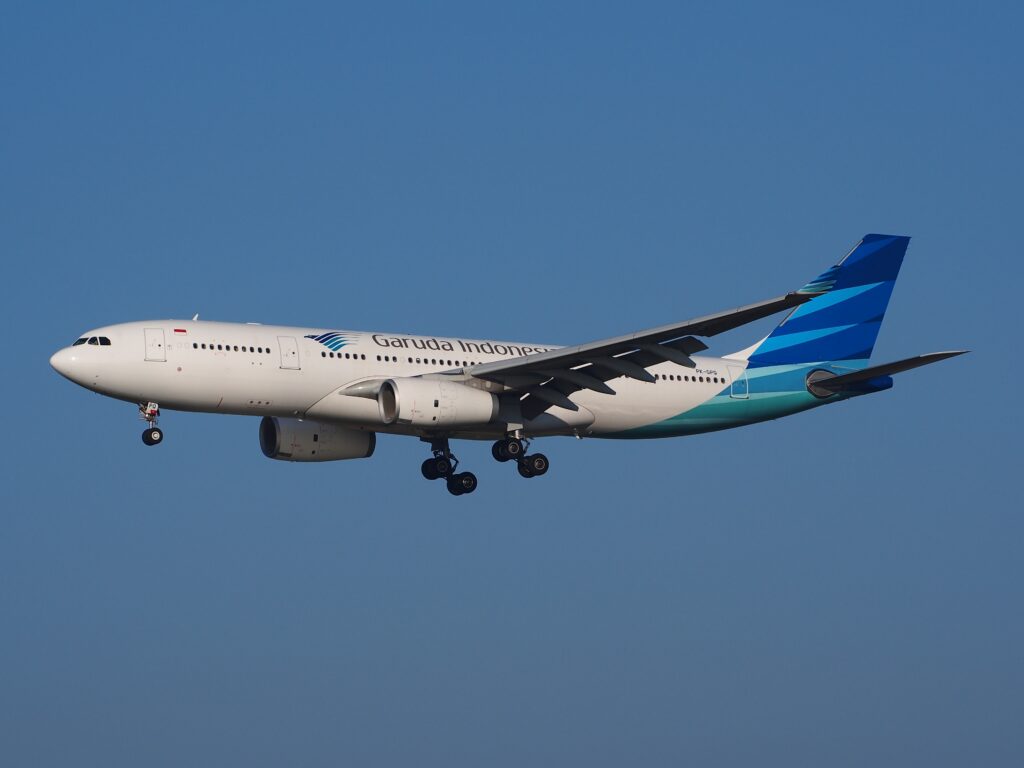
The Airbus A330-200 is a shortened, longer-range version of the A330-300. Since entering service with Canada 3000 in 1998 it has flown long, thin routes for airlines on every continent, and it is the basis of the A330 MRTT tanker.
| General Characteristics | |
| Type | Wide-body jet airliner, Civil and Commercial Aircraft |
|---|---|
| National Origin | Multi-national |
| Manufacturer | Airbus |
| Variants | A330-200, A330-200F, A330 MRTT, ACJ330 |
| Status | In service |
| First Flight | 13 August 1997 |
| Introduction | April 1998 with Canada 3000 |
| Primary Users | Turkish Airlines, Delta Air Lines, Qantas, China Eastern Airlines |
| Number Built | 656 delivered (as of April 2024) |
| Developed From | Airbus A330-300 |
| Capacity & Dimensions | |
| Cockpit Crew | Two |
| Typical Seating | 247–253 (three-class) |
| Overall Length | 58.82 m (193 ft 0 in) |
| Wing Span | 60.3 m (197 ft 10 in) |
| Wing Sweep | 30° |
| Wing Area | 361.6 m² (3,892 sq ft) |
| Overall Height | 17.39 m (57 ft 1 in) |
| Weights, Powerplant & Performance | |
| MTOW | 242,000 kg (534,000 lb) |
| Fuel Capacity | 139,090 L (36,740 US gal) |
| Engines | 2 × GE CF6-80E1, Pratt & Whitney PW4000 or Rolls-Royce Trent 700 |
| Max. Thrust | 300–320 kN (67,500–72,000 lbf) each |
| Typical Cruise Speed | Mach 0.82 |
| Max. Speed | Mach 0.86 (MMO) |
| Range | 13,400 km (7,240 nmi) |
| Service Ceiling | 12,527 m (41,100 ft) |
The Airbus A330-200 is the long-range member of the original A330 family. Airbus made it by shortening the Airbus A330-300 and filling the space with fuel, so that the twinjet could fly routes that until then needed a larger and thirstier aircraft. It first flew on 13 August 1997 and entered service with the Canadian charter airline Canada 3000 in April 1998. Airbus had delivered 656 of the type by April 2024.
Why Airbus Built the A330-200
In the mid-1990s, airlines that wanted a mid-size twinjet for long routes usually bought the Boeing 767-300ER. The A330-300 had more seats, but it lacked the range for many of these routes. Airbus answered with a shorter fuselage, ten frames shorter than the -300, and a centre fuel tank that raised total capacity to 139,090 litres. Because the shorter body moved the tail closer to the wing, Airbus also made the vertical tail about one metre taller to keep the same yaw control. The result could carry around 250 passengers between Europe and Asia or across the Pacific.
Design and Cockpit
The A330-200 shares its wing with the A340, a large wing with 30 degrees of sweep and an area of 361.6 m². Its two-crew flight deck uses the same side-stick and fly-by-wire controls as the A320 and A340, so pilots can hold a common type rating across the families. Many airlines use this to move crews between the A330 and A350, which cuts training costs. The fuselage has the same cross-section as the A300 and A310: wide enough for eight seats across in economy in a 2-4-2 layout, which passengers often prefer because no seat is more than one place away from an aisle.
Engines and Performance
Customers can choose between three engines: the General Electric CF6-80E1, the Pratt & Whitney PW4000 and the Rolls-Royce Trent 700, each producing roughly 300 to 320 kN of thrust. The A330-200 cruises at about Mach 0.82, and its maximum operating Mach number is 0.86. Airbus has raised the maximum take-off weight several times; the latest version, certified by EASA in September 2015, is 242 tonnes, and it gives a range of about 13,400 km (7,240 nmi) with 253 passengers in three classes. That is enough for routes such as Istanbul to Johannesburg or Sydney to Honolulu.
Variants
- A330-200F: a freighter that first flew in 2009. It carries about 70 tonnes of cargo. A fairing under the nose keeps the cabin floor level on the ground, because the nose gear of the passenger version sits low.
- A330 MRTT: the Multi Role Tanker Transport, used by air forces in Europe, Australia, the Middle East and Asia. It can refuel other aircraft with booms or hoses, carry troops and serve as a medical evacuation aircraft.
- ACJ330: a corporate and VIP version with a private cabin.
In Service
The A330-200 replaced many older DC-10s, MD-11s and 767s. Large operators have included Turkish Airlines, Delta Air Lines, Qantas, China Eastern Airlines and Air Europa. Its successor in Airbus’s line-up is the A330-800neo, which keeps the same fuselage length but has new Rolls-Royce Trent 7000 engines and a longer wing. Because many A330-200s are now more than 15 years old, a large number are being converted to freighters, which will keep the type flying for many years.
How It Compares
The A330-200 is shorter than the A330-300 but flies further. Against the Boeing 787-8, it is heavier and burns more fuel per seat, but it costs much less to buy, and airlines can lease used aircraft cheaply. For the largest long-haul routes, airlines usually pick the Airbus A350-900 instead.
Frequently Asked Questions
How many passengers does the Airbus A330-200 carry? Typically 247 to 253 in three classes, and more in two-class or charter layouts.
What is the range of the A330-200? About 13,400 km (7,240 nmi) at the latest 242-tonne maximum take-off weight.
What is the difference between the A330-200 and A330-300? The -200 is about 5 m shorter, carries fewer passengers and has more range.
Start the discussion
Commenting on this aircraft: Airbus A330-200