Airbus A350-900
The Airbus A350-900 is a long-range, twin-engine wide-body built largely from carbon-fibre composites, flying up to about 15,000 km with 300 to 350 passengers.
| General Characteristics | |
| Type | Wide-body jet airliner |
|---|---|
| National Origin | France |
| Manufacturer | Airbus |
| Variants | A350-900, A350-900ULR, A350-900 Regional |
| Status | In service |
| First Flight | 14 June 2013 |
| Introduction | 15 January 2015, with Qatar Airways |
| Primary Users | Singapore Airlines, Qatar Airways, Cathay Pacific, Turkish Airlines |
| Number Built | 743 A350s of all versions (October 2026) |
| Developed From | New design |
| Capacity & Dimensions | |
| Cockpit Crew | Two |
| Typical Seating | 300–350 (three-class) |
| Max Seating | 440 (exit limit) |
| Overall Length | 66.8 m (219 ft 2 in) |
| Wing Span | 64.75 m (212 ft 5 in) |
| Wing Sweep | 31.9° |
| Wing Area | 442 m² |
| Overall Height | 17.05 m (55 ft 11 in) |
| Weights, Powerplant & Performance | |
| MTOW | Up to 283 t |
| Fuel Capacity | About 141,000 L |
| Engines | 2 × Rolls-Royce Trent XWB-84 |
| Max. Thrust | 84,000 lbf (374 kN) each |
| Typical Cruise Speed | Mach 0.85 |
| Max. Speed | Mach 0.89 |
| Range | About 15,000 km (8,100 nmi) |
| Service Ceiling | 43,100 ft (13,100 m) |
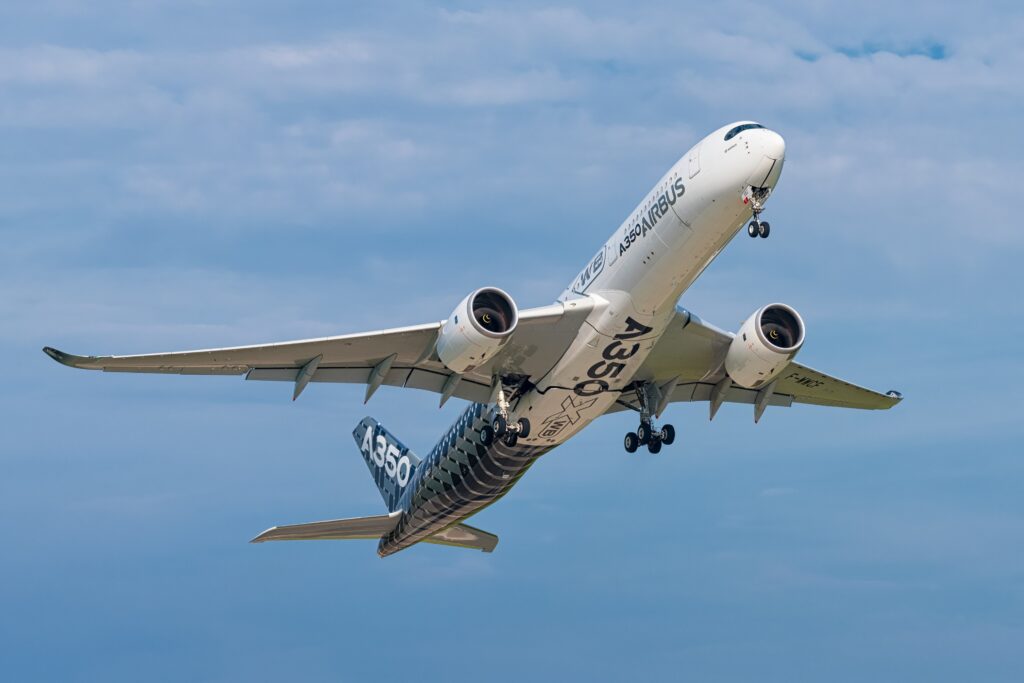
The Airbus A350-900 is a long-range, twin-engine wide-body airliner and the most widely used member of the A350 family. Built largely from carbon-fibre composites and powered by Rolls-Royce Trent XWB engines, it carries around 300 to 350 passengers in a typical three-class layout over distances of up to about 15,000 km, making it one of the main aircraft on the world’s longest routes.
Airbus A350-900 General Characteristics
The A350 was Airbus’s answer to the Boeing 787 and to demand for efficient twin-engine aircraft able to replace older four-engine jets on long-haul routes. The -900 is the baseline model; the longer A350-1000 carries more passengers, and the A350F freighter is under development. The aircraft flew for the first time on 14 June 2013 at Toulouse and entered service with Qatar Airways on 15 January 2015.
More than half of the A350’s structure by weight is made of composite materials, including the fuselage panels and wings. Composites are lighter than aluminium, do not corrode and tolerate higher cabin humidity, which helps both fuel burn and passenger comfort.
A350-900 Cabin and Seating
The A350-900’s cabin is about 5.6 metres wide, which allows nine-abreast economy seating in a 3-3-3 layout. Typical airline configurations seat around 300 to 350 people in three classes. Airbus markets the cabin under the name Airspace, with large overhead bins, quieter engines and LED lighting designed to reduce jet lag on long flights.
A special ultra-long-range version, the A350-900ULR, was developed for Singapore Airlines’ non-stop flights between Singapore and New York, among the longest scheduled flights in the world. Our article on the A350-900ULR avionics looks at the systems behind those 18-hour sectors.
Airbus A350-900 Dimensions
- Length: 66.8 m (219 ft 2 in)
- Wingspan: 64.75 m (212 ft 5 in)
- Height: 17.05 m (55 ft 11 in)
- Wing area: 442 m²
The wing is one of the aircraft’s signatures. Its curved, sharklet-style tips and adaptive trailing edge change shape slightly in flight to keep the wing efficient as weight falls with fuel burn. See our guides to winglets and aspect ratio for why long, slender wings matter.
Airbus A350-900 Engines and Performance
The A350-900 is powered exclusively by the Rolls-Royce Trent XWB-84, each rated at around 84,000 lbf (374 kN) of thrust. Having a single engine supplier simplified development and certification. The aircraft cruises at about Mach 0.85, has a service ceiling of 43,100 feet and a range of roughly 15,000 km, depending on configuration and payload.
The flight deck is closely related to the A380’s, with large displays and fly-by-wire controls, which lets pilots qualified on one Airbus wide-body move to another with reduced training. Read more about how its automation handles demanding conditions in our article on the A350 autopilot and crosswind landings.
Weights and Capacity
Maximum take-off weight has grown over the programme, with current variants certified at up to 283 tonnes. Fuel capacity is about 141,000 litres. Like other modern airliners, the A350 uses a fuel tank inerting system that fills empty tank space with nitrogen-enriched air; our explainer on the A350 nitrogen generation system shows how it works.
Operational Role
Airlines use the A350-900 on long-haul routes that once needed a Boeing 747 or Airbus A340, as well as on high-density medium-haul routes in Asia. Large operators include Singapore Airlines, Qatar Airways, Cathay Pacific and Turkish Airlines. Compared with the four-engine aircraft it replaces, it burns significantly less fuel per seat.
Frequently Asked Questions
How many passengers does the Airbus A350-900 carry?
Typically 300 to 350 in a three-class layout, depending on the airline.
What engines does the A350-900 use?
Two Rolls-Royce Trent XWB-84 turbofans; there is no alternative engine option.
What is the range of the A350-900?
About 15,000 km (8,100 nautical miles) in standard form. The A350-900ULR flies even further.
What is the difference between the A350-900 and A350-1000?
The A350-1000 is about seven metres longer, seats roughly 40 more passengers and uses the more powerful Trent XWB-97 engine.
Airbus A350-900 Summary
The Airbus A350-900 combines a composite airframe, a highly efficient wing and modern Rolls-Royce engines to fly long routes with fewer engines and less fuel than the jets it replaced. More than a decade after entering service, it remains one of the backbone aircraft of the world’s long-haul fleets.
Start the discussion
Commenting on this aircraft: Airbus A350-900