Airbus A400M Atlas
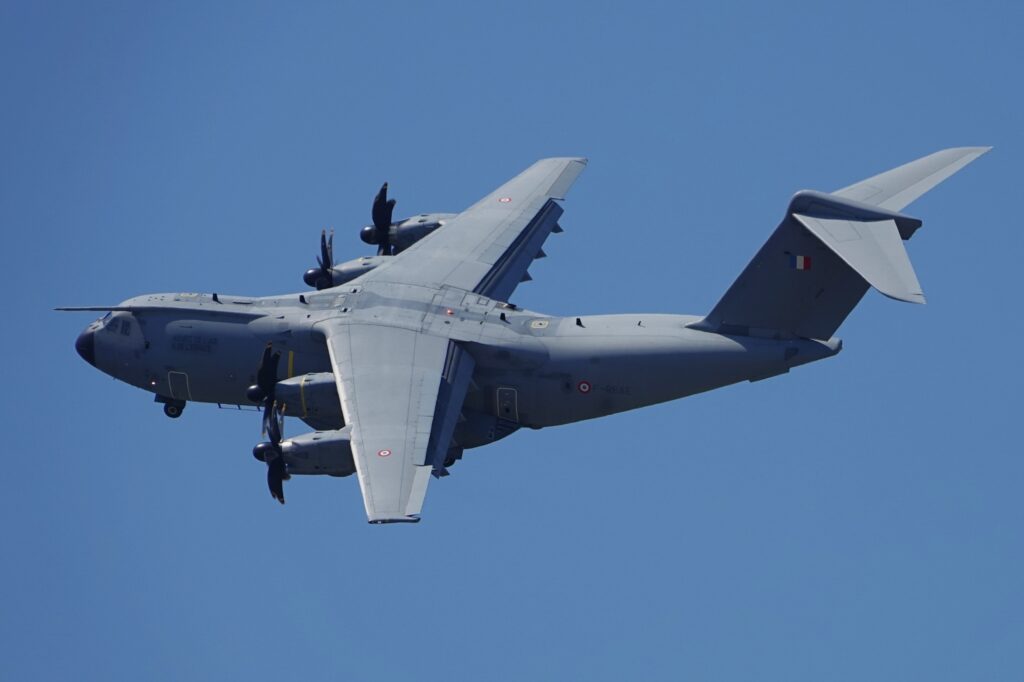
The Airbus A400M Atlas is a four-engine turboprop military transport built for eight European nations. It sits between the C-130 and the C-17 in size, first flew in December 2009 and entered service with the French Air Force in 2013.
| General Characteristics | |
| Type | Cargo Aircraft, Military Aircraft |
|---|---|
| National Origin | Multi-national |
| Manufacturer | Airbus |
| Variants | A400M; A400M in tanker-transport (MRTT) configuration |
| Status | In production and in service |
| First Flight | 11 December 2009 |
| Introduction | August 2013 with the French Air Force |
| Primary Users | German Air Force, French Air and Space Force, Royal Air Force, Spanish Air and Space Force, Turkish Air and Space Force |
| Number Built | 130 delivered by 31 January 2025 |
| Capacity & Dimensions | |
| Cockpit Crew | Two pilots (optional third crew member) and a loadmaster |
| Typical Seating | 116 fully equipped troops or paratroopers |
| Max Seating | 66 stretchers with 25 medical staff |
| Overall Length | 45.1 m (148 ft 0 in) |
| Wing Span | 42.4 m (139 ft 1 in) |
| Wing Area | 225.1 m² (2,423 sq ft) |
| Overall Height | 14.7 m (48 ft 3 in) |
| Weights, Powerplant & Performance | |
| MTOW | 141,000 kg (310,850 lb) |
| OEW | 78,600 kg (173,280 lb) |
| Fuel Capacity | 50,500 kg (111,300 lb) internal |
| Engines | 4 × Europrop TP400-D6 turboprops with eight-blade Ratier-Figeac propellers |
| Max. Thrust | 8,200 kW (11,000 shp) each |
| Typical Cruise Speed | 781 km/h (422 kn) at 9,450 m (31,000 ft) |
| Max. Speed | Mach 0.72 |
| Range | 3,300 km (1,780 nmi) with the maximum 37 t payload; 6,400 km (3,450 nmi) with 20 t |
| Takeoff Distance | 980 m (3,215 ft) tactical take-off at 100 t from a soft field |
| Service Ceiling | 12,200 m (40,000 ft) |
The Airbus A400M Atlas is a four-engine turboprop military transport developed for a group of European air forces. It is designed to carry loads that are too big or too heavy for the Lockheed Martin C-130J Super Hercules while still landing on short, unpaved strips that a jet transport such as the Boeing C-17 would avoid. The A400M first flew from Seville, Spain, on 11 December 2009, and the French Air Force received the first production aircraft in August 2013.
Origins
The project goes back to 1982, when Aérospatiale, British Aerospace, Lockheed and MBB formed a group to study a replacement for the C-130 Hercules and the Transall C-160. Lockheed left in 1989 to develop the C-130J on its own, and the European effort went through several names before it became the A400M under Airbus Military. In May 2003 eight launch nations ordered 180 aircraft through the joint armaments agency OCCAR: Belgium, France, Germany, Luxembourg, Spain, Turkey and the United Kingdom, with Italy leaving the programme early. South Africa and Malaysia joined as industrial partners.
A Difficult Development
The A400M needed a new engine, because no Western turboprop was powerful enough for a cruise speed of Mach 0.72. Airbus chose the Europrop International TP400-D6, at about 8,200 kW (11,000 shp) the most powerful turboprop in the West. Engine software, weight problems and the aircraft’s demanding requirements caused years of delay. By 2009 the programme was three to four years late and billions of euros over budget, and its cancellation was openly discussed. South Africa cancelled its order. In November 2010 the partner nations agreed a new contract, lent Airbus €1.5 billion and reduced the total order to 170 aircraft.
The A400M received its civil type certificate from the European Aviation Safety Agency (EASA) in March 2013. On 9 May 2015 a production aircraft crashed near Seville during a test flight before delivery, killing four crew members. Airbus said the cause was engine calibration data that had been accidentally erased during the installation of engine control software, which left three engines unable to respond normally to the throttles.
Design
The A400M has a high wing, a T-tail and a rear loading ramp. Its four engines drive eight-blade propellers, and the propellers on each wing turn in opposite directions (“down between engines”), which improves airflow over the wing and reduces the loads on it. The cargo hold is 17.71 m long, 4.00 m wide and 3.85 m high, wide enough for helicopters, engineering vehicles or armoured vehicles. The maximum payload is 37 t (81,600 lb), and the aircraft can carry 116 fully equipped troops or 66 stretchers with 25 medical staff.
The cockpit is derived from Airbus airliners, with a fly-by-wire control system, side-sticks and head-up displays. The A400M can refuel other aircraft in flight from wing pods or a hose unit in the hold, and it can be refuelled itself. A low-level terrain-following capability and soft-field landing gear let it deliver supplies close to the front line.
Performance
The A400M cruises at 781 km/h (422 kn) at 9,450 m (31,000 ft), much faster and higher than a C-130. With the full 37 t payload it can fly about 3,300 km (1,780 nmi), and with 20 t about 6,400 km (3,450 nmi). A tactical take-off at 100 t from a soft field needs about 980 m (3,215 ft).
Operators
By 31 January 2025 Airbus had delivered 130 A400Ms. Germany operates the largest fleet, with 53 ordered, followed by France, the United Kingdom (where it is called the Atlas C1), Spain and Turkey. Belgium and Luxembourg share a combined fleet, and Malaysia, Kazakhstan and Indonesia have bought it for export; Indonesia ordered its aircraft in a tanker-transport configuration and received the first in November 2025. The A400M has flown evacuations, humanitarian relief after earthquakes and hurricanes, and supply missions in Africa and the Middle East.
Sources
- Airbus: A400M product page
- Wikipedia: Airbus A400M Atlas (used to check dates and specifications)
Start the discussion
Commenting on this aircraft: Airbus A400M Atlas