Fly-by-Wire Explained: Flight Controls Run by Computers
Fly-by-wire is a flight control system in which the pilot's inputs are sent as electrical signals to computers, which then move the control surfaces. It saves weight and allows flight envelope protection.
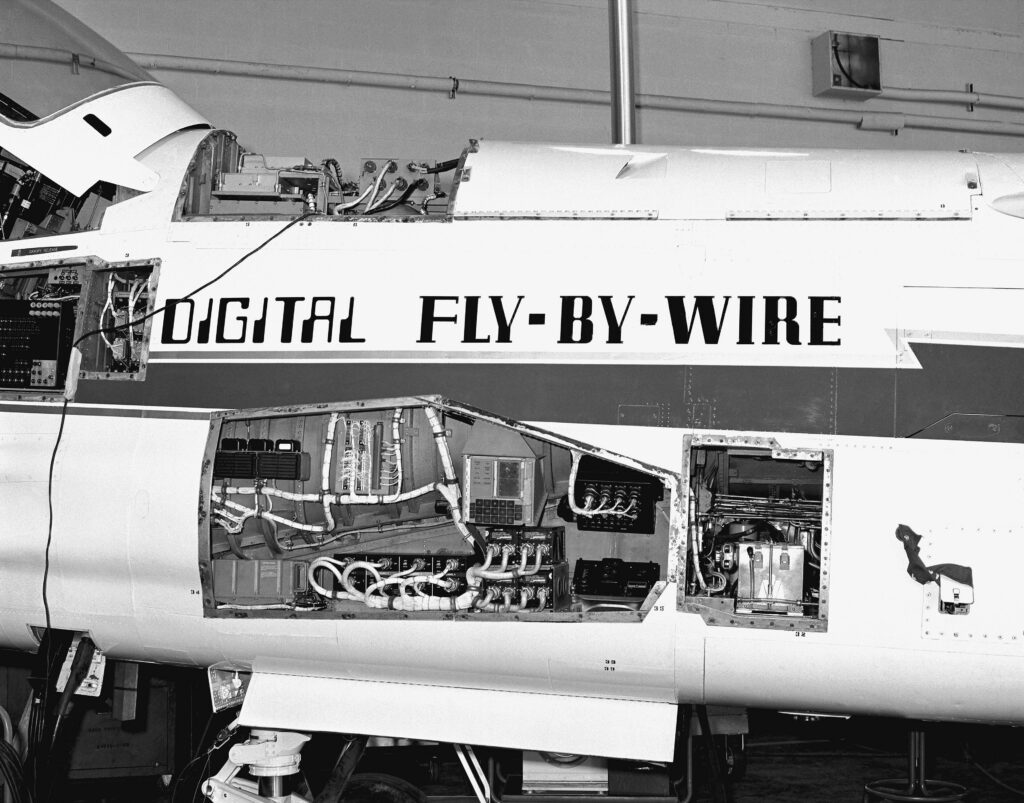
Fly-by-wire (FBW) is a flight control system in which the pilot’s stick or yoke is not mechanically connected to the control surfaces. Instead, sensors measure the pilot’s inputs and send them as electrical signals to flight control computers, which decide how far to move each aileron, elevator, rudder and spoiler, and command hydraulic or electric actuators to move them.
How it works
In a conventional aircraft, cables, pulleys and pushrods link the controls to the surfaces, sometimes with hydraulic boosters. In a fly-by-wire aircraft these are replaced by wires and computers. The computers combine the pilot’s command with data from air data sensors, gyros and accelerometers, and work out the surface movements that will produce the response the pilot asked for. On most Airbus aircraft, for example, moving the sidestick sideways commands a roll rate, and moving it fore and aft commands a load factor, rather than a fixed surface angle.
Because the computers are essential, they are built with heavy redundancy: several independent computers, often from different suppliers and running different software, powered by separate electrical buses and driving surfaces through separate hydraulic systems.
Flight envelope protection
The computers can stop the aircraft from leaving its safe flight envelope. In normal law on an Airbus, for instance, the system limits bank angle, pitch attitude, load factor and speed, and will not let the angle of attack rise to the point of a stall, even if the pilot pulls the stick fully back. If sensors or computers fail, the system degrades to alternate or direct law, with fewer protections. Boeing’s fly-by-wire aircraft use a different philosophy, with protections that the pilot can override by applying more force.
History
NASA’s F-8 Digital Fly-By-Wire research aircraft, a modified US Navy Crusader, was the first aircraft to fly with a digital fly-by-wire system and no mechanical back-up, in 1972. The F-16 was the first production fighter designed with fly-by-wire, which allowed it to be built with relaxed stability for greater agility. Concorde used analogue fly-by-wire signalling. The Airbus A320, which entered service in 1988, was the first airliner with digital fly-by-wire and sidesticks, and the Boeing 777 was Boeing’s first fly-by-wire airliner. Today almost every new airliner and fighter uses it.
Why it matters
Fly-by-wire saves weight and maintenance, makes the aircraft handle the same way across its speed range, allows common type ratings across families, and adds protections against loss of control. The trade-off is complexity: pilots must understand what the computers are doing, especially when the system degrades after a failure.
Frequently Asked Questions
Which airliners use fly-by-wire? All Airbus airliners since the A320, the Boeing 777 and 787, and modern Embraer and COMAC jets, among others.
Is the Boeing 737 fly-by-wire? No. The 737, including the MAX, uses mechanical flight controls with hydraulic power, except for the spoilers on some versions.
What is a sidestick? A small control stick at the side of each pilot, used on Airbus and some other fly-by-wire aircraft instead of a yoke.
References
- NASA Dryden fact sheet: F-8 Digital Fly-By-Wire
- 14 CFR 25.671, Control systems: general
- EASA Easy Access Rules for Large Aeroplanes (CS-25)
Start the discussion
Commenting on this term: Fly-by-Wire Explained: Flight Controls Run by Computers