Boeing 777-9 (777X)
The Boeing 777-9 is the largest version of the 777X family and the longest airliner Boeing has built. It has a new composite wing with folding tips and the GE9X engine. It first flew in January 2020; Boeing expects the first delivery in 2027.
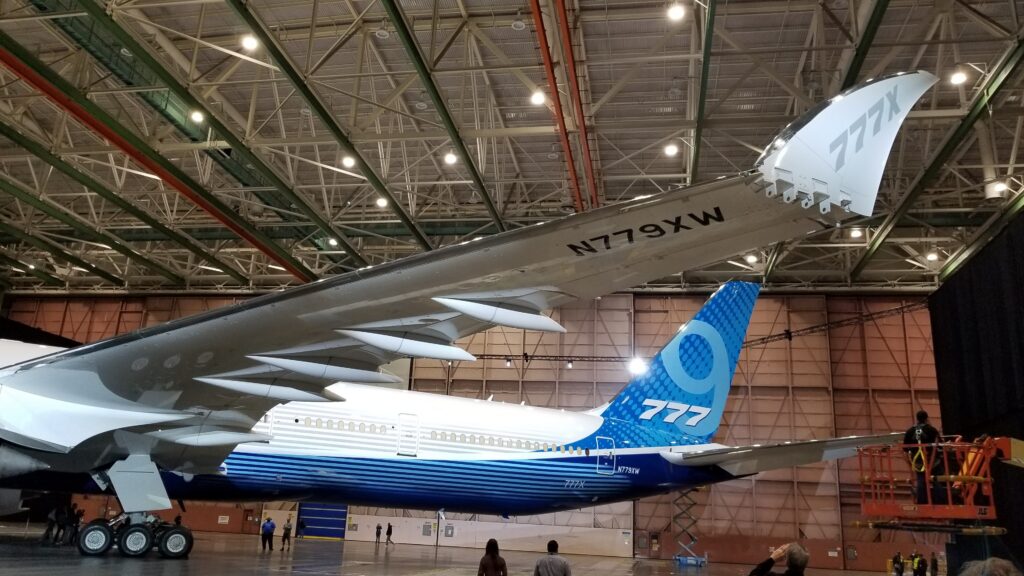
| General Characteristics | |
| Type | Wide-body jet airliner, Civil and Commercial Aircraft |
|---|---|
| National Origin | United States |
| Manufacturer | Boeing |
| Variants | 777-8, 777-9, 777-8F |
| Status | In flight testing (first delivery planned for 2027) |
| First Flight | 25 January 2020 |
| Introduction | Planned for 2027 |
| Primary Users | On order: Emirates, Lufthansa (launch operator), Qatar Airways, Singapore Airlines, Cathay Pacific, British Airways |
| Developed From | Boeing 777-300ER |
| Capacity & Dimensions | |
| Cockpit Crew | Two |
| Typical Seating | 375–450 (two-class, Boeing) |
| Overall Length | 76.72 m (251 ft 9 in) |
| Wing Span | 71.75 m (235 ft 5 in); 64.85 m (212 ft 9 in) with wingtips folded |
| Overall Height | 19.5 m (64 ft 1 in) |
| Weights, Powerplant & Performance | |
| MTOW | 351,534 kg (775,000 lb) |
| OEW | 181,437 kg (400,000 lb) |
| Engines | 2 × GE Aerospace GE9X |
| Max. Thrust | 489 kN (110,000 lbf) each |
| Range | Up to 14,820 km (8,000 nmi) (Boeing) |
The Boeing 777-9 is the larger of the two passenger versions of the 777X, the newest generation of Boeing’s best-selling wide-body. At 76.72 m (251 ft 9 in) it is the longest airliner Boeing has ever built, and it combines the proven 777 fuselage with a completely new carbon-fibre wing, the world’s most powerful jet engine and a feature never seen before on an airliner: wingtips that fold up on the ground. It is designed to replace the 777-300ER and the last four-engine jumbos with 375 to 450 seats in two classes, according to Boeing.
Boeing 777-9 General Characteristics
Boeing launched the 777X at the Dubai Airshow in November 2013 with large orders from Emirates, Qatar Airways and Etihad, after Lufthansa had picked the 777-9 as its launch aircraft in September 2013. Production takes place in Everett, Washington, where Boeing built a dedicated factory for the composite wings. The first 777-9, N779XW, was rolled out in March 2019 and made its first flight on 25 January 2020.
The programme has been slowed by a series of problems: early issues with the GE9X engine, much stricter certification oversight after the 737 MAX accidents, and in August 2024 a grounding of the test fleet after cracks were found in a structural link between an engine and the wing. Testing resumed in January 2025. In October 2025 Boeing said it expected the first delivery, to Lufthansa, in 2027, about seven years later than first planned. The US Federal Aviation Administration then cleared further phases of certification testing, including flights by FAA pilots from mid-2026.
Boeing 777-9 Folding Wingtips
The new wing spans 71.75 m (235 ft 5 in), much wider than the 777-300ER’s, which gives it a high aspect ratio and lower drag. To fit the same airport gates as today’s 777, the outer 3.5 m of each wing folds upwards after landing, reducing the span to 64.85 m (212 ft 9 in). Pilots unfold the tips before take-off, and the system has several locks and cockpit warnings, under special conditions set by the FAA in 2018.
Boeing 777-9 Cabin and Seating
Boeing made the cabin wall thinner, so the 777X cabin is about 10 cm wider inside than the original 777, which helps airlines fit ten seats across in economy. The windows are larger and placed higher, the cabin altitude is lower and the humidity higher, ideas taken from the 787. Boeing quotes 375 to 450 seats in a two-class layout.
Boeing 777-9 Engines and Performance
The two GE Aerospace GE9X engines each produce about 489 kN (110,000 lbf) in service; during testing one GE9X reached a record 134,300 lbf. The fan is 3.4 m (134 in) across, wider than the fuselage of a Boeing 737. Together with the new wing, Boeing expects the 777-9 to burn about 10 per cent less fuel than the 777-300ER and gives a range of up to 14,820 km (8,000 nmi) in its current data (checked 17 November 2026); earlier Boeing figures were 13,500 km (7,285 nmi) with 426 seats. The maximum take-off weight is 351.5 tonnes (775,000 lb).
Operational Role
Emirates is by far the largest customer, and Lufthansa, Qatar Airways, Singapore Airlines, Cathay Pacific, British Airways, Korean Air and others have ordered the aircraft. The 777-9 will take over the role of the 747 and the Airbus A380 on busy long-haul routes, with two engines instead of four.
Frequently Asked Questions
When will the Boeing 777-9 enter service? Boeing said in October 2025 that it expected the first delivery in 2027.
Why does the 777-9 have folding wingtips? So that its very long wing fits the same airport gates as the current 777.
How many seats does the 777-9 have? Boeing quotes 375 to 450 in a two-class layout.
Boeing 777-9 Summary
The 777-9 is Boeing’s answer to the end of the jumbo jet era. Compare it with the Boeing 777-300ER it replaces, the Boeing 747-8 and the Airbus A380.
Start the discussion
Commenting on this aircraft: Boeing 777-9 (777X)