Boeing 787-9
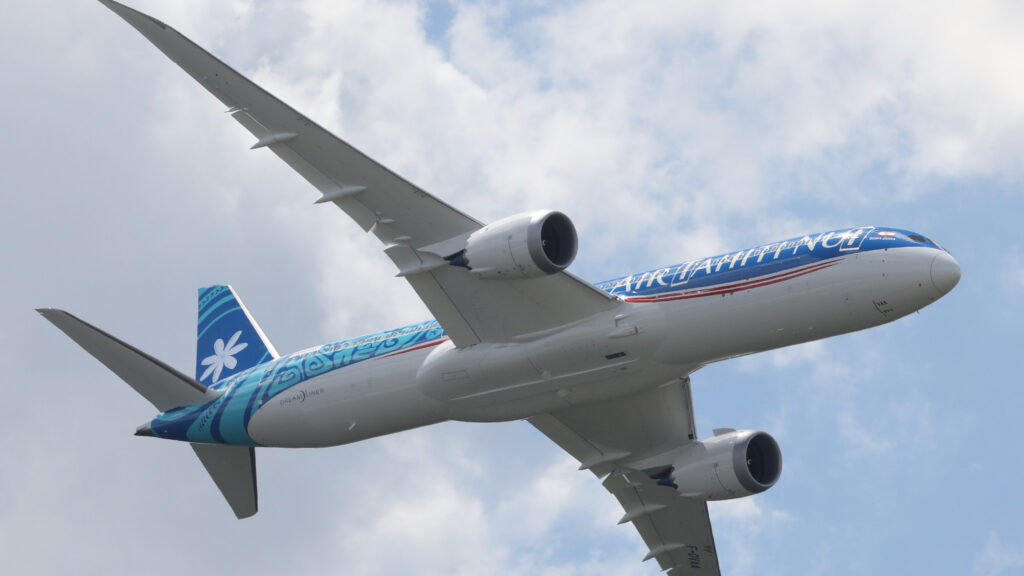
The Boeing 787-9 is the stretched, longer-range version of the 787 Dreamliner. With a carbon-fibre airframe and up to 7,565 nautical miles of range, it is the most popular 787 and a mainstay of long-haul fleets.
| General Characteristics | |
| Type | Wide-body jet airliner, Civil and Commercial Aircraft |
|---|---|
| National Origin | United States |
| Manufacturer | Boeing |
| Variants | 787-8, 787-9, 787-10, BBJ 787 |
| Status | In service |
| First Flight | 17 September 2013 |
| Introduction | 7 August 2014, with All Nippon Airways (launch customer: Air New Zealand) |
| Primary Users | United Airlines, All Nippon Airways, American Airlines, Qatar Airways |
| Number Built | 1,257 787s of all versions (February 2026) |
| Developed From | Boeing 787-8 |
| Capacity & Dimensions | |
| Cockpit Crew | Two |
| Typical Seating | 290–296 (two-class) |
| Max Seating | 420 (exit limit) |
| Overall Length | 62.81 m (206 ft 1 in) |
| Wing Span | 60.12 m (197 ft 3 in) |
| Wing Sweep | 32.2° |
| Wing Area | 377 m² (4,058 sq ft) |
| Overall Height | 17.09 m (56 ft 1 in) |
| Weights, Powerplant & Performance | |
| MTOW | 254,000–259,200 kg (560,000–571,500 lb) |
| OEW | About 128,850 kg (284,000 lb) |
| Fuel Capacity | 126,429 L (33,399 US gal) |
| Engines | 2 × General Electric GEnx-1B or Rolls-Royce Trent 1000 turbofans |
| Max. Thrust | About 316 kN (71,000 lbf) each |
| Typical Cruise Speed | Mach 0.85 (903 km/h, 488 kn) |
| Max. Speed | Mach 0.90 |
| Range | 14,010 km (7,565 nmi) |
| Takeoff Distance | 2,800 m (9,300 ft) |
| Service Ceiling | 43,100 ft (13,100 m) |
The Boeing 787-9 is the most popular version of the 787 Dreamliner, Boeing’s twin-engine long-haul airliner built largely from carbon-fibre composites. It is 6 metres longer than the original 787-8, carries around 290 passengers in two classes and can fly about 7,565 nautical miles. Airlines use it on long, thin routes that once needed a larger four-engine aircraft, such as Perth to London.
Boeing 787-9 General Characteristics
The 787 programme was launched in 2004. The first 787-8 flew in December 2009 and entered service with All Nippon Airways in 2011, after long delays. The stretched 787-9 followed: the prototype made its first flight from Paine Field, Everett, on 17 September 2013. Air New Zealand was the launch customer, and the 787-9 entered commercial service in August 2014. Today it is built in North Charleston, South Carolina.
The family includes the shorter 787-8 and the longer 787-10, which trades range for capacity.
Boeing 787-9 Cabin and Seating
A typical two-class 787-9 seats 290 to 296 passengers, nine abreast in economy. The exit limit is 420. The cabin has the largest windows of any airliner, with electronic dimming instead of shades, and is pressurised to the equivalent of 6,000 ft rather than the usual 8,000 ft, with higher humidity, which many passengers find less tiring on long flights.
Boeing 787-9 Dimensions
The 787-9 is 62.81 m (206 ft 1 in) long, 17.09 m (56 ft 1 in) high and spans 60.12 m (197 ft 3 in). Its long, flexible composite wings, which flex visibly upwards in flight, and its raked wingtips give the aircraft its graceful shape.
Boeing 787-9 Engines and Performance
Customers choose between General Electric GEnx-1B and Rolls-Royce Trent 1000 engines, each rated at around 71,000 lbf (316 kN). The 787 replaces many hydraulic and pneumatic systems with electrical ones and uses a lighter composite structure, which together give about 20 to 25% lower fuel burn than the aircraft it replaces, according to Boeing. It cruises at about Mach 0.85 and has a range of about 14,010 km (7,565 nmi). The maximum take-off weight is up to 259,200 kg (571,500 lb).
Boeing 787-9 Variants and Family
The Dreamliner family has three passenger versions built on the same cockpit, systems and type rating. The original 787-8 seats about 248 passengers in two classes and has the longest range of the family on paper, at about 7,305 nmi (13,530 km). The 787-9 adds about 6 metres and around 50 seats while flying even further, about 7,565 nmi. The 787-10, the longest at 68.3 m, seats about 336 passengers but gives up range, with about 6,330 nmi (11,730 km). Pilots qualified on one version can fly the others, which makes mixed 787 fleets easy for airlines to run. The 787-9 is the sweet spot of the family, and most 787 orders are for this version.
Operational Role
The 787-9 serves long-haul routes of up to about 17 hours. Qantas uses it for non-stop flights between Perth and London, and many airlines use it to open routes between secondary cities that cannot fill a larger aircraft. Major operators include United Airlines, All Nippon Airways, American Airlines and Qatar Airways. The Trent 1000 engines needed repeated inspections and repairs in the late 2010s, which grounded some aircraft for periods.
Frequently Asked Questions
How far can a Boeing 787-9 fly? About 7,565 nautical miles (14,010 km), depending on load.
How many seats does a 787-9 have? Typically 290 to 296 in two classes, up to 420 at the exit limit.
What is the difference between the 787-8 and the 787-9? The 787-9 is about 6 metres longer, carries around 40 more passengers and has a higher take-off weight.
Boeing 787-9 Summary
The 787-9 combines long range, efficiency and passenger comfort, which made it the best-selling Dreamliner. Its closest competitor is the Airbus A350-900. Browse more long-haul airliners in our aircraft database.
Sources
- Boeing, 787 airport compatibility documents and product data
- Air New Zealand and Boeing announcements on the first 787-9 delivery, July 2014
Start the discussion
Commenting on this aircraft: Boeing 787-9