General Dynamics F-16 Fighting Falcon
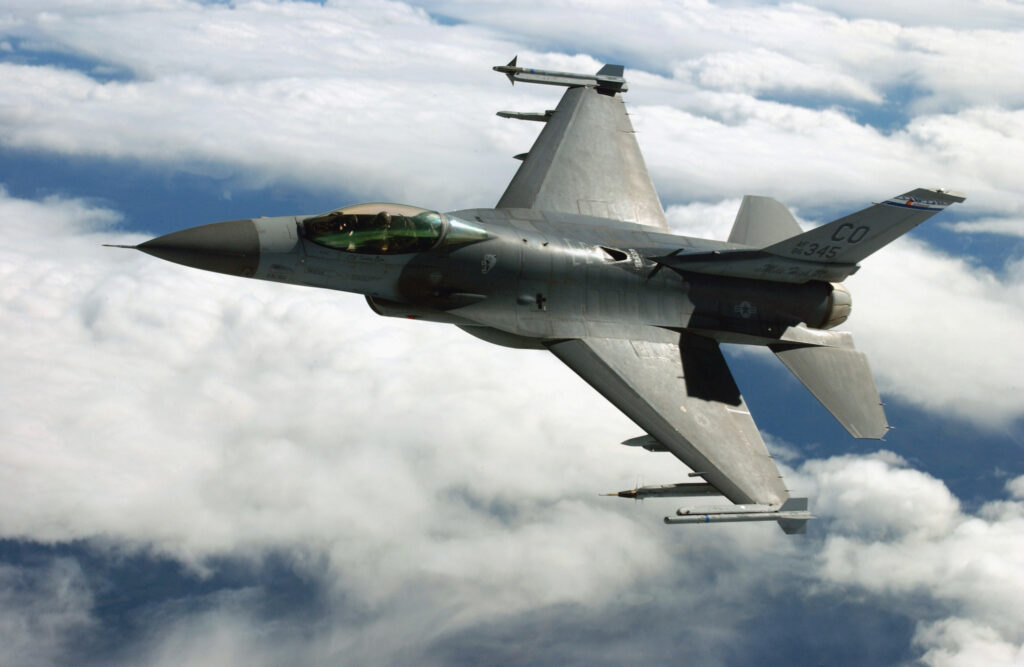
The F-16 Fighting Falcon is a single-engine multirole fighter designed by General Dynamics and now built by Lockheed Martin. More than 4,600 have been built since the 1970s, and it serves with the US Air Force and more than 25 other countries.
| General Characteristics | |
| Type | Military Aircraft, Multirole fighter |
|---|---|
| National Origin | United States |
| Manufacturer | Lockheed Martin |
| Variants | F-16A/B, F-16C/D, F-16E/F Block 60, F-16 Block 70/72 (F-16V) |
| Status | In service; in production as the F-16 Block 70/72 |
| First Flight | 20 January 1974 (unplanned, YF-16); 2 February 1974 (official) |
| Introduction | 17 August 1978 |
| Primary Users | United States Air Force, Turkish Air Force, Israeli Air Force, Egyptian Air Force |
| Number Built | More than 4,600 |
| Developed From | General Dynamics YF-16 |
| Capacity & Dimensions | |
| Cockpit Crew | One (F-16C); two (F-16D) |
| Overall Length | 15.06 m (49 ft 5 in) |
| Wing Span | 9.96 m (32 ft 8 in) |
| Wing Area | 27.87 m² (300 sq ft) |
| Overall Height | 4.88 m (16 ft 0 in) |
| Weights, Powerplant & Performance | |
| MTOW | 19,187 kg (42,300 lb) |
| OEW | 8,573 kg (18,900 lb) |
| Fuel Capacity | 3,175 kg (7,000 lb) internal |
| Engines | 1 × General Electric F110-GE-129 (Block 50) or Pratt & Whitney F100-PW-229 (Block 52) afterburning turbofan |
| Max. Thrust | 131 kN (29,500 lbf) with afterburner (F110-GE-129) |
| Typical Cruise Speed | 933 km/h (504 kn) |
| Max. Speed | Mach 2.05 at 40,000 ft (clean); Mach 1.2 at sea level |
| Range | Combat radius 546 km (295 nmi) on a hi-lo-hi mission with four 1,000 lb bombs; ferry range 4,217 km (2,277 nmi) with three drop tanks |
| Service Ceiling | 15,240 m (50,000 ft) |
The F-16 Fighting Falcon is a single-engine, supersonic multirole fighter designed by General Dynamics and built by Lockheed Martin since the company bought General Dynamics’ aircraft business in 1993. It began as a small, cheap daytime dogfighter and grew into an all-weather strike aircraft, and more than 4,600 have been built. It entered US Air Force service in 1978, is flown by the air forces of more than 25 other countries and is still in production today. Pilots usually call it the “Viper”.
From Lightweight Fighter to Air Combat Fighter
The F-16 came out of the US Air Force’s Lightweight Fighter programme of the early 1970s, pushed by a group of officers and analysts who believed a small, agile fighter would win more air battles than heavy, expensive designs. General Dynamics’ YF-16 and Northrop’s YF-17 were chosen for a fly-off. The YF-16’s first flight was an accident: during a high-speed taxi test at Edwards Air Force Base on 20 January 1974, a roll oscillation made a wingtip missile and a tailplane scrape the runway, and test pilot Phil Oestricher lifted off to avoid a crash. The official first flight followed on 2 February 1974.
The programme then became the Air Combat Fighter competition, with four NATO countries, Belgium, Denmark, the Netherlands and Norway, looking for an F-104 Starfighter replacement. On 13 January 1975 the Air Force chose the YF-16, citing its lower operating costs, longer range and better manoeuvring, and the use of the same Pratt & Whitney F100 engine as the F-15. The four European nations ordered it soon afterwards and built parts and aircraft at home. The US Air Force accepted its first production F-16A on 17 August 1978, and the type became operational with the 34th Tactical Fighter Squadron of the 388th Tactical Fighter Wing at Hill Air Force Base, Utah, on 1 October 1980.
Design
The F-16 introduced several ideas that became common in later fighters. It was one of the first combat aircraft designed with relaxed static stability, meaning it is slightly unstable in pitch and relies on a fly-by-wire flight control computer to keep it under control. This makes it more agile and reduces drag. The pilot flies with a side-stick on the right console rather than a centre stick, sits in a seat reclined 30 degrees to tolerate high g-forces better, and looks out through a one-piece bubble canopy with an excellent all-round view. The airframe is rated for 9 g.
The wing blends smoothly into the fuselage, which adds lift and internal volume, and the engine is fed through a single intake under the fuselage. Armament includes an internal 20 mm M61A1 Vulcan rotary cannon and 11 stations for missiles, bombs, fuel tanks and sensor pods, carrying up to about 7,700 kg (17,000 lb) of stores.
Variants
- F-16A/B: the original single-seat and two-seat models with the APG-66 radar.
- F-16C/D: from 1984, with a new cockpit, the APG-68 radar and, from Block 30, a choice of General Electric F110 or Pratt & Whitney F100 engines. The figures on this page are for the Block 50/52 versions.
- F-16E/F Block 60: developed for the United Arab Emirates, with conformal fuel tanks and an AESA radar.
- F-16 Block 70/72 (F-16V): the current production model, with an AESA radar, a new cockpit display and an extended structural life. Production moved from Fort Worth, Texas, to Greenville, South Carolina, and the first new aircraft left the Greenville line in 2023.
Many older F-16s have been upgraded to the F-16V standard.
Operational Service
F-16s have flown combat missions in the 1991 Gulf War, the Balkans, Afghanistan, Iraq, Syria and Libya, and they have seen extensive combat with Israel, Pakistan and, more recently, Ukraine. Turkey operates one of the largest fleets, many of them built under licence by TUSAŞ (Turkish Aerospace) in Ankara. In the US Air Force the F-16 is also flown by the Thunderbirds demonstration team. Several countries are now replacing older F-16s with the F-35, while others are buying new Block 70s or upgrading their fleets to keep them flying into the 2040s.
Specifications (F-16C Block 50/52)
The F-16C is 15.06 m (49 ft 5 in) long with a span of 9.96 m (32 ft 8 in). With an F110-GE-129 engine producing 131 kN (29,500 lbf) with afterburner, it reaches Mach 2.05 at altitude and climbs to 15,240 m (50,000 ft). Its swept wing and blended body are optimised for manoeuvring rather than endurance, and like most fighters the F-16 trades range for agility: its combat radius on a typical strike mission is about 546 km (295 nmi).
Sources
- US Air Force fact sheet: F-16 Fighting Falcon
- Lockheed Martin: F-16 Block 70/72
- Wikipedia: General Dynamics F-16 Fighting Falcon (used to check dates and specifications)
Start the discussion
Commenting on this aircraft: General Dynamics F-16 Fighting Falcon