Swept Wing Explained: Why Jet Wings Angle Backwards
Almost every jet airliner has a swept wing. Angling the wing backwards lets the aircraft fly closer to the speed of sound before shock waves and steep drag rise set in.
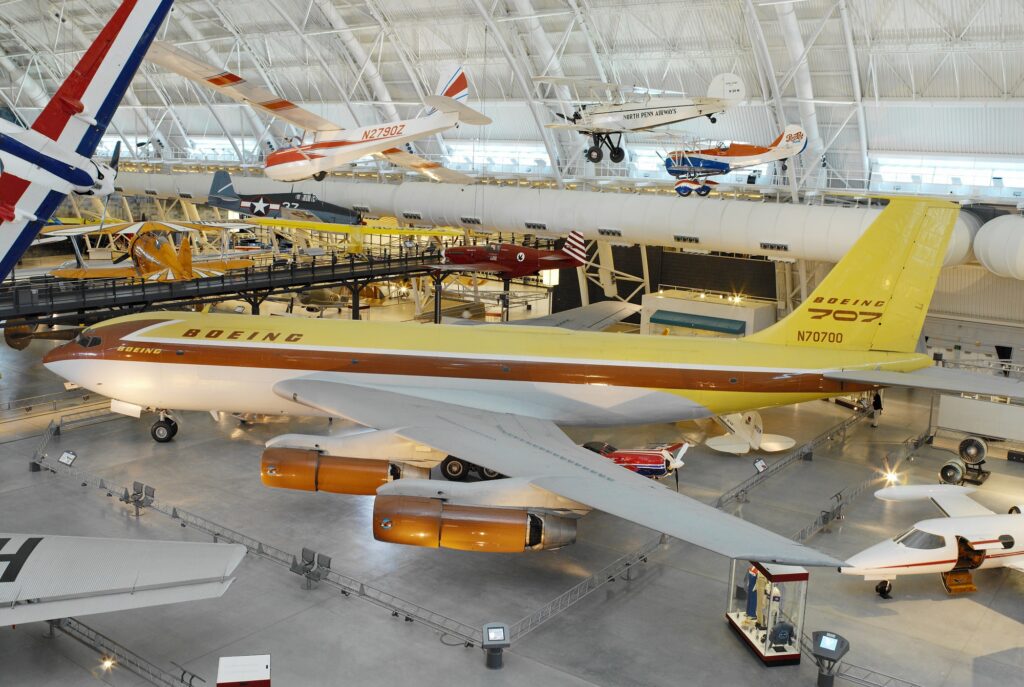
A swept wing is a wing that angles backwards (or, rarely, forwards) from the fuselage instead of sticking straight out. The sweep angle is usually measured along the line one quarter of the way back from the leading edge. Sweep delays the formation of shock waves, so a swept-wing aircraft can fly faster before drag rises steeply.
How sweepback works
On a swept wing, the airflow meets the leading edge at an angle. Only the component of the airflow at right angles to the leading edge is accelerated over the wing; the part flowing along the span has little effect on lift or shock formation. The wing therefore “feels” a lower Mach number than the aircraft is flying at, which raises its critical Mach number. German researchers studied the idea in the 1930s and 1940s, and after the war it was adopted for aircraft such as the North American F-86 Sabre and the Boeing B-47 Stratojet.
Downsides of sweep
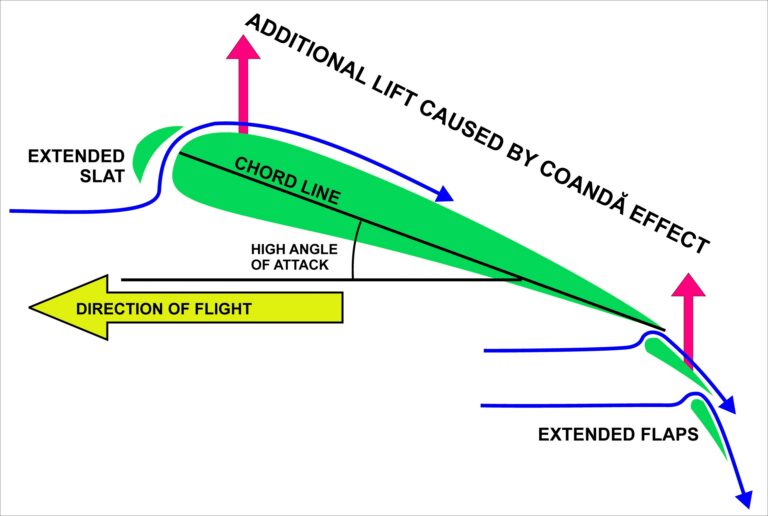
Sweep has costs. A swept wing makes less lift at low speed, so swept-wing airliners need powerful flaps and slats. Air tends to flow outwards along the span, so the wingtips can stall first, causing the nose to pitch up; designers counter this with twist, wing fences, vortex generators and careful aerofoil design. Swept wings also make aircraft more prone to Dutch roll, which is why airliners have yaw dampers.
Where you see it
The Boeing 707, whose prototype, the 367-80, flew in 1954, set the pattern of the swept-wing jet airliner, with about 35 degrees of sweep. Today, the Airbus A320 has a sweep of 25 degrees and the Boeing 787 about 32 degrees. Some military aircraft, such as the F-14 and Tornado, have variable-sweep wings that can move forward for slow flight and back for high speed.
Why it matters
Without swept wings, airliners would have to cruise much more slowly or burn much more fuel. Sweep is a compromise between high-speed efficiency and good low-speed handling, and every jet design balances the two.
Forward sweep
A few aircraft have wings swept forward instead of back, such as the Grumman X-29 research aircraft and the HFB 320 Hansa Jet business jet. Forward sweep makes the wing root stall first, which keeps the ailerons effective, but the wing tends to twist under load, so it needs a very stiff structure.
Frequently Asked Questions
Why are airliner wings swept back? To delay shock waves and drag rise so the aircraft can cruise near Mach 0.8.
Do propeller aircraft need swept wings? Usually not, because they fly too slowly for compressibility effects to matter.
What is the sweep angle of an A320 wing? About 25 degrees.
References
- FAA Pilot’s Handbook of Aeronautical Knowledge (FAA-H-8083-25), chapters 5 (Aerodynamics of Flight) and 6 (Flight Controls)
- NASA Glenn Research Center, Beginner’s Guide to Aeronautics: Wing geometry
Start the discussion
Commenting on this term: Swept Wing Explained: Why Jet Wings Angle Backwards