Lockheed Martin F-35 Lightning II
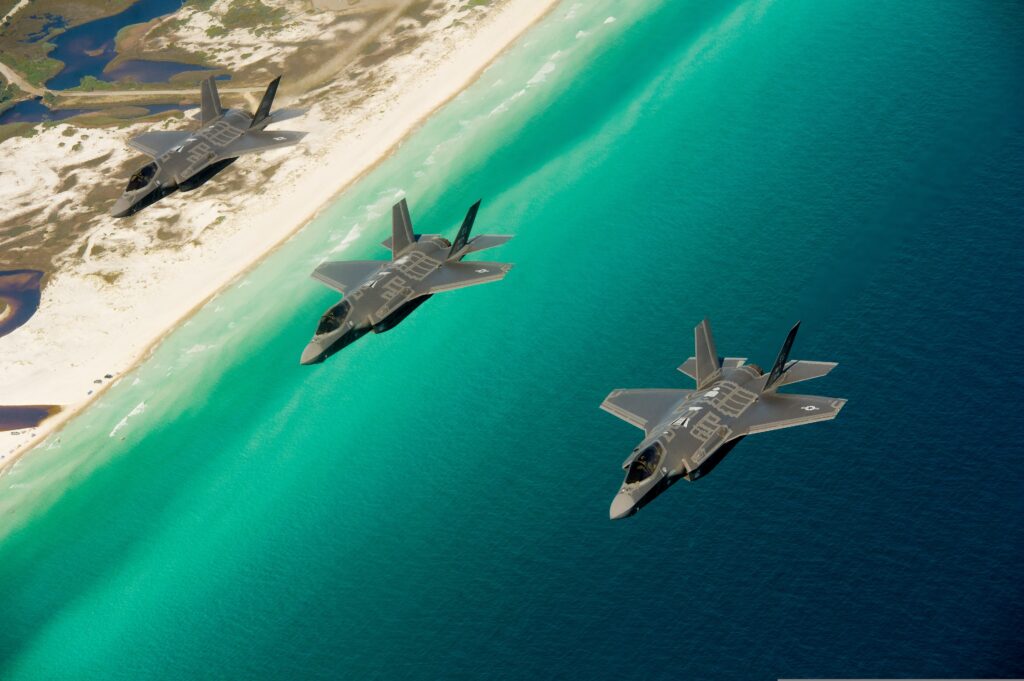
The Lockheed Martin F-35 Lightning II is a single-engine stealth fighter built in three versions: the F-35A for runways, the short take-off and vertical landing F-35B and the carrier-based F-35C. It first flew in 2006 and is flown by the US and many allies.
| General Characteristics | |
| Type | Military Aircraft, Multirole fighter |
|---|---|
| National Origin | United States |
| Manufacturer | Lockheed Martin |
| Variants | F-35A (conventional take-off), F-35B (short take-off and vertical landing), F-35C (carrier), F-35I (Israel) |
| Status | In production and service |
| First Flight | 15 December 2006 (F-35A) |
| Introduction | 31 July 2015 (F-35B, US Marine Corps); 2 August 2016 (F-35A, US Air Force) |
| Primary Users | US Air Force, US Marine Corps, US Navy, Royal Air Force / Royal Navy, Israeli Air Force, Royal Australian Air Force |
| Number Built | More than 1,000 |
| Developed From | Lockheed Martin X-35 |
| Capacity & Dimensions | |
| Cockpit Crew | One |
| Overall Length | 15.7 m (51 ft 5 in) (F-35A) |
| Wing Span | 10.7 m (35 ft) (F-35A) |
| Wing Area | 42.7 m² (460 sq ft) (F-35A) |
| Overall Height | 4.38 m (14 ft 4 in) (F-35A) |
| Weights, Powerplant & Performance | |
| MTOW | 29,900 kg (65,900 lb) (F-35A) |
| OEW | 13,290 kg (29,300 lb) (F-35A) |
| Fuel Capacity | 8,280 kg (18,250 lb) internal (F-35A) |
| Engines | 1 × Pratt & Whitney F135 afterburning turbofan |
| Max. Thrust | 125 kN (28,000 lbf) dry; 191 kN (43,000 lbf) with afterburner |
| Max. Speed | Mach 1.6 at high altitude |
| Range | 2,780 km (1,500 nmi) on internal fuel (F-35A) |
| Service Ceiling | 15,240 m (50,000 ft) |
The Lockheed Martin F-35 Lightning II is a single-seat, single-engine stealth fighter designed to replace several older combat aircraft at once, including the F-16 Fighting Falcon, the F/A-18 Hornet and the AV-8B Harrier. It is built in three main versions that share most of their design: the conventional F-35A, the short take-off and vertical landing F-35B, and the carrier-based F-35C. The first F-35A flew on 15 December 2006, and more than 1,000 have since been built for the United States and its allies, making it the most numerous stealth aircraft in the world.
The Joint Strike Fighter
The F-35 comes from the US Joint Strike Fighter (JSF) programme of the 1990s, which aimed to build one affordable family of aircraft for the US Air Force, Navy and Marine Corps. Lockheed Martin’s X-35 demonstrator beat Boeing’s X-32 in October 2001. Lockheed Martin leads the programme, with Northrop Grumman and BAE Systems as major partners, and a group of allied countries helped fund development, including the United Kingdom, Italy, the Netherlands, Australia, Canada, Denmark and Norway. Turkey was also a partner and built parts for the aircraft, but was removed from the programme in 2019.
Three Versions
- F-35A: takes off and lands on normal runways, carries an internal 25 mm cannon and is the most common version, flown by the US Air Force and most export customers.
- F-35B: can take off from short decks and land vertically. A shaft from the engine drives a large lift fan behind the cockpit, while the rear nozzle swivels downwards. It is flown by the US Marine Corps, the UK, Italy and Japan, and it was the first version to enter service, in July 2015.
- F-35C: has larger wings and a stronger landing gear and tail hook for catapult launches and arrested landings on US Navy aircraft carriers.
How Stealth Works
The F-35 is shaped and coated to reflect as little radar energy as possible back to the radar that sent it. Its weapons, fuel and sensors are carried inside the airframe; weapons sit in internal bays, and only when stealth is less important are extra weapons hung under the wings. The aircraft also combines data from its own radar, infrared cameras and electronic sensors with data from other aircraft, and shows the result to the pilot as a single picture. The pilot wears a helmet that projects flight data and sensor images directly in front of the eyes, so he or she can even “look through” the floor of the aircraft. The flight controls are fully fly-by-wire.
Engine and Performance
All versions use one Pratt & Whitney F135 afterburning turbofan, among the most powerful fighter engines ever built, with about 191 kN (43,000 lbf) of thrust with afterburner in the F-35A. The F-35A can reach Mach 1.6, pull 9 g and carry up to about 8,200 kg (18,000 lb) of weapons in total. On internal fuel its combat radius is about 1,240 km (669 nmi) on a typical strike mission.
Cost and Criticism
The F-35 is the most expensive weapons programme in history. Development took longer than planned, and the aircraft has been criticised for its cost to operate per flight hour, software problems and the availability of spare parts. Supporters point out that the price of each aircraft fell as production rose, and that the F-35 brings stealth and sensor capabilities that older fighters cannot add.
Operators
The F-35 is flown by the US Air Force, Navy and Marine Corps, the UK, Italy, the Netherlands, Norway, Denmark, Australia, Japan, South Korea, Israel (as the modified F-35I Adir), Belgium and Poland, among others. More countries, including Switzerland, Finland, Germany, the Czech Republic, Romania, Greece and Singapore, have ordered it, which means it will be one of the most widely used fighters in the world for decades.
Sources
- Lockheed Martin: F-35 Lightning II
- US Air Force fact sheet: F-35A Lightning II
- Wikipedia: Lockheed Martin F-35 Lightning II (used to check dates and specifications)
Start the discussion
Commenting on this aircraft: Lockheed Martin F-35 Lightning II