








Last Updated: 4 months ago
How the F-16 Fly-By-Wire System Changed Fighter Aircraft Control
Introduction to the F-16 Fly-By-Wire System
General Dynamics F-16 Fighting Falcon is one of the most influential fighter aircraft ever developed. In particular, one of the key technologies that made this aircraft revolutionary is the F-16 Fly-By-Wire System.
Unlike traditional aircraft, where pilot inputs move mechanical cables connected to the control surfaces, the F-16 Fly-By-Wire System translates pilot inputs into electronic signals processed by flight control computers. As a result, the aircraft becomes lighter and more maneuverable.
In addition, the digital control system allows engineers to design the aircraft with improved aerodynamic performance. Therefore, the F-16 can achieve higher agility compared to many earlier fighter aircraft.
What Is the F-16 Fly-By-Wire System?
The F-16 Fly-By-Wire System replaces traditional mechanical control systems with digital flight control computers.
In a conventional aircraft, the process works as follows:
- The pilot moves the control stick.
- Mechanical cables and rods move the control surfaces.
However, the process is very different in the F-16 Fly-By-Wire System:
- The pilot applies force to the control stick.
- Sensors detect the force input.
- Flight control computers calculate the required response.
- Electrical signals command hydraulic actuators to move the control surfaces.
Therefore, the aircraft can respond faster and more precisely to pilot commands.
You can learn more about fly-by-wire technology here:
https://www.nasa.gov/aeronautics
Why the F-16 Needed the Fly-By-Wire System
The F-16 Fly-By-Wire System was necessary because the aircraft was designed with relaxed static stability.
In other words, the aircraft is intentionally slightly unstable. However, this instability actually improves maneuverability and responsiveness in combat situations.
Therefore, the aircraft requires continuous computer corrections during flight. Consequently, the fly-by-wire system makes adjustments many times per second to maintain stable flight.
In other words, the aircraft is intentionally slightly unstable in order to improve:
- maneuverability
- responsiveness
- combat performance
However, such an aircraft cannot be flown safely without computers constantly stabilizing it. Therefore, the F-16 Fly-By-Wire System makes continuous adjustments many times per second to maintain stable flight.
More technical background can be found here:
https://www.lockheedmartin.com
The Unique Side-Stick Controller in the F-16 Fly-By-Wire System
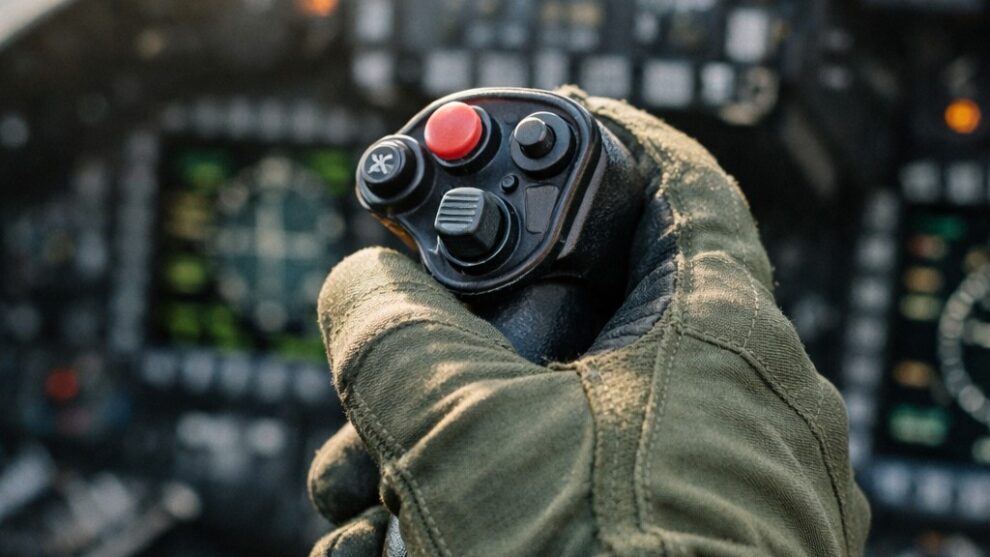
Another important feature of the F-16 Fly-By-Wire System is the side-stick controller.
Instead of a traditional center control stick, the F-16 places the control stick on the right side of the cockpit. This design also improves cockpit ergonomics and pilot visibility.
The stick is primarily force-sensing rather than displacement-based.
For example, typical inputs include:
- Roll command: approximately 17–25 pounds of force
- Pitch command: approximately 10–15 pounds of force
As a result, the F-16 Fly-By-Wire System interprets these forces and converts them into precise control surface movements.
The Early Rigid Stick Problem
Initially, when engineers tested the F-16 Fly-By-Wire System, the side-stick controller was almost completely rigid.
While this allowed precise measurement of pilot inputs, pilots reported that the stick felt unnatural and disconnected. Consequently, many pilots felt they lacked the tactile feedback normally present in traditional aircraft controls.
Therefore, this issue highlighted the importance of human factors engineering.
The Solution: Artificial Feedback and Minimal Movement
To solve this problem, engineers modified the F-16 Fly-By-Wire System.
They introduced:
- small stick displacement
- spring-based artificial feel systems
- improved force feedback
Although the stick still measures force rather than displacement, the small movement provides a more natural sense of control for pilots.
Human Factors in the F-16 Fly-By-Wire System
The design of the F-16 Fly-By-Wire System shows that aerospace engineering must consider more than physics and electronics.
In addition, designers must account for human perception.
Aircraft designers must consider:
- pilot sensory feedback
- muscle memory
- control ergonomics
- cognitive workload
By balancing these factors, engineers ensure both safety and operational effectiveness.
Conclusion: Why the F-16 Fly-By-Wire System Still Matters
The F-16 Fly-By-Wire System fundamentally changed the way fighter aircraft are controlled.
By replacing mechanical control systems with digital flight computers, engineers enabled a new generation of aircraft capable of extreme agility and performance.
Today, fly-by-wire systems inspired by the F-16 Fly-By-Wire System are used in modern fighter jets and commercial aircraft worldwide.
Therefore, the F-16 remains one of the most important milestones in the history of aviation engineering.