







Last Updated: 4 months ago
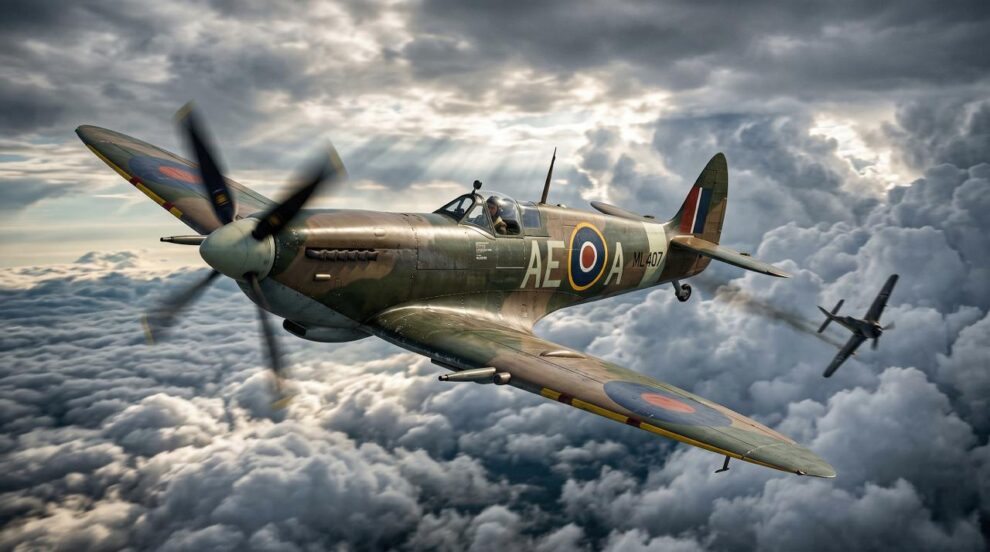
The Supermarine Spitfire Mk 9 is one of the most iconic and strategically critical aircraft of World War II in aviation history. British engineers initially designed this model as a temporary “stop-gap” solution. However, the aircraft eventually evolved into a permanent engineering marvel that changed the course of the war. Aviation experts consider the aerodynamic structure and mass production processes of this aircraft an industrial revolution. R.J. Mitchell created the vision for this legendary fighter plane. Subsequently, Joseph Smith took over the project and achieved technical perfection. This report examines the technical specifications, automation-focused production stages, and combat performance of the Supermarine Spitfire Mk 9 model based on available data.
Design Origins and Historical Development Process
The history of aviation engineering holds innovative solutions born during moments of crisis. The development of the Spitfire series clearly demonstrates this rule. The British Air Ministry issued a modern fighter specification in the early 1930s. This process laid the foundation for the legendary design
R.J. Mitchell, the K5054 Prototype, and First Steps
R.J. Mitchell, chief designer at Supermarine Aviation Works, initially designed the Type 224 model. However, this biplane-style design lost the contract to the Gloster Gladiator. Nevertheless, Mitchell did not give up. He and his team began working on a new design codenamed Type 300. The company named this new aircraft the K5054 prototype. The plane made its first flight at Eastleigh on March 5, 1936.
Chief test pilot Joseph “Mutt” Summers successfully tested this prototype. The prototype reached much higher speeds than contemporary aircraft like the Hawker Hurricane, thanks to its thin-section elliptical wing structure and flush riveting technology. R.J. Mitchell passed away from cancer in 1937. Afterward, his colleague Joseph Smith took over the role of chief designer. Smith successfully managed the entire development process of the aircraft from the Mk I version to the Mk 24 version.
The Focke-Wulf Fw 190 Threat and Emergency Engineering Solution
The Royal Air Force (RAF) faced a new threat in the skies over Northwest Europe in the autumn of 1941. The German Focke-Wulf Fw 190 (Butcher Bird) fighter plane established a serious superiority over British aircraft. The German aircraft carried four 20 mm cannons and two 7.9 mm heavy machine guns. Additionally, the plane possessed a massive roll rate and acceleration capacity.
At that time, Spitfire Mk V aircraft formed the backbone of the RAF fleet. However, the Mk V series experienced a massive disadvantage against the Fw 190. For instance, in June 1942, Fw 190s shot down fifteen Mk V models without suffering any losses. Similarly, they inflicted heavy casualties against Fw 190s during the Dieppe Raid (Operation Jubilee) in August.
Consequently, British engineers had to find an immediate solution. Rolls-Royce engineers were already working on the two-stage supercharged Merlin 61 engine. Mechanics integrated the new engine into the existing Mk Vc airframe. The government created the Supermarine Spitfire Mk 9 model through this modification. This combined design allowed RAF pilots to fight the Fw 190 on equal terms.
Technical Specifications and Aerodynamic Structure
In terms of aviation science, the Supermarine Spitfire Mk 9 represents a flawless synthesis of engine power and aerodynamic structure. Designers continuously modified the aircraft to meet various operational requirements.
Dimensions, Weight, and Aerodynamic Profile
The standard physical and operational characteristics of the aircraft show minor variations depending on the variants coming off the production line. When experts analyze the data, they see that the aircraft has a high power-to-weight ratio.
The following table summarizes the basic technical specifications of the aircraft:
| Technical Specification | Value / Capacity |
| Wingspan | 36 ft 10 in (Normal) / 32 ft 7 in (Clipped) |
| Length | 31 ft 1 in / 29 ft 11 in |
| Height | 9 ft 11 in |
| Empty Weight | 5,000 lbs – 5,634 lbs (2,556 kg) |
| Max Takeoff Weight | 6,418 lbs – 9,500 lbs (4,309 kg) |
| Maximum Speed | 408 mph – 440 mph |
| Cruising Speed | 324 mph |
| Range | 434 miles (Internal) – 1,600 miles |
| Service Ceiling | 36,500 ft – 43,000 ft |
Engineers standardly used the elliptical wing shape to maintain the aerodynamic profile of the aircraft. On the other hand, they applied a “clipped wing” modification on some models to maneuver faster at low altitudes. This process increased the roll capability of the aircraft.
Engine Variations: Rolls-Royce Merlin Series
Engine integration forms the foundation of the aircraft’s operational power. During the later years of the war, engineers developed special engine types optimized for different altitude missions.
First, they produced the F (Fighter) variant (Merlin 63) optimized for medium altitude missions. They mostly used this engine in models with standard wingtips. Second, they produced the LF (Low-altitude Fighter) variant (Merlin 66) for low altitude missions. Designers adjusted the supercharger gearing of the Merlin 66 engine to provide maximum performance at low heights. Finally, they developed the HF (High-altitude Fighter) variant (Merlin 70) for high altitude missions. The second-stage supercharger of the Merlin 70 engine kicked in at much higher altitudes. This situation gave the aircraft an extra 13 km/h speed at high altitudes. Furthermore, the United States-based Packard company produced the licensed Merlin 266 engine. The British named the variants using this engine Mk XVI.
Aerodynamic Modifications and Improvements
Significant physical changes occurred during the early production processes of the Supermarine Spitfire Mk 9 model. Designers changed the elevator shape by adding a larger horn balance and a “kinked” cutout line. Additionally, the tail wheel received a new system that allowed it to swivel while the leg remained inline with the fuselage. Furthermore, engineers extended the vertical tail (fin) tip of the aircraft based on the Griffon-powered Mk XII design. Intercooler and oil cooler radiators placed under both wings of the aircraft gave it a symmetrical appearance when viewed head-on.
The 150 Octane Fuel Revolution and Engine Performance
Industrial competition also led to massive leaps in chemistry and fuel technology. Between 1942 and 1943, British chemists tested much more powerful alternatives instead of the standard 100/130 octane aviation fuel.
Increasing Boost Pressure and Test Processes
Rolls-Royce engineers conducted tests on the Mk 9 with the new fuel at the Hucknall facilities in October 1943.Analyses showed that the new 150 octane (100/150 grade) fuel formula (Specification RDE/F/253) allowed the manifold boost pressure to be increased from +18 lb/sq.in to +25 lb/sq.in.
This pressure increase was a relatively simple procedure applied without the need for major modifications to engine components. The Aeroplane and Armament Experimental Establishment (A. & A.E.E.) at Boscombe Down tested a Merlin 66 engine in November 1943. During the tests, the team cleared the engine for maximum 5-minute combat operations with +25 lb boost pressure.
Supermarine Spitfire Mk 9 Performance Outputs and Climb Data
The integration of 150 octane fuel into the engine by engineers drastically changed the flight dynamics of the aircraft. Researchers documented very clear aerodynamic gains as a result of official tests. The aircraft achieved an increase of approximately 30 mph (48 km/h) in level flight speed at levels below full throttle heights. Moreover, experts observed a massive climb rate increase of about 950 ft/min.
With radiator flaps open, the climb rate at sea level in M.S. (Medium Supercharged) gear reached 5,080 feet per minute. In F.S. (Full Supercharged) gear, this value was 4,335 ft/min. During level speed measurements, the team recorded a true airspeed (TAS) of 364 mph at 2,800 feet with M.S. gear, and 389 mph at 13,800 feet with F.S. gear. On the other hand, this high-pressure operating system increased the engine’s fuel consumption by approximately 24%.Utilizing a Rotol 4-blade wooden propeller, the aircraft transformed into an excellent interceptor fighter with this update.
Table: Spitfire Mk 9 Climb and Altitude Speed Test Data (Merlin 66, +25 lb Boost, 150 Octane
| Test Parameter | Gear Status | Radiator Status | Achieved Speed / Climb Rate | Reference Altitude |
| Max. Climb Rate | M.S. Gear (Medium) | Open | 5,080 ft/min | Sea Level (500 ft) |
| Max. Climb Rate | F.S. Gear (Full) | Open | 4,335 ft/min | 11,400 ft |
| Max. Climb Rate | F.S. Gear (Full) | Closed | 4,750 ft/min | 11,400 ft |
| Max. Level Flight Speed | M.S. Gear (Medium) | – | 364 mph | 2,800 ft |
| Max. Level Flight Speed | F.S. Gear (Full) | – | 389 mph | 13,800 ft |
| Estimated Improvement | All Gears | – | +950 ft/min (Climb) | Overall Test Value |
| Estimated Speed Increase | All Gears | – | +30 mph (Speed) | Overall Te |
Supermarine Spitfire Mk 9 Wing Types and Armament Systems
The Supermarine Spitfire Mk 9 utilized universal wing designs that adapted to different armament configurations to respond to tactical needs on the battlefield. This standardization greatly facilitated mechanical repair processes on the front lines.
C Wing (Universal Wing) Configuration
Unlike previous models, the “C” wing structure allowed engineers to flexibly change armament combinations in the field. Mechanics could easily integrate the old “A” wing (eight Browning machine guns) or “B” wing (mixed cannon and machine gun) layouts into this new wing.
Designers mounted two Hispano 20mm cannons on the inboard section of the C wing, near the wheel wells. The team supported these cannons with a belt-fed ammunition system carrying 120 rounds per gun, which doubled the capacity of the drum-fed system found in the “B” wing. Additionally, they placed four 0.303 caliber Browning machine guns on the outboard section of the wing.
E Wing and Increased Firepower
During the later years of the war, engineers took the firepower of the aircraft to a much more devastating level with the E wing configuration. They integrated the 0.50 caliber Browning machine guns, which were also found in the American-made P-51 Mustang aircraft, into the system.
In the E wing layout, experts moved the 20mm Hispano cannon to the outboard position while placing the heavier 0.50 caliber Browning machine gun in the inboard position. Consequently, they did not use machine guns on the outer section and covered the old slots. Engineers increased the capacity of the 20mm cannons to 140 rounds per gun on the E wing. Additionally, they used advanced electronic sighting systems such as the Gyro Gun Sight (GGS) Mk IID on some models. Therefore, the strike precision of the pilots increased significantly.
Industrial Production Processes and Standardization
In aviation science, getting an aircraft off the mass production line without losses is as critical an engineering success as designing it perfectly. Despite being a small enterprise, Supermarine created a massive production miracle. The “Shadow Factories” project played a key role in this process.
Shadow Factories and Castle Bromwich
The British government launched the “Shadow Factories” plan in 1935 to prevent the collapse of aircraft production in the event of a possible war. Project managers aimed to transfer the mass production techniques of the automotive industry to the aviation industry (technology transfer). The government appointed Herbert Austin to manage the project.
Under the management of Lord Nuffield (owner of Morris Motors), the team built a massive factory over agricultural land and a sewage treatment plant in Castle Bromwich near Birmingham. Construction and the start of production were quite difficult due to union issues and skilled worker strikes. However, the Air Ministry took direct control and resolved the problems. The Castle Bromwich Aeroplane Factory employed approximately 12,000 workers. Workers mass-produced the vast majority of Spitfire and Seafire variants at this facility between 1940 and 1946.
Distributed Production Network and Workforce Management
German Luftwaffe aircraft bombed and destroyed the main Woolston and Itchen factories in Southampton in 1940.Following this, Minister of Aircraft Production Lord Beaverbrook ordered an immediate “dispersal scheme”.
Authorities secretly distributed production lines across counties such as Berkshire, Hampshire, and Wiltshire. In this context, they used bus depots, workshops, and even hotels as assembly lines. For example, a garage in Reading specialized in fuselage manufacturing, while another garage in Salisbury solely produced parts. The company relocated the Supermarine Headquarters to Hursley Park mansion southwest of Winchester.
The greatest industrial success of this system was overcoming the lack of skilled labor (deskilling). Managers delegated tasks not requiring heavy skills to young men and female workers thanks to automation and part standardization acquired from the automotive industry. Female workers successfully completed delicate processes such as sewing and doping (varnishing) aircraft rudders in sections known as the “Dope Room”.
Cost Analysis and Supermarine Spitfire Mk 9 Fund Campaigns
When the government placed the first order for 310 Supermarine Spitfires in 1936, they set the estimated cost per aircraft at £1,395,000 total (around £4,500 each). However, with delays, this price rose to approximately £9,500. The cost breakdown of the manufactured components was as follows:
- Hand-fabricated fuselage: £2,500
- Rolls-Royce Merlin Engine: £2,000
- Wing set: £1,800
- Guns and landing gears: £800 (each)
- Propeller: £350
Government officials launched the Spitfire Fund to cover the costs. During the campaign, they presented the nominal cost of the aircraft as £5,000. While the state of Uruguay donated for 17 aircraft, regions like Trinidad, the Gold Coast, and Hong Kong funded entire squadrons. Factories produced a total of over 20,351 Spitfires. Workers manufactured between 5,665 and 5,739 units of the Mk 9 variant, making it the second most produced model.
Supermarine Spitfire Mk 9: Combat Performance and Tactical Superiority
The Supermarine Spitfire Mk 9 is a ruthless weapon of war rather than merely a technical achievement. The performance the aircraft displayed against its rivals on the battlefield fully proves its historical value.
Focke-Wulf Fw 190 Comparison and Dogfight Dynamics
Air battles between Allied forces and German forces severely tested the dynamics of the aircraft. According to official intelligence and “Boscombe Down” tests published by researchers, the Spitfire Mk 9 and Fw 190A had advantages in different disciplines.
The German Fw 190A aircraft was far superior to the Mk 9 in terms of roll rate and overall maneuverability. An Fw 190 pilot could escape from a Spitfire by executing a sudden “flick-roll” in the opposite direction of the angle of attack and then diving rapidly. Commanders instructed allied pilots to be particularly cautious of this maneuver. Furthermore, up to 20,000 feet altitude, the climb performance of both aircraft was approximately equal.
On the other hand, when it came to the turning circle, the Supermarine Spitfire Mk 9 established an absolute superiority. Thanks to its tight turning radius, the Spitfire could get inside the Fw 190A in a dogfight to make the killing shot. Consequently, experienced Luftwaffe pilots strictly avoided engaging in turn fights with the Spitfire.
Supermarine Spitfire Mk 9 Kill-to-Loss Ratios
The most objective metric measuring the combat performance of a fighter plane is the kill-to-loss ratio. When military historians analyze RAF statistics, they see that the aircraft had a fantastic score. In official records, the aircraft has an air-to-air Kill-to-Loss Ratio of 5.00 (calculated over 42 confirmed kills). For comparison, the Mk V model achieved a ratio of 4.88, while the Mk VIII model reached 9.88. This statistic is clear data proving the model’s air superiority.
MJ730: A Historic Supermarine Spitfire Mk 9 Profile
Among the thousands of airframes produced by engineers, certain individual airframes stand out with their unique combat histories. The Supermarine Spitfire Mk IXe with tail number MJ730, located at the Military Aviation Museum, is one of the best living proofs of this history.
Operational History, Squadrons, and “The Question Mark”
Workers built this aircraft at the Castle Bromwich factory, and chief test pilot Alex Henshaw tested it on December 10, 1943. Later, authorities shipped the aircraft to Casablanca, Morocco, via the S.S. Leeds City. Pilots participated in over 100 combat missions with this aircraft throughout World War II.
First, No. 417 Squadron of the Royal Canadian Air Force defended the Anzio beachhead taking off from the Marcianise base in Italy using this aircraft. Next, No. 154 Squadron stationed in Poretta, Corsica, executed 95 combat missions to support the invasion of Southern France. Here, Hollywood director William Wyler recorded the aircraft on color film for the movie “Thunderbolt”.
In October 1944, the aircraft moved to Kalamaki, Greece, joined No. 32 Squadron, and executed 12 combat missions over the Balkans. While in this squadron, it became the personal aircraft of Squadron Leader George Frederick Silvester. Silvester had previously taught American pilots of the 52nd Pursuit Group how to fly Spitfires in 1942. As a joke, mechanics painted a massive “Question Mark” (The CO’s Query) on the fuselage, and the commander decided to keep this mark.
Post-War Era and Restoration – Supermarine Spitfire Mk 9
After the war, the British transferred the MJ730 aircraft to the re-established Italian Air Force. The aircraft later served in the Israeli Air Force. Many years later, in 1976, scrap collector Robs Lamplough found the aircraft abandoned at Kibbutz Kabri near the Lebanese border. The restoration team brought the aircraft back to Britain in 1978 and returned it to the skies in 1988. This historical journey is a clear symbol of machine durability and the flawless production line.
In conclusion, the Supermarine Spitfire Mk 9 is a priceless monument of aerodynamic history. Blossoming from R.J. Mitchell’s prototype and evolving under the pressure of the German Fw 190, this machine underwent wonderful processes, from 150 octane fuel optimizations to the automated production volume of Castle Bromwich shadow factories. Engineers demonstrated to the whole world the extent to which the industrial war mechanism could be perfected. When its technical flawlessness, E wing armament, and Merlin engine performance combined, the Spitfire Mk 9 thoroughly deserved its place at the center of military strategies.
Source Links:
- https://www.militaryaviationmuseum.org/aircraft/supermarine-spitfire-mk-ixe/
- https://www.spitfiresociety.org/content-History,Spitfire
- https://en.wikipedia.org/wiki/Supermarine_Spitfire
- https://www.wwiiaircraftperformance.org/150grade/150-grade-fuel.html
- https://theaviationgeekclub.com/how-a-captured-focke-wulf-fw-190a-led-to-the-development-of-the-spitfire-mk-ix-the-best-close-in-fighter-of-wwii/
- https://en.wikipedia.org/wiki/British_shadow_factories
- https://highsierrapilots.club/supermarine-spitfire-shadow-factory-ww2/
- https://heritagecalling.com/2021/03/04/from-prototype-to-defender-of-the-skies-the-story-of-the-spitfire/
Did you know AviationStream.com has a YouTube channel? Check out TheAeroGraphyOfficial and subscribe to watch fun, highly engaging aviation Shorts!