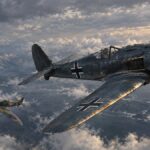








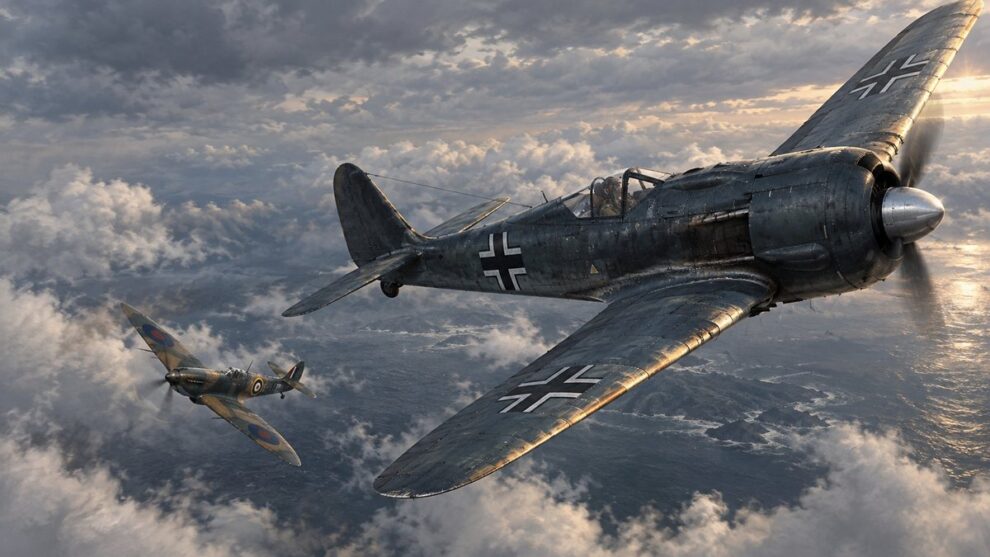
In the late summer of 1941, RAF pilots crossing the Channel met an aircraft that broke the rules. It rolled faster than anything they had flown. It dived away whenever a fight turned against it. In level flight, it simply left the Spitfire Mk V behind. Moreover, it was blunt-nosed and air-cooled, so by the design orthodoxy of the day it should not have worked at all. The Fw 190 vs Spitfire contest had just been rewritten.
The Focke-Wulf Fw 190 was not a better Spitfire. Instead, it argued that the Spitfire’s whole design philosophy had solved the wrong problem. Therefore, understanding Fw 190 vs Spitfire means understanding two engineering teams answering two different questions. It also means understanding what happened when Rolls-Royce finally answered back.
A Cavalry Horse, Not a Racehorse: Kurt Tank’s Design Brief
Focke-Wulf’s technical director Kurt Tank began work in 1937. The Reich Air Ministry wanted an insurance policy, a back-up in case the Messerschmitt Bf 109 line faltered. However, Tank read the brief differently.
He had watched Luftwaffe units fly from unpaved forward strips in poor weather. Conscript ground crews maintained those aircraft. As a result, he concluded that peak performance on a test-flight card mattered less than the performance an average squadron could actually extract.
His framing became famous. The Spitfire and Bf 109 were racehorses: superb, highly strung, and demanding. In contrast, he wanted a cavalry horse. It would absorb rough treatment, tolerate battle damage, and start reliably on a cold morning. Above all, a pilot with few training hours could fly it.
In fact, almost every controversial decision in the Fw 190 follows from that choice. The engine, the landing gear, the electrical system and even the cockpit layout are not compromises against performance. Rather, they are the design brief made physical.
The BMW 801: Why a Radial Engine Was the Heresy That Worked
The powerplant caused the most argument. Every serious European fighter of the period used a liquid-cooled inline V12. The Merlin, the Daimler-Benz DB 601 and the Hispano-Suiza 12Y all followed that pattern. The reasoning looked unanswerable, because a slim inline engine gives a small frontal area, and frontal area drives pressure drag.
Tank chose the BMW 801 instead. This fourteen-cylinder twin-row radial displaced 41.8 litres. In the 801D-2 it delivered roughly 1,700 PS. On paper, therefore, he had accepted a much larger frontal cross-section.
Beating the Drag Penalty
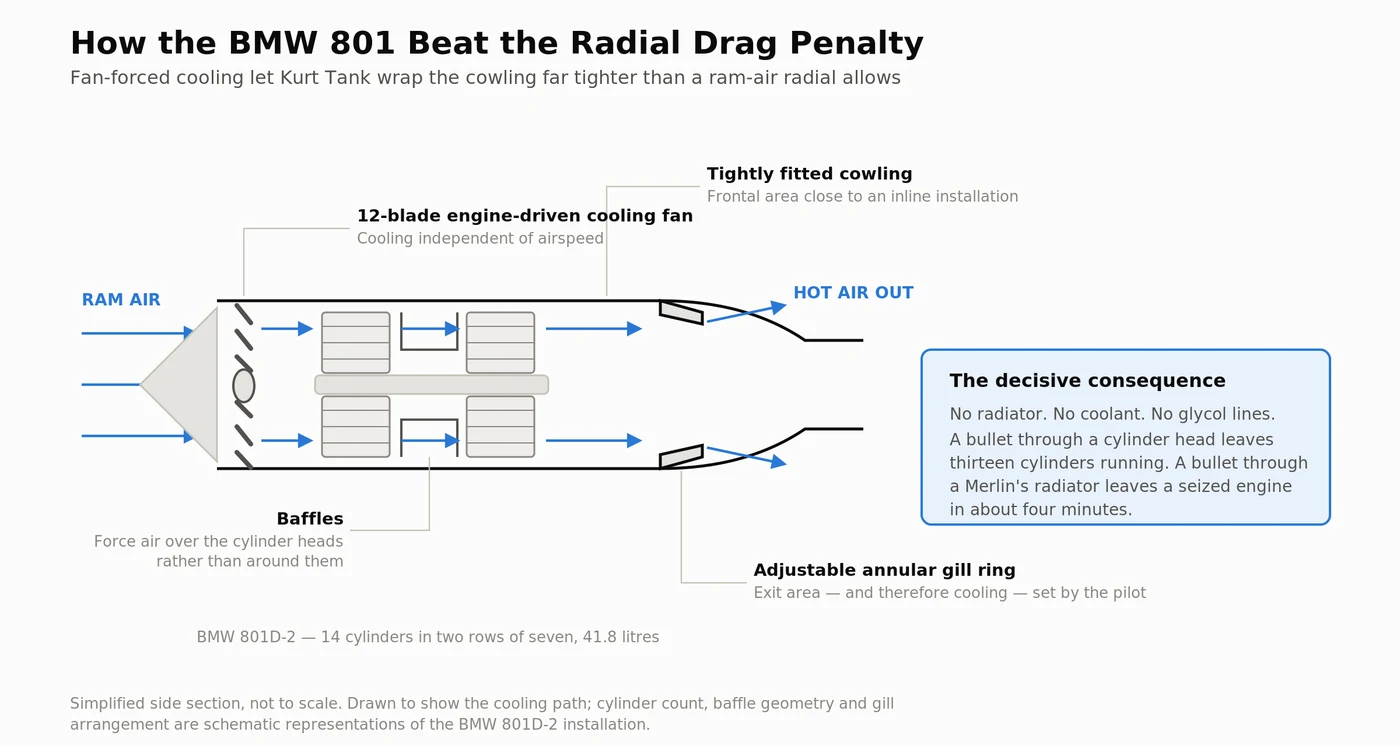
In practice, Tank attacked the drag problem with engineering rather than dogma. He wrapped a tight cowling closely around the cylinder banks. Then he added a twelve-blade cooling fan, driven by the engine and mounted just behind the propeller spinner.
Conventional radials rely on ram air. Consequently, their cooling fails exactly when a pilot needs it most, at low speed and high power during a climb. The fan solved that. It force-fed air through baffles, which directed the flow over the cylinder heads and out through a controllable gill ring. Because cooling no longer depended on airspeed, Tank could draw the cowling far tighter than convention allowed.
Why Air Cooling Survived Gunfire
The radial’s real advantage was never drag. A bullet through a cylinder head leaves you thirteen cylinders and a rough-running engine. A bullet through a Merlin’s radiator leaves you a seized engine about four minutes later.
As a result, that survivability mattered enormously over occupied Europe. The Spitfire carried underwing radiators and coolant plumbing, which formed a large, thin-skinned and unarmoured target. The Fw 190, by contrast, had no coolant system to lose. Designers still apply the same logic to redundancy and single points of failure today, as our analysis of triple redundancy in commercial flight computers shows.
The Kommandogerät: A Mechanical FADEC, Twenty Years Early
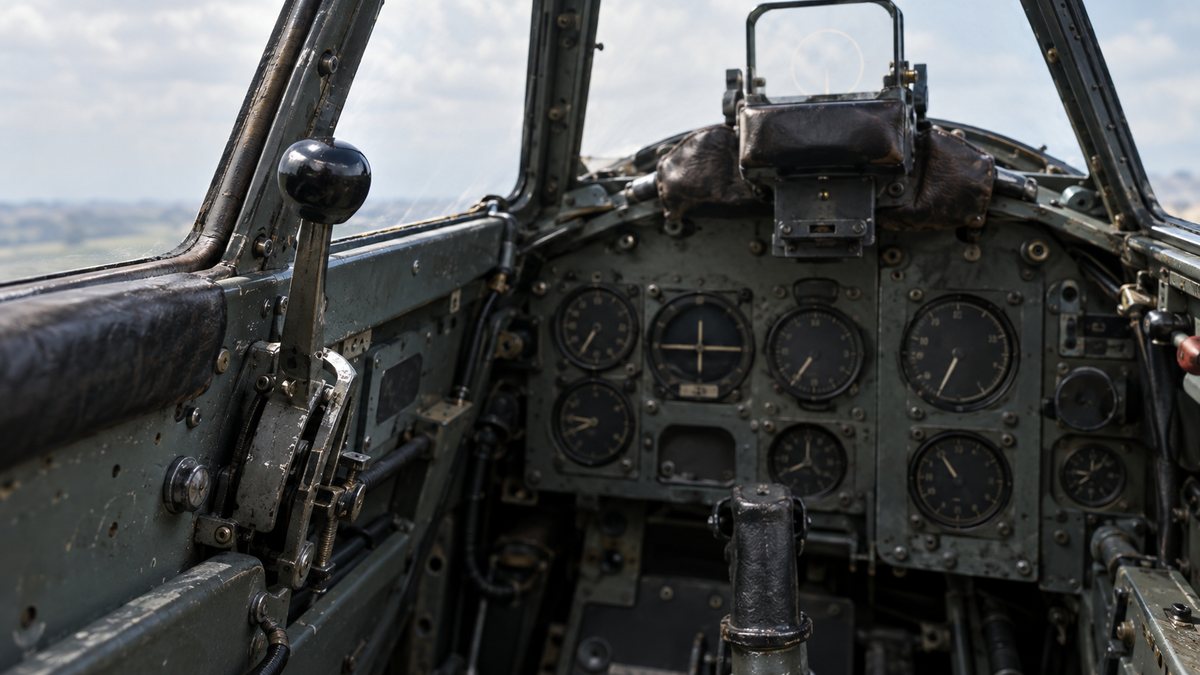
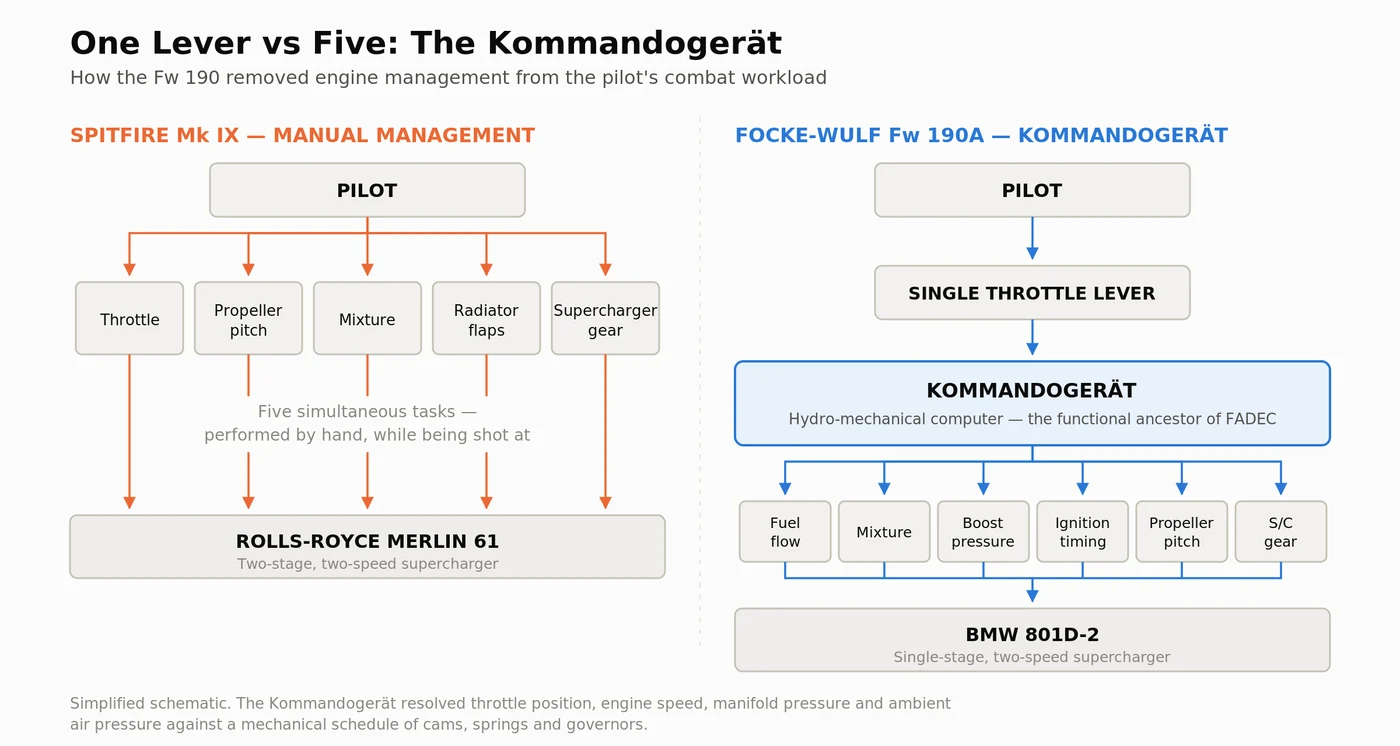
The Fw 190’s most modern feature receives the least attention. In 1941, a Spitfire or Bf 109 pilot managed throttle, propeller pitch, mixture, radiator flaps and supercharger gear as separate tasks. He often did so while someone was shooting at him. Mismanagement cost speed and altitude, and occasionally it cost the engine.
Focke-Wulf and BMW removed the problem entirely. Their Kommandogerät, literally “command device”, was a hydro-mechanical computer mounted on the engine. It reduced everything to a single throttle lever.
The unit read manifold pressure, engine speed, ambient air pressure and throttle position. From those inputs it scheduled fuel flow, mixture strength, boost, ignition timing, propeller pitch and supercharger gear. A mechanical schedule of cams and governors resolved the whole calculation.
That description matches a modern Full Authority Digital Engine Control almost exactly. The pilot commanded thrust, and the machine decided how to deliver it safely. A contemporary FADEC uses sensor buses and redundant processing channels. The Kommandogerät used pressure capsules, springs and cam profiles. Nevertheless, the design intent is identical, and the distance to today’s fly-by-wire and fly-by-light control systems is shorter than the calendar suggests.
Of course, the payoff showed up in pilot workload. A Luftwaffe pilot with limited training could fly the Fw 190 near its limits, because the aircraft removed the tasks he was most likely to get wrong.
Airframe Engineering: Wing Loading, Roll Rate and the Landing Gear Nobody Mentions
The Fw 190 used a small wing of roughly 18.3 m², against the Spitfire’s 22.5 m². Its wing loading therefore ran near 210 kg/m², while a Spitfire Mk V sat around 140–150 kg/m². Conventional wisdom called this a straightforward defect. In one respect it was: the Spitfire out-turned the Fw 190 comprehensively, and it did so at every altitude of the war.
Why Roll Rate Decided the Fw 190 vs Spitfire Fight
Yet high wing loading buys things. In addition, it buys a smoother ride in turbulence and better handling at speed. Critically, it also lowers roll inertia. Well-harmonised ailerons stayed light at speed, so the Fw 190 rolled at roughly 160°/s. The standard elliptical-wing Spitfire managed about half that, and its ailerons grew heavy above 400 mph.
Roll rate is the ability to change a turn, and it precedes every manoeuvre. Consequently, a pilot who reverses faster dictates the geometry of the fight, even while losing every sustained turn. That explains why the tactical picture stayed so lopsided despite the Spitfire’s turning advantage. For the aerodynamics behind that elliptical planform, see our Spitfire engineering retrospective.
The Undercarriage Nobody Mentions
Performance comparisons rarely mention the landing gear. Nevertheless, the Spitfire’s undercarriage arguably destroyed more airframes in some months than the Luftwaffe did. Its inward-retracting gear gave a track of about 1.7 m. That made it twitchy on grass and unforgiving in a crosswind.
The Fw 190 used wide, outward-mounted gear with a track near 3.5 m, stressed for sink rates around 4.5 m/s. Novice pilots therefore walked away from landings that would have written off a Spitfire. In a war of attrition, that is a performance figure like any other.
Tank also made the aircraft largely electric. Motors drove the landing gear, flaps and trim instead of hydraulics, and the guns fired electrically. Fewer fluid lines meant fewer things to leak, freeze or lose to a bullet.
Fw 190 versus Spitfire Mk V: The Shock of 1941
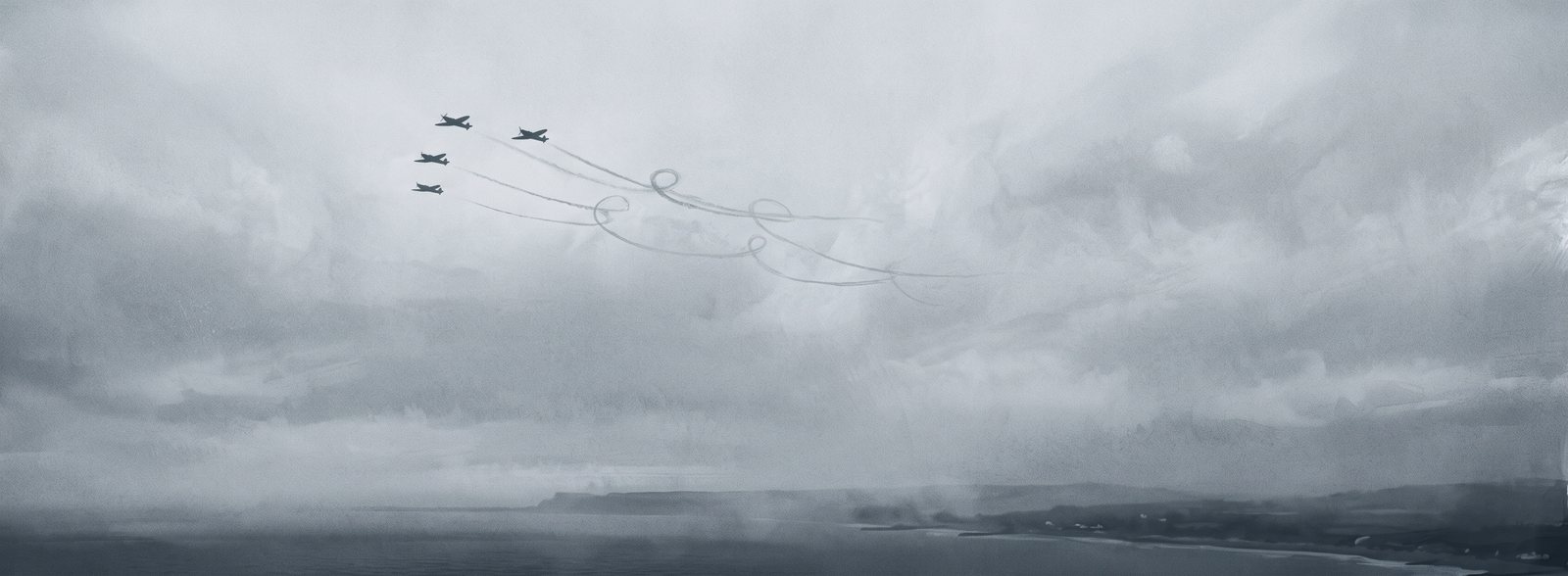
The Fw 190A reached JG 26 on the Channel Front in late summer 1941. The RAF’s response resembled alarm more than assessment. Across most of the useful altitude band, the Fw 190A ran 25–35 mph faster than the Spitfire Mk V. It also out-rolled it decisively, out-dived it, and carried heavier armament.
The Spitfire Mk V was not a bad aircraft. Its engine had simply run out of development margin. The single-stage Merlin 45 had one critical altitude, and performance fell away above and below it. For roughly twelve months, therefore, the Luftwaffe held daylight air superiority over occupied Europe, and losses on RAF offensive sweeps climbed to an unsustainable rate.
Clearly, Fighter Command wanted a captured example badly. Combined Operations reportedly examined a commando raid to steal one from a French airfield. In the event, they never needed it.
23 June 1942: The Gift at RAF Pembrey
On 23 June 1942, Oberleutnant Armin Faber of III./JG 2 lost his bearings after combat over the Channel. He mistook the Bristol Channel for the English Channel. After a victory roll, he landed his Fw 190A-3, Werk Nr. 313, at RAF Pembrey in South Wales. The station’s duty pilot captured him on the spot.
Finally, the RAF had an intact, undamaged Fw 190. It went to the Royal Aircraft Establishment at Farnborough, where flight trials began on 3 July 1942. Afterwards it moved to the Air Fighting Development Unit at Duxford for comparative trials, including mock combat against the new Spitfire Mk IX.
Within weeks, rumour gave way to measured data. The RAF learned exactly where the Fw 190 was superior, exactly where it was not, and precisely where its advantage collapsed. That last point proved decisive.
The Merlin 61 Answer: How the Spitfire Mk IX Beat the Fw 190
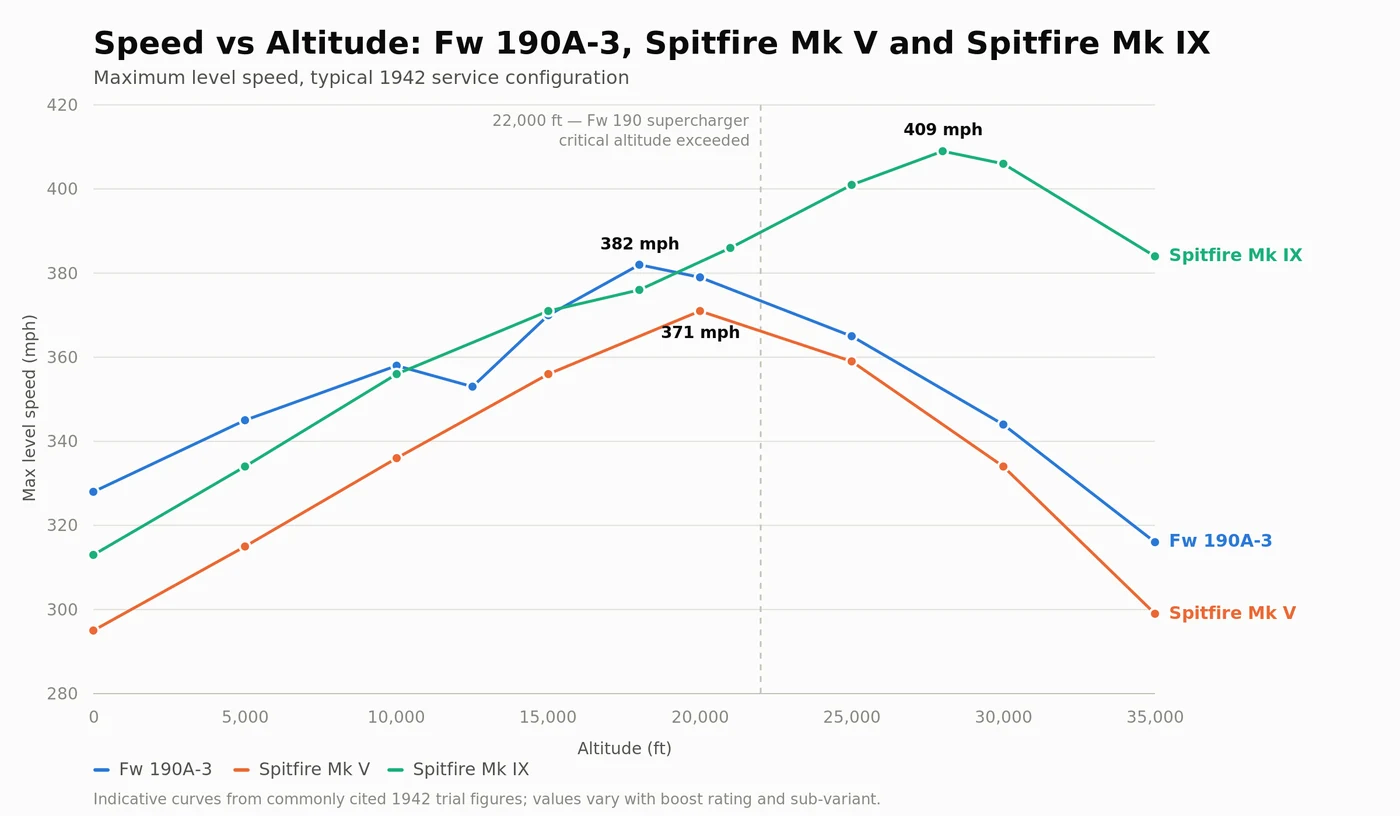
The BMW 801’s supercharger held the Fw 190’s single weakness. A single-stage, two-speed supercharger only maintains manifold pressure up to a limited critical altitude. Above roughly 22,000 feet, therefore, the Fw 190A’s performance fell away sharply, and the airframe offered no straightforward fix.
Two Stages, One Decisive Advantage
Rolls-Royce had been working on the answer even before the Fw 190 appeared. The Merlin 61 introduced a two-stage, two-speed supercharger with an intercooler between stages. Two compressor impellers now worked in series, and each stage added pressure ratio. Meanwhile the intercooler cooled the charge air, which controlled detonation and recovered density. The engine delivered roughly 1,565 hp, and its high-altitude performance was transformed rather than merely improved.
Supermarine’s engineers then did the pragmatic thing. They dropped the Merlin 61 into an essentially Mk Vc airframe. The Spitfire Mk IX was explicitly a stopgap, meant to hold the line until the redesigned Mk VIII arrived. It first flew in early 1942, entered full production in June, and reached squadrons the following month.
Ultimately, the stopgap became one of the most-produced and most respected Spitfire variants of the war. Above 25,000 feet it did not merely match the Fw 190A; it comprehensively outclassed it. Everywhere else, it kept the Spitfire’s turning advantage. Our Supermarine Spitfire Mk 9 engineering analysis covers the airframe and production story in full.
Crucially, from a distance the Mk IX looked almost identical to the Mk V. Luftwaffe pilots kept attacking what they believed were Mk Vs. The psychological effect of that mistake was substantial.
Fw 190 vs Spitfire Mk IX: Head-to-Head Specifications
| Parameter | Focke-Wulf Fw 190A-3 | Supermarine Spitfire Mk IX |
|---|---|---|
| Engine | BMW 801D-2, 14-cyl air-cooled radial, 41.8 L | Rolls-Royce Merlin 61, liquid-cooled V12, 27 L |
| Supercharging | Single-stage, two-speed | Two-stage, two-speed with intercooler |
| Power | ~1,700 PS | ~1,565 hp |
| Engine control | Kommandogerät — single-lever automatic | Manual: throttle, pitch, mixture, radiator |
| Max speed | ~382 mph (615 km/h) at ~18,000 ft | ~409 mph (658 km/h) at ~28,000 ft |
| Wing area | ~18.3 m² | ~22.5 m² |
| Roll rate | ~160°/s — decisive advantage | Roughly half, heavier ailerons at speed |
| Turn radius | Inferior at all altitudes | Superior at all altitudes |
| Above 25,000 ft | Performance falls away sharply | Dominant |
| Undercarriage track | ~3.5 m — excellent ground handling | ~1.7 m — narrow, unforgiving |
| Battle damage tolerance | High — no coolant system | Low — vulnerable radiators and glycol lines |
| Armament (typical) | 2 × MG 151/20 20 mm + 2 × MG 17 7.92 mm | 2 × 20 mm Hispano + 4 × .303 Browning |
Fw 190 vs Spitfire: Two Correct Answers to Different Questions
Reducing Fw 190 vs Spitfire to a single winner misreads both aircraft. Each team optimised against different constraints, and both optimisations were correct.
Reginald Mitchell’s team designed for interception. Climb high, get there fast, turn inside the bomber escort. The large elliptical wing, the low wing loading and the slim liquid-cooled engine all serve altitude performance and turning flight. The narrow undercarriage and the fragile cooling system are the bill.
Kurt Tank designed for a mass-mobilised air force in a long attrition war, flying from improvised airfields. He optimised robustness, low pilot workload, damage tolerance, easy maintenance and roll authority. Turn radius and high-altitude performance are his bill.
The war then judged both designs. Focke-Wulf answered with the Fw 190D-9 “Dora” and its Jumo 213 inline engine, and eventually with the high-altitude Ta 152. Both were good aircraft. However, both arrived too late and in numbers too small to matter. The Spitfire meanwhile kept absorbing engines, from Merlin to Griffon, throughout the war and beyond, because its airframe still had margin.
The engineering lesson outlives the aircraft. In 1941 the Fw 190 was the better system, and its subsystem thinking was more advanced almost everywhere, particularly in automation. The Spitfire, however, was the more extensible airframe. In a conflict measured in years rather than months, extensibility won. That trade-off still shapes how aircraft programmes are planned today.
Frequently Asked Questions
Against the Spitfire Mk V in 1941–42, yes — the Fw 190A was faster, rolled roughly twice as fast, dived better and hit harder, giving the Luftwaffe daylight superiority over the Channel for about a year. Against the Spitfire Mk IX from mid-1942, no single answer applies: the Fw 190 kept its roll-rate and low-altitude advantages, while the Mk IX dominated above roughly 25,000 feet and out-turned it everywhere.
Kurt Tank prioritised battle-damage tolerance, field maintainability and reliability over minimum frontal area. An air-cooled radial has no coolant system to be disabled by a single bullet and can keep running with cylinder damage. Tank neutralised the expected drag penalty with a tight cowling and a twelve-blade engine-driven cooling fan that fed air over the cylinder heads independently of airspeed.
A hydro-mechanical engine-control computer on the BMW 801 that automatically scheduled fuel flow, mixture, boost, ignition timing, propeller pitch and supercharger gear from a single throttle lever. Functionally it performed the role of a modern FADEC, roughly two decades before digital engine control existed, and it dramatically reduced pilot workload in combat.
On 23 June 1942, Oberleutnant Armin Faber became disoriented after combat, mistook the Bristol Channel for the English Channel, and landed his Fw 190A-3 at RAF Pembrey in Wales. The aircraft was flight-tested at RAE Farnborough from 3 July 1942 and later flown in comparative trials against the Spitfire Mk IX at Duxford.
The Rolls-Royce Merlin 61’s two-stage, two-speed supercharger with intercooling. The Fw 190’s single-stage supercharger lost effectiveness above about 22,000 feet, while the Merlin 61 maintained manifold pressure far higher, giving the Mk IX roughly 409 mph at 28,000 feet and decisive superiority in the altitude band where the Fw 190 was weakest.
Over 20,000 Fw 190s of all variants were produced, making it one of the most numerous German fighters of the Second World War, alongside the Messerschmitt Bf 109.
Sources and Further Reading
- Focke-Wulf Fw 190 — Design and Prototypes, historyofwar.org
- Supermarine Spitfire Mk IX, historyofwar.org
- Armin Faber and the capture of Fw 190A-3 Werk Nr. 313, Wikipedia