








Last Updated: 4 months ago
← Back to Aircraft Database| General Characteristics | |
| Type | Civil and Commercial Aircraft, Wide-body jet airliner |
|---|---|
| National Origin | Multi-national |
| Manufacturer | Airbus |
| Status | In service |
| First Flight | 27 April 2005; 21 years ago |
| Introduction | 25 October 2007, with Singapore Airlines |
| Primary Users | Emirates British Airways Singapore Airlines Qantas |
| Number Built | 254 (including 3 test aircraft) |
| Developed From | N/A |
| Capacity & Dimensions | |
| Weights, Powerplant & Performance | |
| Typical Cruise Speed | Mach 0.85 (488 kn; 903 km/h; 561 mph) typical Mach 0.89 (515 kn; 955 km/h; 593 mph) max. |
| Range | 14,800 km (7,991 nmi) |
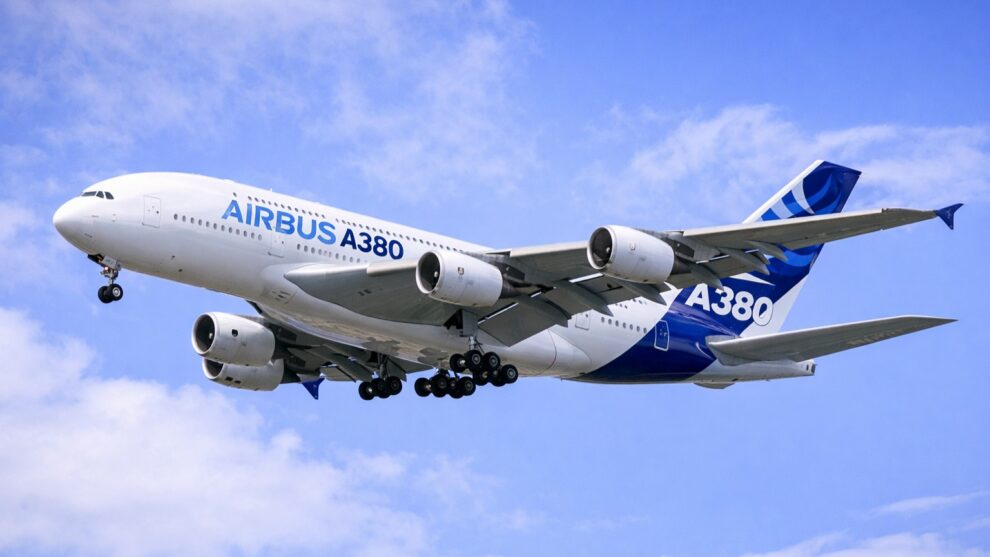
The Airbus A380 is the largest passenger airliner ever built. It is a four-engine, full-length double-deck wide-body aircraft designed for high-capacity long-haul routes between major international airports. As a result, the A380 became one of the most recognizable aircraft in modern commercial aviation.
Airbus developed the aircraft for airlines that needed to carry very large numbers of passengers on busy routes. Instead of increasing flight frequency at slot-restricted airports, airlines could use one very large aircraft to move more people on each departure. Therefore, the Airbus A380 became especially useful on dense long-haul routes linking major global hubs.
The aircraft first flew on April 27, 2005, and entered commercial service on October 25, 2007, with Singapore Airlines. Although production has ended, the A380 remains in service with several major airlines. Moreover, its size, cabin comfort and double-deck layout continue to make it a favorite among many aviation enthusiasts and passengers.
Airbus A380 General Characteristics
| Feature | Specification |
|---|---|
| Aircraft Type | Full-length double-deck wide-body jet airliner |
| Main Category | Civil and Commercial Aircraft |
| Additional Category | Wide-body airliner |
| Additional Category | Wide-body jet airliner |
| Manufacturer | Airbus |
| National Origin | Multi-national |
| Aircraft Family | Airbus A380 |
| Main Variant | Airbus A380-800 |
| First Flight | April 27, 2005 |
| Introduction | October 25, 2007, with Singapore Airlines |
| Cockpit Crew | Two pilots |
| ICAO Code | A388 |
| Primary Role | High-capacity long-haul passenger transport |
| Status | Out of production, still in airline service |
The Airbus A380 is not simply a large wide-body aircraft. It is the only full-length double-deck jet airliner in commercial service history. Because of this layout, both the main deck and upper deck extend almost the full length of the fuselage.
A380 Cabin and Seating
The cabin is the most famous part of the A380 design. Airlines can configure the aircraft with several cabin classes, including first class, business class, premium economy and economy. In typical airline layouts, the aircraft often carries more than 500 passengers. In maximum all-economy certification, it can carry up to 853 passengers.
| Feature | Specification |
|---|---|
| Typical Seating | More than 500 passengers, depending on airline layout |
| Maximum Certified Seating | Up to 853 passengers |
| Cabin Type | Full-length double-deck wide-body cabin |
| Passenger Decks | Main deck and upper deck |
| Cabin Concept | High-capacity long-haul passenger comfort |
| Common Airline Use | Major hub-to-hub international routes |
The A380’s cabin gives airlines unusual flexibility. Some operators use dense seating for high-capacity routes, while others install premium cabins, lounges, showers or large first-class suites. Therefore, the aircraft can serve both mass transport and premium long-haul travel.
In addition, the wide cabin and double-deck layout help create a spacious passenger experience. The aircraft became known for its quiet cabin, smooth ride and large interior volume. Consequently, many passengers still consider it one of the most comfortable commercial aircraft.
Airbus A380 Dimensions
The Airbus A380 is physically enormous. Its length is about 73 metres, and its wingspan is nearly 80 metres. Because of these dimensions, airports needed special planning for gates, taxiways, jet bridges and ground handling equipment.
| Feature | Specification |
|---|---|
| Overall Length | About 72.72 m / 238 ft 7 in |
| Wingspan | About 79.75 m / 261 ft 8 in |
| Overall Height | About 24.09 m / 79 ft |
| Fuselage Type | Full-length double-deck wide-body fuselage |
| Wing Layout | Low-wing swept configuration |
| Engine Layout | Four underwing turbofan engines |
| Passenger Deck Area | About 550 m² across two decks |
The aircraft’s size allowed Airbus to create a large cabin without using an extremely long single deck. However, the large wingspan also made airport compatibility an important design challenge. As a result, the A380 became closely associated with major international airports that could support very large aircraft operations.
The double-deck fuselage gives the aircraft its unmistakable appearance. Even from a distance, the large upper deck and four-engine layout make the A380 easy to identify.
Airbus A380 Engines and Performance
The Airbus A380 uses four high-bypass turbofan engines. Depending on the airline and aircraft version, it can be powered by Rolls-Royce Trent 900 engines or Engine Alliance GP7000 engines. These engines provide the thrust needed for very heavy long-haul operations.
| Feature | Specification |
|---|---|
| Engine Options | 4 × Rolls-Royce Trent 900 or 4 × Engine Alliance GP7000 |
| Engine Type | High-bypass turbofan |
| Number of Engines | Four |
| Maximum Operating Speed | About Mach 0.89 |
| Typical Cruise Speed | About Mach 0.85 |
| Range | About 8,000 nautical miles / 14,800 km |
| Typical Mission | Long-haul and ultra-long-haul passenger routes |
| Maximum Takeoff Weight | About 575 tonnes, depending on variant |
The Airbus A380 offers very long range for such a large aircraft. Therefore, airlines can use it on intercontinental routes between major hubs. Examples include Europe to Asia, the Middle East to North America and long sectors across the Pacific region.
Although the aircraft has four engines, Airbus designed it for strong fuel efficiency per passenger when airlines fill the cabin effectively. However, the A380 works best on routes with consistently high demand. If an airline cannot fill enough seats, smaller twin-engine wide-body aircraft may offer better economics.
Weights and Capacity
| Feature | Specification |
|---|---|
| Maximum Takeoff Weight | About 575,000 kg |
| Maximum Certified Seating | 853 passengers |
| Typical Airline Seating | Often above 500 passengers |
| Lower Deck Cargo Role | Passenger baggage and belly freight |
| Aircraft Class | Very large aircraft / superjumbo airliner |
The A380’s payload capability supports both passengers and cargo. Even in passenger service, the aircraft can carry baggage and freight in its lower compartments. Nevertheless, the aircraft’s main value comes from passenger capacity rather than dedicated cargo use.
Because of its high seating capacity, the A380 can reduce congestion on busy airport pairs. One A380 flight can move as many passengers as multiple smaller aircraft in some configurations. Consequently, the aircraft made sense for airlines focused on high-density hub operations.
Why Airbus Built the A380
Airbus built the A380 to challenge the largest long-haul aircraft market and to support growth at congested major airports. During the aircraft’s development, many industry planners expected hub-and-spoke networks to remain dominant. Therefore, Airbus designed a very large aircraft that could move large numbers of passengers between major hubs.
The aircraft also allowed airlines to create unique cabin products. Some operators installed showers, onboard lounges, premium suites and spacious business-class cabins. In addition, the large cabin gave airlines more freedom to design passenger experiences that smaller aircraft could not easily match.
However, the market later shifted toward smaller and more efficient twin-engine long-haul aircraft. Airlines increasingly preferred aircraft such as the Airbus A350 and Boeing 787, which could serve thinner point-to-point routes. As a result, A380 production ended, but the aircraft remained a major symbol of aviation ambition.
Operational Role
The Airbus A380 mainly serves high-demand long-haul routes. Airlines use it between major international hubs where passenger volume is strong and airport slots are valuable. Because the aircraft carries so many passengers, it works best when airlines can consistently fill its seats.
Major operators used the A380 on routes linking Europe, Asia, the Middle East, Australia and North America. The aircraft became especially important for Emirates, which built a large A380 network through Dubai. Other airlines also used it for flagship long-haul services.
Although some airlines retired the type during or after the global travel downturn, several carriers returned the A380 to service as long-haul demand recovered. Therefore, the aircraft continues to appear at major airports and on premium international routes.
Passenger Experience
The A380 became famous not only for size, but also for comfort. The aircraft offers a quieter cabin than many older wide-body jets, and its large interior gives passengers a spacious feeling. Moreover, the double-deck layout allows airlines to separate cabin classes in creative ways.
Some airlines used the upper deck for premium cabins, while others used both decks for mixed-class seating. In addition, the aircraft allowed unique luxury features such as lounges, bars and shower suites. These cabin options helped the A380 become a passenger favorite on many long-haul routes.
Even in economy class, passengers often notice the aircraft’s stable ride and lower perceived noise levels. As a result, the A380 remains one of the most memorable aircraft to fly on.
Comparison with Other Airbus Wide-Bodies
The A380 is much larger than the Airbus A330 and Airbus A350. While the A330 and A350 use two engines, the A380 uses four engines. Therefore, the A380 offers much higher passenger capacity but also requires stronger demand to operate efficiently.
The Airbus A350 became more attractive for many airlines because it offers long range, modern materials and lower fuel burn with two engines. In contrast, the A380 provides unmatched capacity and cabin space. Because of this, the two aircraft serve different network strategies.
The A380 fits dense hub-to-hub flying. The A350 fits both hub routes and thinner long-haul city pairs. This difference helps explain why the A380 became iconic but did not sell in the same numbers as smaller long-haul twinjets.
Production and Legacy
Airbus delivered 251 A380 aircraft to 14 customers. Although production ended, the aircraft still receives support for continued airline operation. This matters because many A380s remain valuable on routes where passenger demand is strong.
The aircraft also influenced later aircraft design. Airbus used advanced materials, digital design methods and new systems during the A380 program. In addition, the aircraft later became useful as a test platform for future propulsion and technology projects.
The Airbus A380 may not have changed the market exactly as originally expected, but it changed aviation culture. It became a symbol of scale, comfort and engineering ambition. For many people, it remains the ultimate passenger airliner.
Frequently Asked Questions
What is the Airbus A380?
The Airbus A380 is a four-engine, full-length double-deck wide-body passenger airliner and the largest commercial passenger aircraft ever built.
How many passengers can the Airbus A380 carry?
The aircraft can carry more than 500 passengers in many airline layouts and is certified for up to 853 passengers in maximum all-economy seating.
What engines does the A380 use?
The aircraft can use four Rolls-Royce Trent 900 engines or four Engine Alliance GP7000 engines.
What is the range of the Airbus A380?
The A380 has a range of about 8,000 nautical miles, or approximately 14,800 kilometres.
Is the Airbus A380 still in production?
No. Airbus ended A380 production, but several airlines continue to operate the aircraft on major long-haul routes.
Airbus A380 Summary
The Airbus A380 is the world’s largest passenger airliner and the only full-length double-deck commercial jet ever built. With four powerful turbofan engines, a range of about 8,000 nautical miles, maximum certified seating for 853 passengers and unmatched cabin space, the A380 remains one of the most iconic aircraft in aviation history. Although production has ended, the aircraft continues to serve high-demand long-haul routes and remains a symbol of Airbus engineering ambition.
The rationale behind the development of the A380
During the 1990s, the commercial aviation sector experienced significant growth. Although advancements such as ETOPS (Extended-range Twin-engine Operational Performance Standards) and aircraft like the Boeing 767 represented important progress, airlines still predominantly depended on the hub-and-spoke model for long-haul connectivity. Within this system, passengers are transported from smaller regional cities to major hub airports, such as London Heathrow. From there, they transfer to larger aircraft that carry them to another major hub, for example Dallas/Fort Worth, before continuing to their final destination on a smaller aircraft. While the hub-and-spoke model enables airlines to provide a wide range of travel options, increasing congestion and limited slot availability at major hub airports have constrained further expansion.
Source : Did A Design Flaw Really Kill The Airbus A380?
Did you knowAviationStream.com has a YouTube channel? Check out TheAeroGraphyOfficial and subscribe to watch fun, highly engaging aviation Shorts!