






Last Updated: 4 days ago
← Back to Aircraft Database| General Characteristics | |
| Type | Civil and Commercial Aircraft |
|---|---|
| National Origin | United States |
| Manufacturer | Cessna Textron Aviation |
| Variants | Soloy Pathfinder 21 |
| Status | In service |
| First Flight | December 9, 1982 |
| Introduction | 1984 |
| Number Built | >3,000 |
| Capacity & Dimensions | |
| Cockpit Crew | one or two |
| Typical Seating | 2,224 lb (1,009 kg) / 332 US gal (1,257 L) |
| Overall Length | 37 ft 7 in (11.46 m) |
| Wing Span | 52 ft 1 in (15.87 m) |
| Wing Area | 279 sq ft (25.96 m) |
| Overall Height | 54 in (1.37 m) |
| Weights, Powerplant & Performance | |
| MTOW | 8,000 lb (3,629 kg) |
| OEW | 4,730 lb (2,145 kg) |
| Engines | 1 × Pratt & Whitney Canada PT6A-114A turboprop, 675 shp (503 kW) |
| Typical Cruise Speed | 186 kn (214 mph, 344 km/h) true air speed |
| Range | 1,070 nmi (1,230 mi, 1,980 km) |
| Service Ceiling | 25,000 ft (7,600 m) |
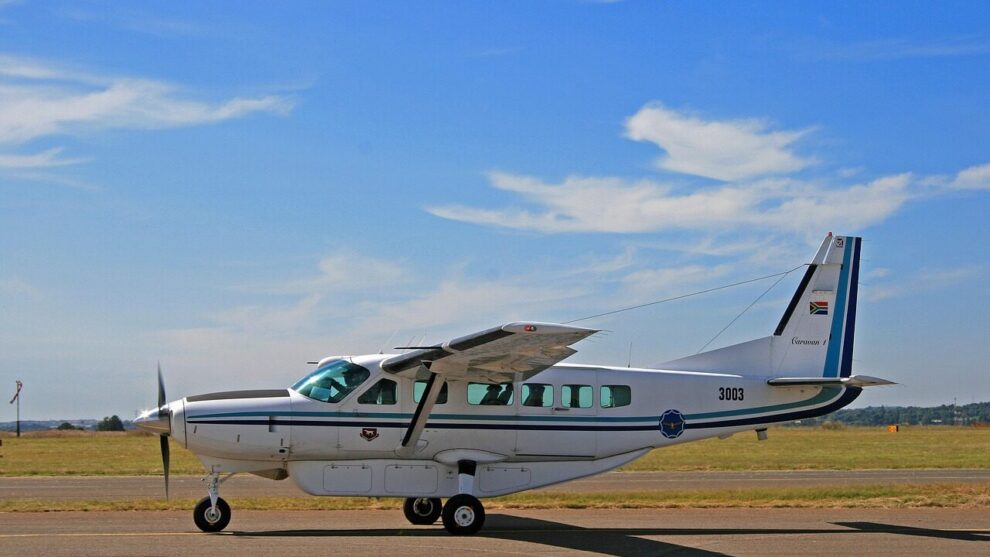
The Cessna Caravan 208 is one of the most successful single-engine utility turboprops in aviation. Cessna designed the aircraft for operators that needed rugged performance, simple operation and strong mission flexibility. As a result, the Caravan became popular with commuter airlines, cargo operators, humanitarian organizations, government agencies and private owners.
The aircraft uses a high-wing layout, fixed landing gear and a single Pratt & Whitney Canada PT6A turboprop engine. Therefore, it offers a practical combination of reliability, payload capability and short-field performance. The Cessna Caravan 208 can operate from paved runways, grass strips, gravel surfaces and remote airfields where larger aircraft may not be practical.
The Caravan program began in the early 1980s. The Cessna 208 prototype first flew in 1982, received FAA type certification in 1984 and entered customer deliveries in 1985. Since then, the aircraft has built a reputation as a true aviation workhorse. Although the larger Grand Caravan EX later expanded the family, the standard Caravan 208 remains an important aircraft in its own right.
Cessna Caravan 208 General Characteristics
| Feature | Specification |
|---|---|
| Aircraft Type | Single-engine utility turboprop aircraft |
| Main Category | Light Aircraft |
| Additional Category | Civil and Commercial Aircraft |
| Optional Category | Special-Purpose Aircraft |
| Manufacturer | Cessna Textron Aviation |
| National Origin | United States |
| Aircraft Family | Cessna Caravan |
| Model | Cessna 208 Caravan |
| First Prototype Flight | 1982 |
| FAA Type Certification | 1984 |
| First Deliveries | 1985 |
| Crew | One or two pilots, depending on operation |
| Maximum Occupants | 10–14, depending on configuration |
| Primary Roles | Passenger, cargo, utility and special mission operations |
The Cessna Caravan 208 was designed around practicality rather than luxury. Its cabin can support passenger seating, cargo layouts or mixed-use arrangements. In addition, optional equipment such as a cargo pod, floats or special mission equipment can expand the aircraft’s role.
Because of this flexibility, the Caravan has served in many environments. Operators use it in remote communities, island routes, regional passenger services, cargo feeder networks, skydiving, aerial survey and humanitarian support.
Caravan 208 Cabin and Utility Layout
The cabin is one of the strongest features of the aircraft. It offers enough space for passengers, cargo or mission equipment while keeping the aircraft compact and efficient. Moreover, the large loading doors and optional cargo pod make the aircraft useful for operators that need quick loading and flexible payload options.
| Feature | Specification |
|---|---|
| Maximum Occupants | 10–14 |
| Cabin Height | 54 in / 1.37 m |
| Cabin Width | 64 in / 1.63 m |
| Cabin Length | 12 ft 9 in / 3.88 m |
| Baggage Weight Capacity | 325 lb / 147 kg |
| Baggage Volume | 31.5 cu ft / 0.89 m³ |
| Optional Cargo Pod | Adds extra external storage volume |
The Cessna Caravan 208 can serve as a passenger aircraft during one mission and a cargo aircraft in another configuration. Therefore, it gives operators unusual flexibility for a single-engine turboprop.
In passenger service, the aircraft works well for short regional sectors and remote community flights. In cargo service, it can carry parcels, mail, supplies and essential goods. Meanwhile, special mission operators can adapt the aircraft for surveillance, medical support, parachute operations or aerial work.
Cessna Caravan 208 Dimensions
The Caravan’s dimensions support its rugged utility role. It is large enough to carry meaningful payload but compact enough for smaller airports and remote strips. Its high-wing design also improves ground clearance and makes loading easier in many operating environments.
| Feature | Specification |
|---|---|
| Length | 37 ft 7 in / 11.5 m |
| Height | 14 ft 10 in / 4.5 m |
| Wingspan | 52 ft 1 in / 15.9 m |
| Wing Area | 279 sq ft / 25.96 m² |
| Wheelbase | 11 ft 8 in / 3.54 m |
| Tread | 11 ft 8 in / 3.56 m |
| Landing Gear | Fixed tricycle landing gear |
| Wing Position | High wing |
The fixed landing gear reduces mechanical complexity. In addition, the rugged landing gear allows the aircraft to use grass, gravel and other less-developed surfaces when operators follow approved procedures. This makes the Caravan especially useful in places where runway infrastructure is limited.
The high-wing configuration also improves downward visibility. As a result, pilots benefit during approach, landing, aerial survey work and low-speed utility operations.
Engine and Performance
The Cessna Caravan 208 uses a Pratt & Whitney Canada PT6A-114A turboprop engine. This engine is one of the key reasons for the aircraft’s reputation. It provides dependable power, good fuel efficiency and strong support across the global turboprop maintenance network.
| Feature | Specification |
|---|---|
| Engine | Pratt & Whitney Canada PT6A-114A |
| Engine Type | Single turboprop |
| Power Rating | 675 shp / 503 kW |
| Propeller | McCauley 3-blade aluminum, constant-speed, full-feathering |
| Maximum Cruise Speed | 186 ktas / 344 km/h |
| Maximum Range | 1,070 nm / 1,982 km |
| Maximum Operating Altitude | 25,000 ft / 7,620 m |
| Maximum Climb Rate | 1,234 fpm / 376 mpm |
| Maximum Limit Speed | 175 kias / 324 km/h |
| Stall Speed | 61 kcas / 113 km/h |
The aircraft does not focus on high cruise speed. Instead, it prioritizes payload, reliability and operating flexibility. Therefore, the Cessna Caravan 208 fits missions where dependability and utility matter more than speed.
Its 1,070 nautical mile maximum range gives operators useful planning flexibility. However, actual range depends on payload, fuel load, weather, altitude and mission profile. For many short-haul operators, the aircraft’s combination of range and useful load is more important than maximum speed.
Weights and Fuel Capacity
| Feature | Specification |
|---|---|
| Maximum Ramp Weight | 8,035 lb / 3,645 kg |
| Maximum Takeoff Weight | 8,000 lb / 3,629 kg |
| Maximum Landing Weight | 7,800 lb / 3,538 kg |
| Basic Empty Weight | 4,730 lb / 2,145 kg |
| Useful Load | 3,305 lb / 1,499 kg |
| Maximum Payload | 3,070 lb / 1,393 kg |
| Full Fuel Payload | 1,081 lb / 490 kg |
| Usable Fuel Weight | 2,224 lb / 1,009 kg |
| Usable Fuel Volume | 332 gal / 1,257 L |
These figures explain why the aircraft became popular with working operators. The Caravan can carry passengers, cargo or equipment while still operating from relatively short runways. Moreover, the full-fuel payload gives operators practical flexibility for real-world missions.
The optional cargo pod can also improve utility. It allows operators to carry extra baggage or freight without taking up cabin space. Consequently, passenger and mixed-use operations can benefit from more cabin comfort and better storage separation.
Short-Field and Remote Operations
The Cessna Caravan 208 has a strong reputation for short-field and remote operations. Its high wing, fixed landing gear and turboprop power help it operate from airfields that may not suit larger or faster aircraft.
| Feature | Specification |
|---|---|
| Takeoff Distance | 2,055 ft / 626 m |
| Takeoff Ground Roll | 1,160 ft / 354 m |
| Landing Distance | 1,625 ft / 495 m |
| Landing Ground Roll | 715 ft / 218 m |
These figures depend on weight, runway surface, temperature, elevation and pilot technique. Nevertheless, they show the aircraft’s utility-focused design. Because of this capability, the Caravan often serves regions where roads are limited, distances are long and air transport is essential.
In addition, the aircraft can support float operations in approved configurations. This allows operators to serve lakes, rivers and coastal communities. Therefore, the Caravan can adapt to landplane and amphibious missions depending on equipment.
Why Operators Choose the Caravan
Operators choose the Caravan because it combines simple design with real capability. It is easier to operate than many larger twin-engine aircraft, yet it offers more payload and mission flexibility than smaller piston aircraft. As a result, it fills a valuable place in the utility aviation market.
The aircraft also benefits from broad support. Cessna and Textron Aviation have supported the Caravan family for decades, and the PT6A engine family has a strong global maintenance reputation. Therefore, operators in remote regions often value the aircraft for reliability and parts support.
Another reason is adaptability. The Cessna Caravan 208 can support passenger service in the morning, cargo transport later in the day and special mission work in another configuration. This makes it valuable for operators that need one aircraft type to perform many tasks.
Operational Role
The Caravan operates in many different markets. Commuter airlines use it for regional passenger service. Cargo operators use it for feeder freight and parcel routes. Humanitarian organizations use it to reach remote communities. Government agencies use it for surveillance, patrol and emergency support.
The aircraft also works well for skydiving operations, aerial survey, medical transport and island services. In each role, the Caravan offers a practical mix of payload, cabin space, low-speed handling and rugged operation.
Although the aircraft has a simple appearance, its operational value is significant. It allows small communities, remote regions and specialized operators to maintain reliable air transport without needing larger aircraft.
Comparison with the Grand Caravan EX
The Cessna Caravan 208 is the standard short-fuselage version, while the Grand Caravan EX is the longer 208B development. The Grand Caravan EX offers more cabin length, more useful load and a more powerful PT6A-140 engine. Therefore, it fits operators that need greater capacity.
However, the standard Caravan 208 remains useful because it is smaller, lighter and very flexible. It works well for operators that do not need the extra size of the Grand Caravan. In addition, its performance and simplicity make it attractive for many utility missions.
The two aircraft belong to the same broader Caravan family, but they should not be mixed in a database. The Cessna Caravan 208 and Grand Caravan EX have different dimensions, weights and performance figures.
Frequently Asked Questions
What is the Cessna Caravan 208 used for?
The aircraft is used for passenger transport, cargo operations, utility flying, humanitarian missions, aerial survey, skydiving and special mission work.
How many passengers can the Caravan 208 carry?
The aircraft can carry 10–14 occupants depending on interior configuration, equipment and operational rules.
What engine does the Cessna Caravan 208 use?
The aircraft uses one Pratt & Whitney Canada PT6A-114A turboprop engine rated at 675 shp.
What is the range of the Cessna Caravan 208?
The aircraft has a maximum range of about 1,070 nautical miles, depending on configuration and operating conditions.
Is the Caravan 208 the same as the Grand Caravan EX?
No. The standard Cessna Caravan 208 is shorter than the Grand Caravan EX. The Grand Caravan EX is the larger 208B version with more capacity and a more powerful engine.
Cessna Caravan 208 Summary
The Cessna Caravan 208 is a rugged single-engine utility turboprop with a strong reputation for reliability, payload and mission flexibility. With its high-wing layout, fixed landing gear, PT6A-114A engine, 1,070 nautical mile range and adaptable cabin, it remains one of the most useful aircraft in light utility aviation. Whether used for passengers, cargo, humanitarian work or special missions, the Caravan continues to prove why it became a global aviation workhorse.
Did you knowAviationStream.com has a YouTube channel? Check out TheAeroGraphyOfficial and subscribe to watch fun, highly engaging aviation Shorts!