Airbus A340-600
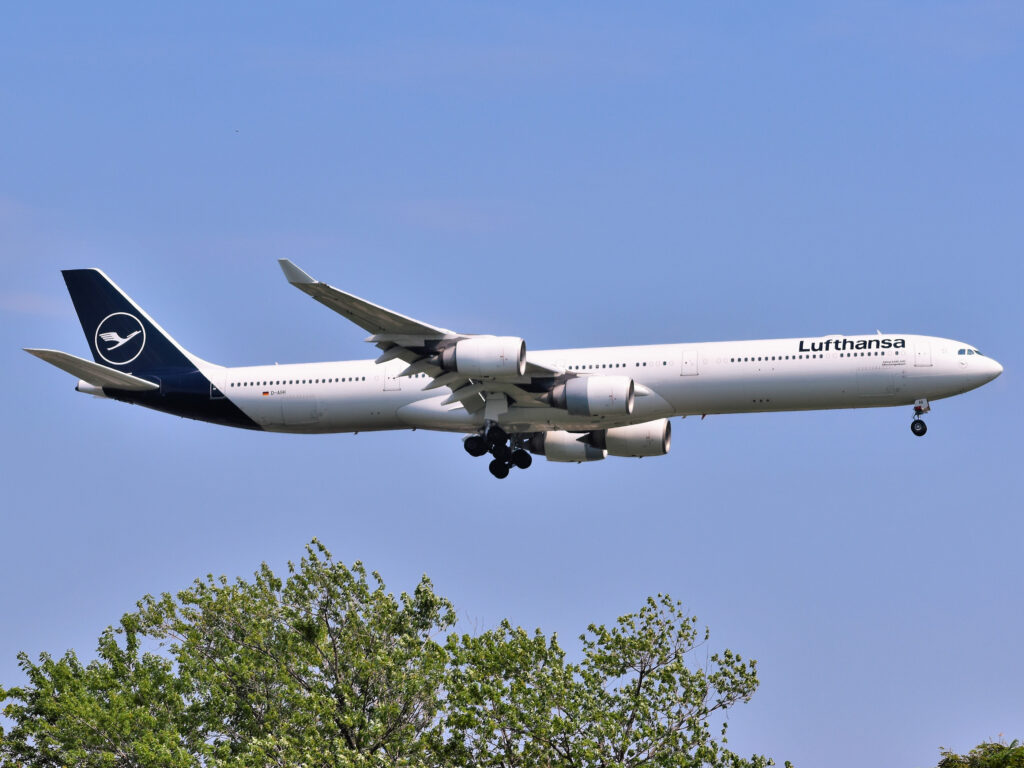
The Airbus A340-600 is the longest member of the A340 family. When it entered service with Virgin Atlantic in 2002 it was the world's longest airliner, built to replace early Boeing 747s on long-haul routes. Airbus delivered 97.
| General Characteristics | |
| Type | Wide-body jet airliner, Civil and Commercial Aircraft |
|---|---|
| National Origin | Multi-national |
| Manufacturer | Airbus |
| Variants | A340-600, A340-600HGW (High Gross Weight) |
| Status | Out of production (2001–2011); few remain in service |
| First Flight | 23 April 2001 |
| Introduction | August 2002 with Virgin Atlantic |
| Primary Users | Lufthansa (retired October 2026), Virgin Atlantic (historical), Iberia (historical), Mahan Air |
| Number Built | 97 delivered |
| Developed From | Airbus A340-300 |
| Capacity & Dimensions | |
| Cockpit Crew | Two |
| Typical Seating | 320–370 (three classes) |
| Max Seating | 440–475 (exit limit) |
| Overall Length | 75.36 m (247 ft 3 in) |
| Wing Span | 63.45 m (208 ft 2 in) |
| Wing Sweep | 31.1° |
| Wing Area | 437.3 m² (4,707 sq ft) |
| Overall Height | 17.93 m (58 ft 10 in) |
| Weights, Powerplant & Performance | |
| MTOW | 380,000 kg (837,800 lb) |
| OEW | 174,000 kg (383,600 lb) |
| Fuel Capacity | 155,500 kg (342,800 lb) without auxiliary tank |
| Engines | 4 × Rolls-Royce Trent 556 turbofans (Trent 560 on the -600HGW) |
| Max. Thrust | 248–275 kN (55,780–61,900 lbf) each |
| Typical Cruise Speed | Mach 0.82 at 11,900 m (39,000 ft) |
| Max. Speed | Mach 0.86 |
| Range | 14,450 km (7,800 nmi) with three-class seating |
| Takeoff Distance | 3,400 m (11,150 ft) at MTOW, sea level, ISA |
| Service Ceiling | 12,634 m (41,450 ft) |
The Airbus A340-600 is the longest version of Airbus’s four-engine A340. At 75.36 m (247 ft 3 in), it was the longest airliner in the world when it entered service in 2002, longer than both the Boeing 747-400 and, later, the A380. Airbus designed it to replace early Boeing 747s on long-haul routes, offering a similar number of seats with lower trip costs. It first flew on 23 April 2001, Virgin Atlantic began flying it in August 2002, and Airbus delivered 97 before production ended.
A Stretched A340
In the late 1990s Airbus launched two new, heavier A340s at the same time: the ultra-long-range A340-500 and the high-capacity -600. Both share a new, larger wing of 437.3 m² (4,707 sq ft) with more sweep, a larger tail, more fuel and four Rolls-Royce Trent 500 engines in place of the CFM56s of the A340-300.
The -600 is almost 12 m longer than the -300. Its maximum take-off weight of 380 tonnes is carried by a four-wheel bogie on the fuselage centreline, between the two main gear legs under the wings. It has five passenger doors on each side. Because the fuselage is so long, pilots taxi with the help of a camera system that shows the nose and main gear on the cockpit screens, so they can keep the wheels on the taxiway in tight turns.
The Cabin
A typical three-class A340-600 seated around 380 passengers, about the same as a 747-200 but with roughly a quarter more cargo space under the floor. The long lower deck also gave airlines new options: Lufthansa moved some lavatories and crew rest areas downstairs, freeing space in the main cabin for more seats.
The A340-600HGW
The A340-600HGW (High Gross Weight) first flew on 18 November 2005 and was certified on 14 April 2006. A strengthened structure, more fuel and Trent 560 engines of 275 kN (61,900 lbf) each raised its range to about 14,600 km (7,900 nmi). Airbus used new production methods on this version, including laser-beam welding of fuselage panels. Qatar Airways took delivery of four, the first in September 2006.
Engines
Both the A340-500 and the -600 are powered only by the Rolls-Royce Trent 500, a three-shaft turbofan that Rolls-Royce developed for these two aircraft from the Trent 700 used on many A330s. Airbus did not offer an alternative engine, so every A340-600 left Toulouse with Rolls-Royce power. With four engines, the -600 could also fly long overwater routes without the diversion-time limits that applied to twin-engine aircraft, although by the time it entered service those rules had been relaxed for twins.
Rivals and Retirement
The A340-600 competed directly with the Boeing 777-300ER, and the twin-engine 777 won the market. The four-engine A340 burned noticeably more fuel per seat, a gap that widened as fuel prices rose. Virgin Atlantic, Iberia, Cathay Pacific, South African Airways, Etihad and others flew the -600, and most retired it in the 2010s.
Lufthansa became the last large operator. It grounded its A340-600s at the start of the COVID-19 pandemic and announced their retirement in 2021, but brought them back in 2022 when demand returned and new aircraft were delayed. The airline flew its last scheduled A340-600 service in October 2026. Airbus’s successor for this size class is the A350-1000, which carries a similar load on two engines.
The A340 Family
| Model | Length | Span | Typical seats (3-class) | Range | Built |
|---|---|---|---|---|---|
| A340-200 | 59.4 m (194 ft 11 in) | 60.3 m (197 ft 10 in) | 210–250 | 13,500 km (7,300 nmi) | 28 |
| A340-300 | 63.69 m (208 ft 11 in) | 60.3 m (197 ft 10 in) | 250–290 | 12,408 km (6,700 nmi) | 218 |
| A340-500 | 67.93 m (222 ft 10 in) | 63.45 m (208 ft 2 in) | 270–310 | 16,670 km (9,000 nmi) | 34 |
| A340-600 | 75.36 m (247 ft 3 in) | 63.45 m (208 ft 2 in) | 320–370 | 14,450 km (7,800 nmi) | 97 |
Sources
- Airbus: A340 aircraft characteristics for airport planning
- Wikipedia: Airbus A340 (used to check dates, delivery totals and the specification table)
- Runway Girl Network: Lufthansa bids farewell to its last Airbus A340-600 (October 2026)
Start the discussion
Commenting on this aircraft: Airbus A340-600