Airbus A340-500
The Airbus A340-500 was the world's longest-range airliner when it entered service in 2003. Singapore Airlines used it for an 18-hour nonstop between Singapore and Newark, but its fuel burn kept sales low: Airbus delivered only 34.
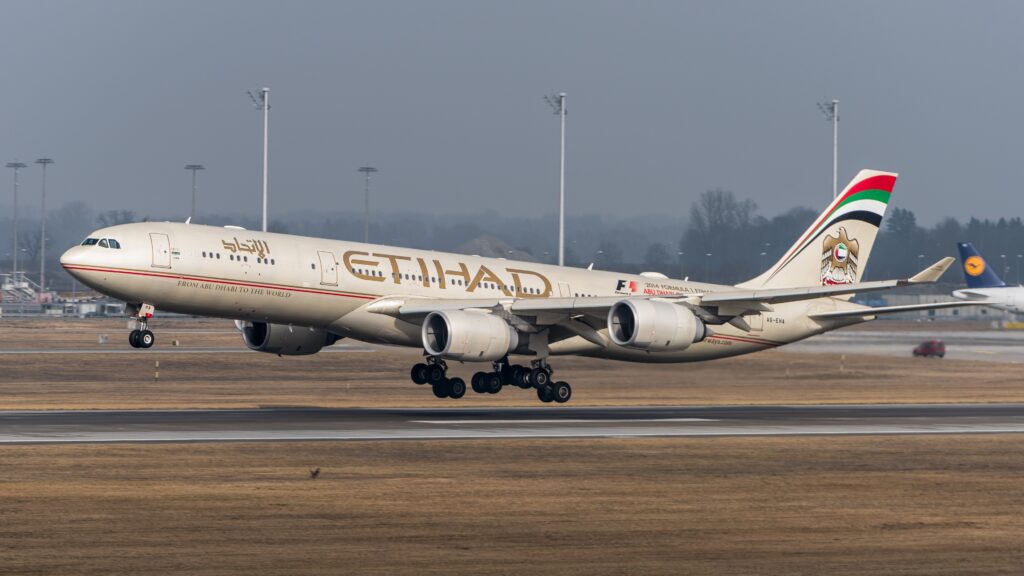
| General Characteristics | |
| Type | Wide-body jet airliner, Civil and Commercial Aircraft |
|---|---|
| National Origin | Multi-national |
| Manufacturer | Airbus |
| Variants | A340-500, A340-500IGW (Increased Gross Weight) |
| Status | Out of production (2002–2012); mainly government and VIP use |
| First Flight | 11 February 2002 |
| Introduction | 2003 with Emirates |
| Primary Users | Emirates (historical), Singapore Airlines (historical), Etihad Airways (historical), Qatar Amiri Flight |
| Number Built | 34 delivered |
| Developed From | Airbus A340-300 |
| Capacity & Dimensions | |
| Cockpit Crew | Two |
| Typical Seating | 270–310 (three classes) |
| Max Seating | 375 (exit limit) |
| Overall Length | 67.93 m (222 ft 10 in) |
| Wing Span | 63.45 m (208 ft 2 in) |
| Wing Sweep | 31.1° |
| Wing Area | 437.3 m² (4,707 sq ft) |
| Overall Height | 17.53 m (57 ft 6 in) |
| Weights, Powerplant & Performance | |
| MTOW | 380,000 kg (837,800 lb) |
| OEW | 168,000 kg (370,400 lb) |
| Fuel Capacity | 175,200 kg (386,200 lb) |
| Engines | 4 × Rolls-Royce Trent 553 turbofans (Trent 556 on the -500IGW) |
| Max. Thrust | 248–275 kN (55,780–61,900 lbf) each |
| Typical Cruise Speed | Mach 0.82 at 11,900 m (39,000 ft) |
| Max. Speed | Mach 0.86 |
| Range | 16,670 km (9,000 nmi) with three-class seating |
| Takeoff Distance | 3,350 m (11,000 ft) at MTOW, sea level, ISA |
| Service Ceiling | 12,634 m (41,450 ft) |
The Airbus A340-500 was built for one job: flying further without stopping than any airliner before it. When it entered service in 2003, it was the longest-range commercial aircraft in the world, able to cover about 16,670 km (9,000 nmi) with three-class seating. It made possible some of the longest scheduled flights ever operated, but its high fuel burn meant only 34 were delivered.
Development
Airbus developed the -500 together with the larger A340-600, giving both a new, larger wing, a bigger tail and four Rolls-Royce Trent 500 engines. The -500 is 4.3 m longer than the A340-300 but much shorter than the -600, and it uses the extra space and weight for fuel rather than passengers: its tanks hold about 175 tonnes, around half as much again as the -300’s.
The A340-500 first flew on 11 February 2002 and was certified on 3 December 2002. Air Canada was due to be the launch customer, but it entered bankruptcy protection in early 2003, so Emirates received the first aircraft and used it to open nonstop flights from Dubai to New York, the airline’s first route to the Americas.
Design
To carry the extra weight, the centreline main landing gear became a four-wheel bogie, although the -500 does not need the additional strengthening of the longer -600. The four Trent 553 engines produce about 248 kN (55,780 lbf) of thrust each. A camera taxiing aid, standard on the -600, was an option. The cockpit kept the fly-by-wire controls and glass displays of the earlier A340 and A330, so crews could move between the types easily.
A heavier A340-500IGW (Increased Gross Weight) first flew on 13 October 2006. Using the strengthened structure of the -600HGW and Trent 556 engines, it could fly about 17,000 km (9,200 nmi).
Record Flights
The A340-500’s best-known route was Singapore Airlines’ nonstop service between Singapore and Newark, New York. Flown in a business-class-only layout in its final years, the flight covered about 15,344 km and took around 18 hours, and for years it was the longest scheduled nonstop flight in the world. Thai Airways, Etihad and Arik Air also used the -500 for very long routes.
Range in Practice
On paper the A340-500 could fly from London to Perth in Western Australia without stopping, although headwinds on the way back would have forced a fuel stop. Real range always depends on how many passengers and how much cargo are on board. Singapore Airlines first flew its -500s with 181 seats in two classes, then switched to a lighter cabin of only 100 business-class seats, which made the very long sectors easier to fly with a sensible payload.
Why So Few Were Built
The A340-500 carried a large structure and a huge fuel load for comparatively few passengers. Ultra-long flights are only profitable when enough passengers will pay premium fares, and when fuel prices rose sharply in the late 2000s the economics no longer worked. Singapore Airlines ended its Newark flights in 2013 and returned its aircraft to Airbus as part of an order for the A350; Emirates also retired its fleet early. The route itself came back in 2018 with the A350-900ULR, which flies further on two engines.
Today the few A340-500s still flying are mostly government and VIP transports, such as those of the Qatar Amiri Flight and the Royal Thai Air Force.
The A340 Family
| Model | Length | Span | Typical seats (3-class) | Range | Built |
|---|---|---|---|---|---|
| A340-200 | 59.4 m (194 ft 11 in) | 60.3 m (197 ft 10 in) | 210–250 | 13,500 km (7,300 nmi) | 28 |
| A340-300 | 63.69 m (208 ft 11 in) | 60.3 m (197 ft 10 in) | 250–290 | 12,408 km (6,700 nmi) | 218 |
| A340-500 | 67.93 m (222 ft 10 in) | 63.45 m (208 ft 2 in) | 270–310 | 16,670 km (9,000 nmi) | 34 |
| A340-600 | 75.36 m (247 ft 3 in) | 63.45 m (208 ft 2 in) | 320–370 | 14,450 km (7,800 nmi) | 97 |
Sources
- Airbus: A340 aircraft characteristics for airport planning
- Wikipedia: Airbus A340 (used to check dates, delivery totals and the specification table)
Start the discussion
Commenting on this aircraft: Airbus A340-500