Boeing 747-100 Original Jumbo Jet
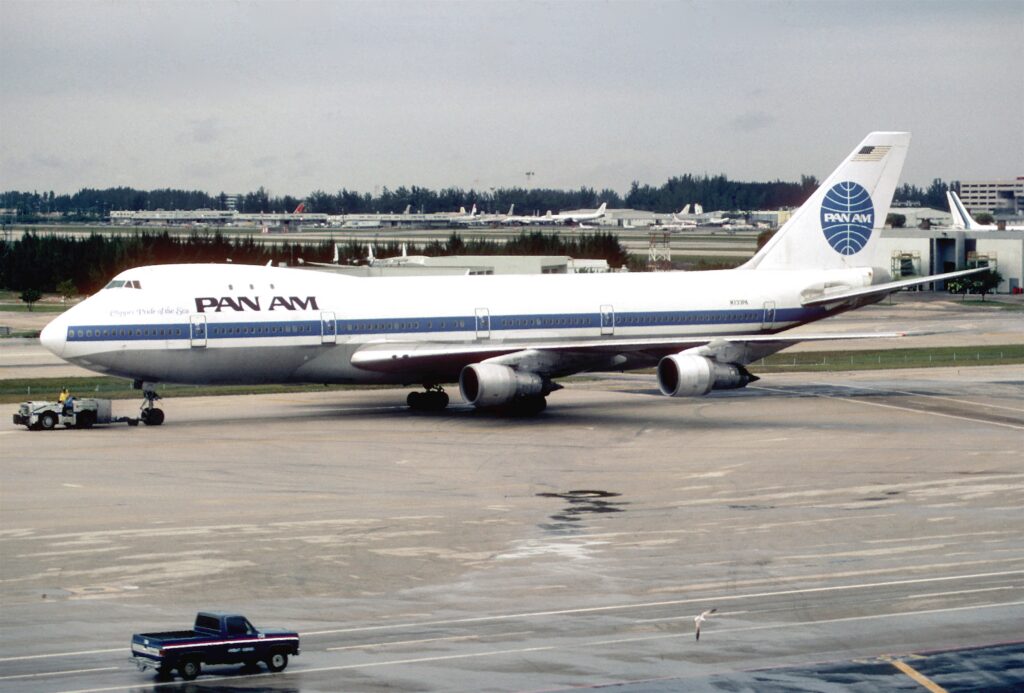
The Boeing 747-100 was the original jumbo jet. It first flew on 9 February 1969 and entered service with Pan Am in January 1970; 205 were built, including the high-density 747SR and the heavier 747-100B.
| General Characteristics | |
| Type | Wide-body jet airliner, Civil and Commercial Aircraft |
|---|---|
| National Origin | United States |
| Manufacturer | Boeing |
| Variants | 747-100, 747-100B, 747SR (-100SR, -100BSR); 747SP derived from it |
| Status | Out of production; retired from passenger service |
| First Flight | 9 February 1969 |
| Introduction | 22 January 1970 with Pan Am |
| Primary Users | Pan Am, Trans World Airlines, Japan Airlines, All Nippon Airways (historical); NASA Shuttle Carrier Aircraft |
| Number Built | 205 (167 747-100, 9 747-100B, 29 747SR) |
| Capacity & Dimensions | |
| Cockpit Crew | Three (two pilots and a flight engineer) |
| Typical Seating | 366 (Boeing typical layout) |
| Overall Length | 70.66 m (231 ft 10 in) |
| Wing Span | 59.64 m (195 ft 8 in) |
| Wing Sweep | 37.5° |
| Wing Area | 511 m² (5,500 sq ft) |
| Overall Height | 19.33 m (63 ft 5 in) |
| Weights, Powerplant & Performance | |
| MTOW | 333.4–340.2 t (735,000–750,000 lb) |
| OEW | 162.4–173.0 t (358,000–381,480 lb) |
| Fuel Capacity | 178,710–183,380 L (47,210–48,445 US gal) |
| Engines | 4 × Pratt & Whitney JT9D turbofans (General Electric CF6-45 on some 747SR aircraft) |
| Max. Thrust | 193–230 kN (43,500–51,600 lbf) each |
| Typical Cruise Speed | Mach 0.84 |
| Range | 8,560 km (4,620 nmi) with 366 passengers and baggage |
| Takeoff Distance | 3,250 m (10,650 ft) |
The Boeing 747-100 is the original version of the Boeing 747, the aircraft that introduced the wide-body era. The prototype, N7470 “City of Everett”, first flew on 9 February 1969, and Pan Am flew the first passenger service from New York to London on 22 January 1970. With seats for about 366 people in a typical layout, the 747-100 carried more than twice as many passengers as the Boeing 707 it was designed to supplement.
Development
Pan Am launched the 747 in April 1966 with an order for 25 aircraft. Boeing designed it, built a new factory at Everett, Washington, and flew it in under three years. The fast pace caused problems: the new Pratt & Whitney JT9D engines suffered stalls and casing distortion, and in the second half of 1969 a number of finished airframes waited at Everett for engines. The type received its FAA certificate in December 1969, just weeks before entering service.
Early 747-100s had only three windows on each side of the short upper deck, because Pan Am and other airlines first used the space as a lounge reached by a spiral staircase. When airlines began putting seats upstairs, Boeing offered a ten-window upper deck, first on aircraft for United Airlines, and some older aircraft were converted.
Design
The 747-100 set the shape every later 747 followed: a twin-aisle fuselage up to ten seats wide, a raised flight deck that leaves room for a nose cargo door, and a large wing swept at 37.5 degrees. The wing area is 511 m² (5,500 sq ft), and the aircraft is 70.66 m (231 ft 10 in) long with a span of 59.64 m (195 ft 8 in).
The flight deck has three crew stations: two pilots and a flight engineer, who managed the fuel, electrical, hydraulic and air systems from a side panel. Four hydraulic systems power the flight controls, and the 16-wheel main landing gear spreads the aircraft’s weight over four legs.
Engines and Performance
All standard 747-100s were powered by four Pratt & Whitney JT9D turbofans, at first the -3A version and later improved -7 models, giving between 193 and 230 kN (43,500 and 51,600 lbf) of thrust each. The maximum take-off weight is 333.4 to 340.2 t (735,000 to 750,000 lb), depending on the build standard. Boeing quotes a range of 8,560 km (4,620 nmi) with 366 passengers and their baggage, enough for transatlantic routes but marginal for the longest routes airlines wanted to fly. That limit led directly to the heavier and more powerful 747-200.
Sub-variants
- 747SR (Short Range): built for Japan Air Lines and later All Nippon Airways for busy domestic routes. It had a strengthened structure for many more take-offs and landings and less fuel. Seven -100SRs and 20 -100BSRs were built, and two -100BSR SUD aircraft for JAL had the long upper deck of the 747-300, giving up to 563 seats.
- 747-100B: a heavier version based on the strengthened SR structure, with a maximum take-off weight of up to 750,000 lb and more fuel. Only nine were built, for Iran Air and Saudi Arabian Airlines.
- 747SP: a shortened long-range derivative that entered service in 1976. It has its own family of figures and is not part of the -100 count.
In total, 205 aircraft of the 747-100 family were delivered: 167 standard 747-100s, nine -100Bs and 29 747SRs.
Later Life
As the 747-200 and 747-400 arrived, many 747-100s were converted into freighters, flown by charter airlines or used for spare parts. NASA modified two of them, N905NA and N911NA, as Shuttle Carrier Aircraft to fly the Space Shuttle orbiters across the United States on their backs. The last passenger flights by a 747-100 were made by Iran Air, which retired its sole 747-100B, EP-IAM, in 2014. The original prototype, N7470, is preserved at the Museum of Flight in Seattle.
Start the discussion
Commenting on this aircraft: Boeing 747-100 Original Jumbo Jet