Boeing 767-300ER
The Boeing 767-300ER is the extended-range version of the stretched 767. It entered service with American Airlines in 1988 and became the aircraft that made twin-engine flights across the North Atlantic common.
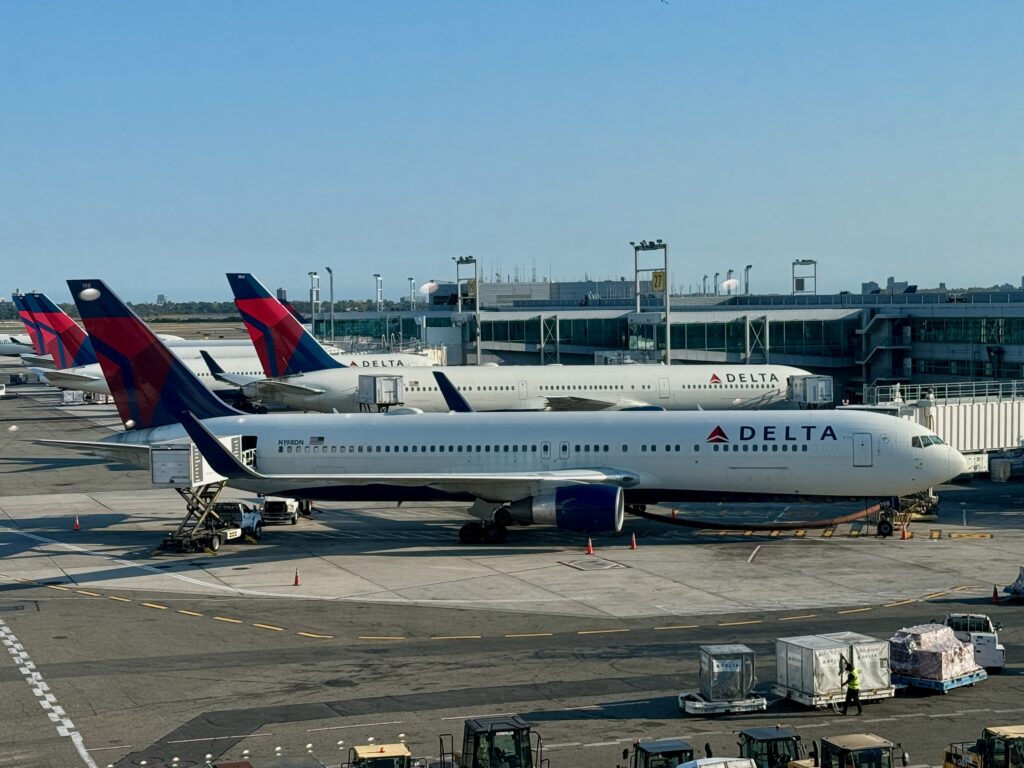
| General Characteristics | |
| Type | Wide-body jet airliner, Civil and Commercial Aircraft |
|---|---|
| National Origin | United States |
| Manufacturer | Boeing |
| Variants | 767-300, 767-300ER, 767-300F, KC-46 Pegasus (derivative) |
| Status | In service |
| First Flight | 9 December 1986 |
| Introduction | 3 March 1988 with American Airlines |
| Primary Users | Delta Air Lines, United Airlines, American Airlines (retired 2020), LATAM |
| Developed From | Boeing 767-300 |
| Capacity & Dimensions | |
| Cockpit Crew | Two |
| Typical Seating | 218 (three-class), 261 (two-class) |
| Max Seating | 290 (all economy), 299 with extra exit doors |
| Overall Length | 54.94 m (180 ft 3 in) |
| Wing Span | 47.57 m (156 ft 1 in) |
| Wing Sweep | 31.5° |
| Wing Area | 283.3 m² (3,049 sq ft) |
| Overall Height | 16.03 m (52 ft 7 in) |
| Weights, Powerplant & Performance | |
| MTOW | 186,880 kg (412,000 lb) |
| OEW | 90,011 kg (198,440 lb) |
| Fuel Capacity | 91,380 L (24,140 US gal) |
| Engines | 2 × Pratt & Whitney PW4000, GE CF6-80C2 or Rolls-Royce RB211-524H |
| Max. Thrust | about 270 kN (60,000 lbf) each (PW4060) |
| Typical Cruise Speed | 850 km/h (459 kn) at 12,000 m (39,000 ft) |
| Range | 10,670–11,070 km (5,760–5,980 nmi) |
| Service Ceiling | 13,100 m (43,100 ft) |
The Boeing 767-300ER is the extended-range version of the stretched Boeing 767, and the version that sold best. It first flew on 9 December 1986 and entered service with American Airlines on 3 March 1988. More than any other aircraft, it made it normal for airlines to cross the North Atlantic with only two engines, and for 20 years it was a common sight at airports from New York to Tokyo.
From Short-Haul Widebody to Ocean Crosser
Boeing launched the 767 in 1978 as a medium-range widebody, and the first version, the 767-200, entered service in 1982. The 767-300 followed in 1986 with a fuselage 6.4 m longer. Airlines soon asked for more range, so Boeing strengthened the structure, added a centre fuel tank and raised the maximum take-off weight. Within a few years the 767-300ER could take off at 186,880 kg (412,000 lb) and fly about 11,000 km. That made routes such as London to Houston or Frankfurt to Chicago possible with an aircraft smaller and cheaper to run than a Boeing 747.
ETOPS: Twin Engines Across the Ocean
Before the mid-1980s, twin-engine airliners had to stay within 60 minutes’ flying time of a suitable airport. ETOPS rules (Extended-range Twin-engine Operational Performance Standards) allowed operators with proven reliability to fly up to 120 minutes, and later 180 minutes, from the nearest airport. The 767 was the type that proved the idea worked. By the 1990s, more flights crossed the North Atlantic on 767s than on any other aircraft, and the four-engine 747 gave way to twins on many routes.
Cabin and Design
The 767 cabin is 4.72 m wide. The usual economy layout is seven seats across, 2-3-2, so most passengers have a window or an aisle. In two classes the 767-300ER typically seats about 261, or 218 in three classes. The two-crew flight deck was designed at the same time as the 757’s, and pilots can fly both types on one type rating. Many 767-300ERs were later fitted with blended winglets made by Aviation Partners Boeing, which add about 4.3 m to the span and cut fuel burn on long flights.
Engines and Performance
Buyers could choose between the Pratt & Whitney PW4000, the General Electric CF6-80C2 and the Rolls-Royce RB211-524H. With PW4060 engines of about 270 kN (60,000 lbf) each, the aircraft cruises at around 850 km/h at 39,000 ft and has a range of about 10,670 km (5,760 nmi); Boeing quotes up to 11,070 km (5,980 nmi) for the heaviest version.
Freighters and Tankers
Passenger 767s are being retired as airlines move to the 787 and A330neo, but the airframe has a long second life. The 767-300F freighter is flown by FedEx, UPS and others, and many retired 767-300ERs have been converted to cargo aircraft for e-commerce networks. The US Air Force’s KC-46 Pegasus tanker is also built on the 767 line in Everett. By October 2026 Boeing had delivered 1,380 767s of all versions.
How It Compares
The 767-300ER competed directly with the Airbus A330-200, which offered more range and a wider cabin. Its long-haul successor at Boeing is the Boeing 787-8, which flies further on about 20% less fuel.
The 767-300ER Today
Delta Air Lines and United Airlines still fly the 767-300ER on transatlantic and some domestic routes, many with lie-flat business-class seats fitted during the 2010s. Both airlines plan to replace their passenger 767s with newer widebodies over the next few years. Cargo airlines are moving the other way: retired 767-300ERs are cheap to buy, the conversion is well proven, and the converted aircraft fit neatly between narrow-body freighters and large widebodies.
Frequently Asked Questions
How many seats does a Boeing 767-300ER have? Typically 218 in three classes or about 261 in two classes.
What does ER mean on the 767-300ER? Extended Range: a heavier take-off weight and more fuel for longer flights.
Is the Boeing 767 still in production? Yes, as the 767-300F freighter and the KC-46 tanker.
Start the discussion
Commenting on this aircraft: Boeing 767-300ER