Boeing 777-200/200ER
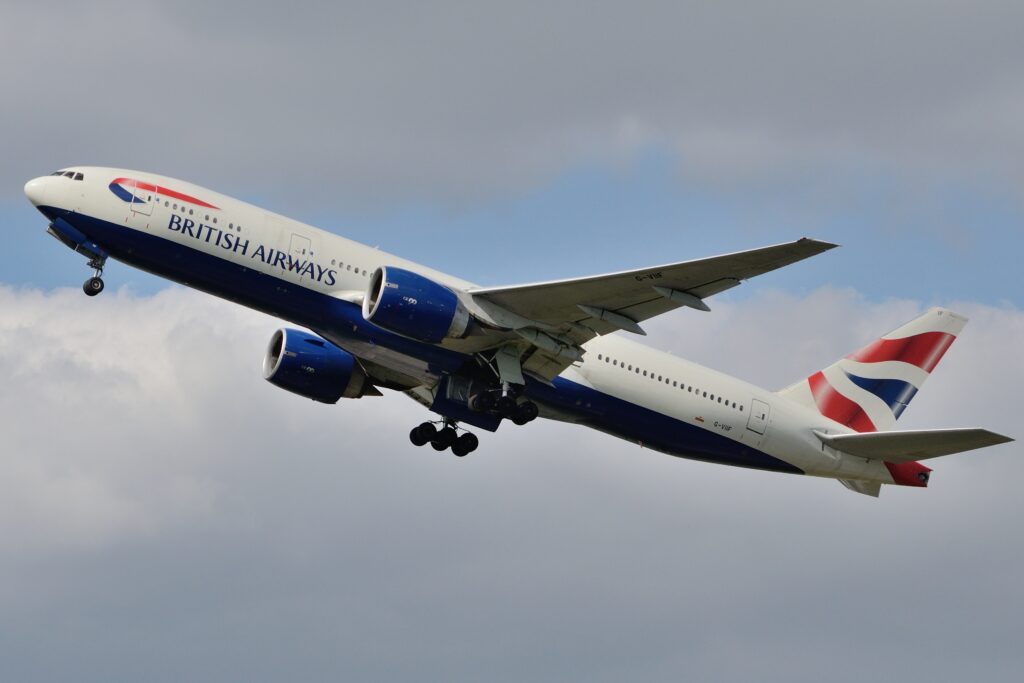
The Boeing 777-200 and 777-200ER were the first versions of the 777, the world's largest twinjet. The -200 entered service with United Airlines in 1995, and the longer-range -200ER, first delivered to British Airways in 1997, became one of the most successful long-haul aircraft ever built.
| General Characteristics | |
| Type | Wide-body jet airliner, Civil and Commercial Aircraft |
|---|---|
| National Origin | United States |
| Manufacturer | Boeing |
| Variants | 777-200, 777-200ER |
| Status | In service; out of production |
| First Flight | 12 June 1994 |
| Introduction | June 1995 with United Airlines (777-200); February 1997 with British Airways (777-200ER) |
| Primary Users | United Airlines, British Airways, American Airlines, Singapore Airlines |
| Number Built | 88 (777-200) and 422 (777-200ER) |
| Capacity & Dimensions | |
| Cockpit Crew | Two |
| Typical Seating | 305 (three-class); 313 (two-class) |
| Max Seating | 440 (exit limit) |
| Overall Length | 63.73 m (209 ft 1 in) |
| Wing Span | 60.93 m (199 ft 11 in) |
| Wing Sweep | 31.6° |
| Wing Area | 427.8 m² (4,605 sq ft) |
| Overall Height | 18.5 m (60 ft 9 in) |
| Weights, Powerplant & Performance | |
| MTOW | 247,200 kg (545,000 lb); 777-200ER: 297,550 kg (656,000 lb) |
| OEW | 135,850 kg (299,550 lb); 777-200ER: 138,100 kg (304,500 lb) |
| Fuel Capacity | 117,340 L (31,000 US gal); 777-200ER: 171,171 L (45,220 US gal) |
| Engines | 2 × Pratt & Whitney PW4000, Rolls-Royce Trent 800 or General Electric GE90 |
| Max. Thrust | 343 kN (77,200 lbf) each; 777-200ER: 417 kN (93,700 lbf) each |
| Typical Cruise Speed | Mach 0.84 |
| Max. Speed | Mach 0.87–0.89 |
| Range | 9,700 km (5,240 nmi); 777-200ER: 13,080 km (7,065 nmi) |
| Takeoff Distance | 2,440 m (8,000 ft); 777-200ER: 3,380 m (11,100 ft) |
| Service Ceiling | 13,140 m (43,100 ft) |
The Boeing 777-200 and 777-200ER were the first two versions of the Boeing 777, the largest twin-engine airliner in the world when it entered service. The 777-200 first flew on 12 June 1994 and began flying passengers with United Airlines in June 1995. The heavier, longer-range Boeing 777-200ER, first delivered to British Airways on 6 February 1997, became the best-selling version of the early 777, with 422 delivered, and it helped make long-haul flying with two engines the normal way to cross oceans.
Designing the 777
In the late 1980s, airlines needed a replacement for the DC-10 and L-1011 TriStar, and Boeing had a gap between its 767 and 747. A group of eight airlines, among them United, American, British Airways, Delta and Japan Airlines, worked with Boeing on the design from the start, an approach Boeing called “Working Together”. They asked for a wider cabin than the 767, flexible interiors and lower operating costs than any 767 stretch. The 777 was also the first airliner designed entirely on computer, using the CATIA 3D system, so that parts fitted together before any metal was cut.
Design and Technology
The 777 was Boeing’s first airliner with fly-by-wire flight controls, although it kept a traditional control yoke rather than a side-stick. Its large wing, with 31.6° of sweep and an area of 427.8 m², gives it good take-off performance and a high cruise speed of about Mach 0.84. The fuselage is 6.20 m wide, wide enough for nine or ten seats across in economy. Each main landing gear leg has six wheels, the largest gear of any airliner when it first flew. The 777-200 was also the first aircraft to be approved for 180-minute ETOPS operations from the day it entered service, which allowed airlines to fly it across the Atlantic and Pacific straight away.
Engines
Airlines could choose from three engines: the Pratt & Whitney PW4000, the Rolls-Royce Trent 800 and the General Electric GE90. The GE90 has a fan 3.12 m across, and for many years it was the largest jet engine in service. On the basic 777-200 each engine gives about 343 kN (77,200 lbf) of thrust, and on the 777-200ER up to 417 kN (93,700 lbf).
777-200 vs 777-200ER
The two versions have the same size: 63.73 m (209 ft 1 in) long with a wingspan of 60.93 m (199 ft 11 in). The difference is weight and fuel.
- 777-200: maximum take-off weight 247,200 kg, fuel capacity 117,340 litres and a range of about 9,700 km (5,240 nmi). It was aimed mainly at US domestic and regional routes. Nine customers took 88 aircraft.
- 777-200ER: originally called the 777-200IGW (increased gross weight). Maximum take-off weight 297,550 kg, fuel capacity 171,171 litres and a range of about 13,080 km (7,065 nmi), enough for London to Singapore or Los Angeles to Sydney with a fuel stop to spare on most routes. Thirty-three customers took 422 aircraft.
Some airlines, such as Singapore Airlines, ordered -200ERs with engines de-rated to lower thrust, which cut purchase price and landing fees on shorter routes; the engines could later be re-rated to full power.
In Service
United Airlines, the launch customer, flew its first 777 revenue flight from London Heathrow to Washington Dulles on 7 June 1995, and it still uses its -200s on US domestic routes and flights to Hawaii. British Airways, American Airlines, Delta, Singapore Airlines, Air France, Emirates and Malaysia Airlines all flew large fleets of -200ERs. Later variants such as the 777-300ER took over many long-haul routes, and Boeing now offers the 787-10 and the 777-9 in its place. Many early -200ERs are now being retired, while others continue as cargo conversions.
Safety Record
The 777 has a strong safety record, but the -200ER has been involved in several well-known accidents. British Airways Flight 38 lost power on both engines on final approach to Heathrow in January 2008 because ice crystals in the fuel blocked the fuel-oil heat exchangers; all on board survived. Malaysia Airlines Flight 370 disappeared over the Indian Ocean in March 2014, and Malaysia Airlines Flight 17 was shot down over eastern Ukraine in July 2014.
Frequently Asked Questions
What is the difference between the 777-200 and the 777-200ER? They are the same size, but the -200ER is heavier, carries more fuel and flies about 3,400 km further.
How many 777-200ERs were built? 422, delivered to 33 customers.
Is the 777-200ER still in production? No. Boeing no longer offers the -200 or -200ER.
Start the discussion
Commenting on this aircraft: Boeing 777-200/200ER