Boeing 777F (Freighter)
The Boeing 777F is the cargo version of the 777-200LR and the largest twin-engine freighter in service. Since its first delivery to Air France in 2009 it has become the backbone of long-haul air cargo for FedEx, DHL, Qatar Airways Cargo and many others.
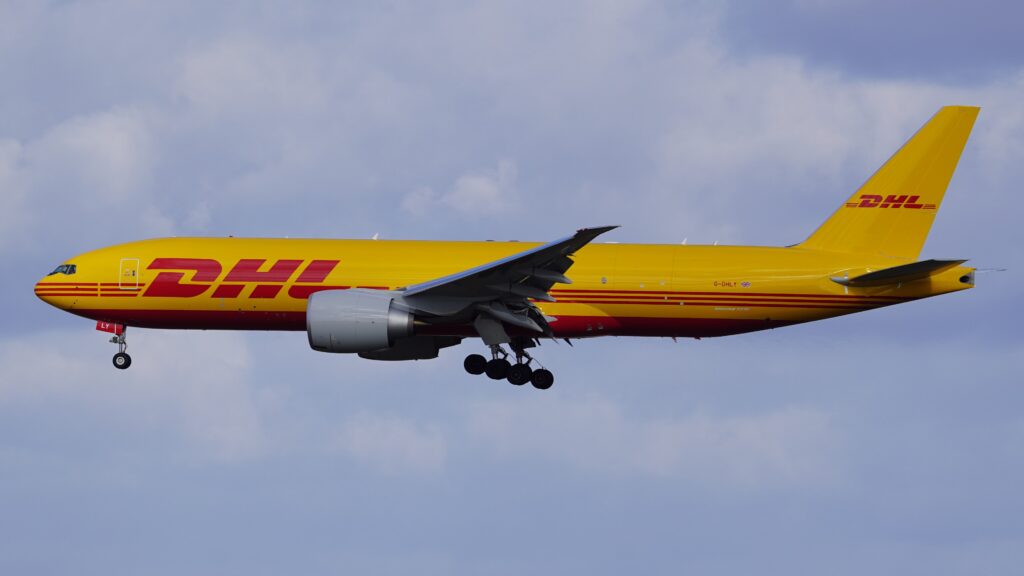
| General Characteristics | |
| Type | Wide-body jet airliner, Cargo Aircraft, Civil and Commercial Aircraft |
|---|---|
| National Origin | United States |
| Manufacturer | Boeing |
| Variants | 777F |
| Status | In production and in service |
| First Flight | 14 July 2008 |
| Introduction | February 2009 with Air France |
| Primary Users | FedEx Express, Qatar Airways Cargo, DHL, Cathay Cargo |
| Developed From | Boeing 777-200LR |
| Capacity & Dimensions | |
| Cockpit Crew | Two |
| Max Seating | 11 (supernumerary area and flight deck) |
| Overall Length | 63.73 m (209 ft 1 in) |
| Wing Span | 64.80 m (212 ft 7 in) |
| Wing Sweep | 31.6° |
| Wing Area | 436.8 m² (4,702 sq ft) |
| Overall Height | 18.6 m (61 ft 1 in) |
| Weights, Powerplant & Performance | |
| MTOW | 347,815 kg (766,800 lb) |
| OEW | 144,379 kg (318,300 lb) |
| Fuel Capacity | 181,283 L (47,890 US gal) |
| Engines | 2 × General Electric GE90-110B1 |
| Max. Thrust | 489 kN (110,000 lbf) each |
| Typical Cruise Speed | Mach 0.84 |
| Max. Speed | Mach 0.87–0.89 |
| Range | 9,200 km (4,970 nmi) at maximum payload |
| Takeoff Distance | 2,830 m (9,300 ft) |
| Service Ceiling | 13,140 m (43,100 ft) |
The Boeing 777F (777 Freighter) is the all-cargo version of the Boeing 777 and the largest twin-engine freighter flying today. Based on the long-range 777-200LR, it can carry a maximum payload of about 103.7 tonnes (228,700 lb) and fly about 9,200 km (4,970 nmi) fully loaded. The 777F first flew on 14 July 2008, was certified by the FAA and EASA on 6 February 2009, and was first delivered to Air France on 19 February 2009. It remains in production at Everett, Washington.
From Passenger Jet to Freighter
Boeing built the 777F by combining the airframe, wing and engines of the 777-200LR with fuel tanks derived from the 777-300ER. The passenger windows and doors were removed, a large main-deck cargo door was added behind the wing on the left side, and the floor was strengthened to take heavy pallets. Behind the flight deck is a rigid cargo barrier with a small area for up to four extra people, with business-class seats, two crew bunks, a galley and a toilet, so that relief pilots or couriers can travel with the cargo.
Payload and Range
The 777F’s maximum take-off weight is 347,815 kg (766,800 lb). Its maximum payload of about 103.7 tonnes is close to that of the four-engine Boeing 747-200F, which it was designed to replace, but it burns far less fuel because it has two engines rather than four. With a full load the 777F can fly about 9,200 km (4,970 nmi), enough to link Hong Kong and Anchorage or Frankfurt and Chicago non-stop, and with a light load it can fly up to about 18,000 km (9,750 nmi). The main deck holds 27 standard pallets, and the total cargo volume is about 652.7 m³ (23,051 cu ft).
Engines
The 777F uses two General Electric GE90-110B1 turbofans, each producing up to 489 kN (110,000 lbf) of thrust. Because it uses the same engines as the -200LR and the same family of engines as the 777-300ER, airlines that fly both passenger and cargo 777s can share spare engines and maintenance teams.
Why Cargo Airlines Like It
The 777F replaced older types such as the 747-200F, the MD-11F and the DC-10F. Long-range freighters earn money by flying heavy loads over long distances, and the 777F’s mix of payload, range and fuel efficiency has made it one of the most popular cargo aircraft of its time. It can fly many routes non-stop that older freighters needed a fuel stop for, which saves landing fees and time. Its main-deck height also allows it to carry large items such as engines and racing cars, although it cannot load through the nose like the 747 freighter.
Operators
FedEx Express is the largest operator of the 777F. Other large fleets fly with Qatar Airways Cargo, DHL, Cathay Cargo, Emirates SkyCargo, Lufthansa Cargo, Turkish Cargo, Korean Air, China Airlines and Air China Cargo. The aircraft is also used for charter work, including the transport of racehorses, livestock and relief supplies.
Future of the 777F
New international rules on aircraft carbon-dioxide emissions mean that the 777F, which was designed in the 2000s, cannot be built in its current form indefinitely. Boeing plans to replace it with the 777-8 Freighter, based on the new 777X family, which will carry more cargo and burn less fuel per tonne. Until then the 777F continues to sell well, helped by strong demand from e-commerce and express carriers.
Frequently Asked Questions
How much cargo can a Boeing 777F carry? About 103.7 tonnes (228,700 lb) at maximum payload.
What is the range of the 777F? About 9,200 km (4,970 nmi) with maximum payload.
Who operates the most 777Fs? FedEx Express has the largest fleet.

Start the discussion
Commenting on this aircraft: Boeing 777F (Freighter)