Korean Air Lines Flight 902 Shootdown: The 1978 Cold War Airspace Incident
The 1978 Cold War Airspace Incident
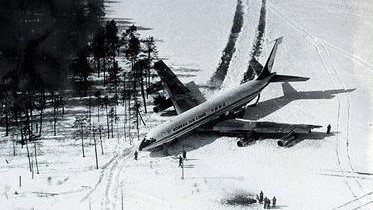
The Korean Air Lines Flight 902 shootdown was a Cold War-era aviation incident that occurred on April 20, 1978, when a civilian passenger aircraft was shot down after unintentionally entering Soviet airspace. The event led to international tensions and renewed attention on navigation errors and military response protocols.
Overview of Korean Air Lines Flight 902
Korean Air Lines Flight 902 was a scheduled international passenger service operating from Paris, France, to Seoul, South Korea, with a stopover in Anchorage, Alaska.
The aircraft involved was a Boeing 707, a widely used long-haul aircraft during the 1970s. On board were passengers and crew completing the long intercontinental journey.
How the Aircraft Entered Soviet Airspace
During the flight over the Arctic region, the aircraft experienced a significant navigational error. The crew mistakenly deviated from their intended route and entered Soviet airspace over the Kola Peninsula.
At the time, navigation systems were less advanced than modern GPS-based systems, relying heavily on inertial navigation and radio aids, which were more prone to drift and error over long distances.
Interception by Soviet Forces
Once the aircraft was detected, Soviet air defense systems scrambled interceptor aircraft. The Boeing 707 was tracked and eventually intercepted by a Sukhoi Su-15.
The Soviet pilots attempted to communicate and signal the aircraft to land, but communication was limited and the situation escalated quickly.
Ultimately, the interceptor fired upon the aircraft, striking it and forcing an emergency descent.
Emergency Landing on a Frozen Lake
Despite severe damage, the aircraft did not crash immediately. The crew managed to perform a forced landing on a frozen lake in northwestern Russia.
The landing was extremely harsh:
- The fuselage sustained major structural damage
- The aircraft broke apart upon impact
- Some passengers survived the initial crash
Soviet rescue teams later reached the site and evacuated survivors.
Casualties and Survivors
The shootdown resulted in:
- Multiple passenger fatalities
- A number of survivors rescued from the crash site
- Significant injuries among those who survived
Although not the deadliest aviation disaster of its time, it was highly significant due to its political context.
Investigation and Political Reaction
The incident was investigated within the context of Cold War tensions. Soviet authorities claimed the aircraft had entered restricted military airspace and did not respond appropriately to interception attempts.
Internationally, the shootdown was widely criticized, particularly because the aircraft was a civilian passenger flight.
The event increased diplomatic tensions between the Soviet Union and South Korea, as well as other Western nations.
Related Military Aviation Event Events
More significant events from aviation history
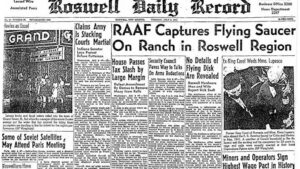
Roswell Incident
🗓 8 July, 1947 📍 33°57′01″N 105°18′51″W / 33.95028°N 105.31417°W / 33.95028; -105.31417 ★★★☆☆ Read full story →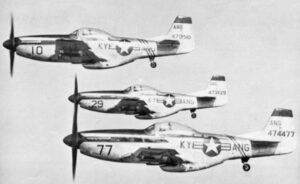
Mantell UFO Incident
🗓 7 January, 1948 📍 United States of America ★★★☆☆ Read full story →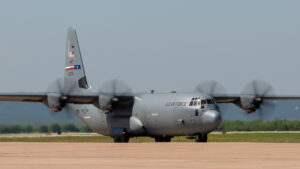
The First Flight of C-130J Super Hercules
🗓 5 April, 1996 ★★☆☆☆ Read full story →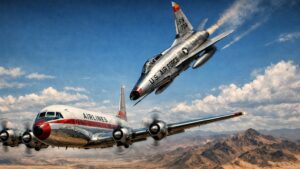
United Airlines Flight 736: The Crash That Changed Aviation
🗓 21 April, 1958 📍 Clark County, Nevada, United States ★★★★☆ Read full story →