United Airlines Flight 736: The Crash That Changed Aviation
Discover the story of United Airlines Flight 736. This fatal 1958 mid-air collision transformed air traffic control forever.
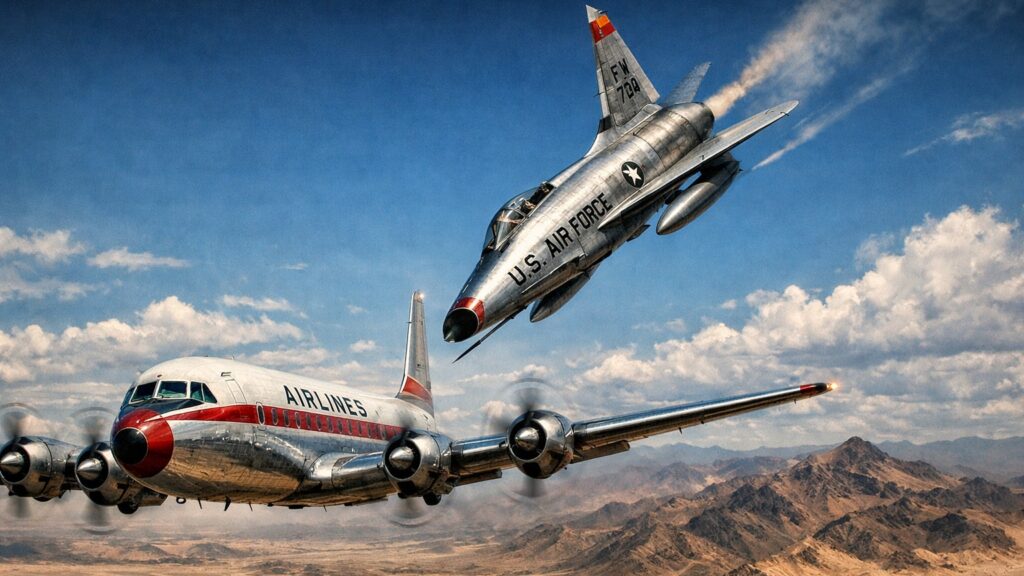
Initially, the skies over Nevada seemed perfectly clear on April 21, 1958. However, disaster struck when United Airlines Flight 736 collided with a military jet. Specifically, a Douglas DC-7 and an Air Force F-100F Super Sabre crashed mid-air. Consequently, all 49 people on board both aircraft perished instantly. Therefore, we will explore how this horrific tragedy fundamentally changed aviation safety forever.
The Routine Journey of United Airlines Flight 736
First, the civilian airliner began a standard transcontinental journey from Los Angeles. Basically, the DC-7 carried 42 passengers and a crew of five. Furthermore, the pilots flew straight and level at an altitude of 21,000 feet. Indeed, they traveled safely within the designated “Victor 8” commercial airway.
The Blind Military Descent
Meanwhile, a military F-100F fighter jet took off from Nellis Air Force Base. Specifically, an instructor and a trainee pilot manned the tandem cockpit. Next, the trainee practiced an instrument-only descent under a blind-flying hood. Therefore, the instructor carried the sole responsibility of spotting outside commercial traffic.
The Fatal Collision Over Las Vegas
Tragically, military and civilian air traffic controllers operated completely independently. As a result, neither crew knew the other aircraft was nearby. Subsequently, the descending fighter jet sliced directly through the right wing of the airliner. Ultimately, the massive aerodynamic forces tore both crippled airplanes apart over the desert.
The Secret Passengers
Interestingly, the passenger list included highly cleared Department of Defense contractors. Specifically, they managed sensitive American ballistic missile programs. Consequently, the military established new travel rules immediately after the crash. Indeed, critical personnel from the same project can no longer fly together.
Creating the FAA: The Legacy of United Airlines Flight 736
Following the crash, investigators blamed high speeds and cockpit visibility limits. Furthermore, they heavily faulted the government for allowing military drills in civilian airways. Therefore, Congress took swift and decisive action against the authorities. Ultimately, they passed the Federal Aviation Act of 1958.
A Unified Airspace
Basically, this landmark legislation created the modern Federal Aviation Administration (FAA). Consequently, the new agency gained absolute authority over all military and civilian airspace. Indeed, the tragic loss of United Airlines Flight 736 finally forced a unified, safe sky.
Frequently Asked Questions (FAQs)
What caused the United Airlines Flight 736 crash? The crash happened because military and civilian air traffic controllers did not communicate. A descending military jet struck the airliner within a designated commercial airway.
Were there any survivors in the collision? No. The mid-air collision caused massive structural damage to both aircraft. All 49 passengers and crew members on both planes died.
How did this accident change aviation rules? The disaster directly led to the creation of the Federal Aviation Agency (FAA). This gave one single government body total control over both civilian and military flights.
So, here is the ultimate question for you: Can you imagine flying today if military jets still trained inside commercial airways without radar warnings? Let us know your thoughts in the comments below!
Related Historical Aviation Accidents Events
More significant events from aviation history
Assassination of Juvénal Habyarimana and Cyprien Ntaryamira: The 1994 Aircraft Shootdown in Rwanda
🗓 6 April, 1994 📍 Presidential Palace gardens, near Kigali International Airport, Kigali, Rwanda, 1°58′32″S 30°10′26″E / 1.9756°S 30.1739°E / -1.9756; 30.1739 ★★★★☆ Read full story →
1996 Charkhi Dadri Collision: The Deadliest Mid-Air Crash
🗓 12 November, 1996 📍 Charkhi Dadri, Haryana, India, 28°33′38″N 76°18′15″E / 28.56056°N 76.30417°E / 28.56056; 76.30417 ★★★★☆ Read full story →
The Tragedy of Lauda Air Flight 004
🗓 26 May, 1991 📍 Phu Toei National Park, Suphan Buri province, Thailand, 14°56′48″N 99°27′10″E / 14.94667°N 99.45278°E / 14.94667; 99.45278 ★★★☆☆ Read full story →
The Tragic Mystery of China Northern Airlines Flight 6136
🗓 7 May, 2002 📍 Bohai Bay, near Dalian Zhoushuizi International Airport, Dalian, Liaoning, China, 39°00′N 121°48′E / 39°N 121.8°E / 39; 121.8 ★★★☆☆ Read full story →