Wake Turbulence Explained: Why Airliners Keep Their Distance
Wake turbulence is the invisible swirl every wing leaves behind. How it forms, why heavy jets need more space, and how pilots and controllers avoid it.
If you have ever wondered why a controller makes your aircraft wait two minutes after a big jet takes off, the answer is wake turbulence. Every wing that produces lift leaves two rotating masses of air behind it. They are invisible, they can last for minutes, and behind a heavy airliner they are strong enough to roll a smaller aircraft right over. Much of the spacing you see at a busy airport exists to keep aircraft out of them.
How a wing creates a wake
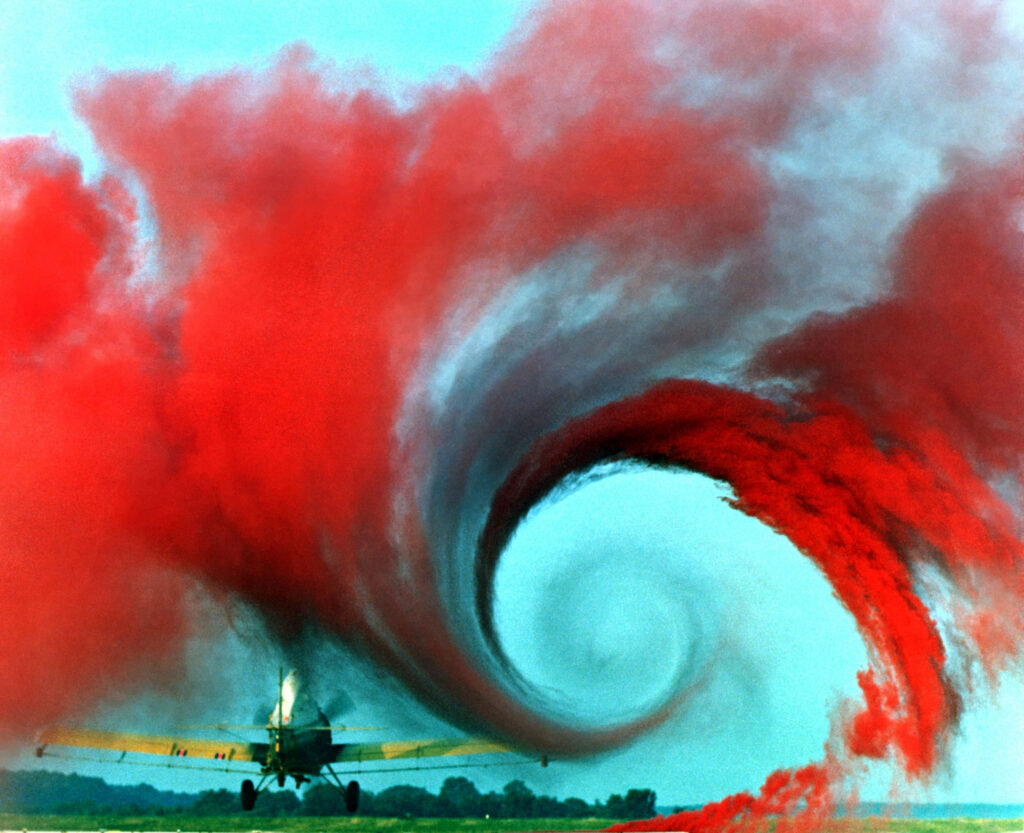
A wing makes lift because the air pressure below it is higher than the pressure above it. At the wingtips, the high-pressure air tries to escape around the tip into the low-pressure area on top. Combined with the forward motion of the aircraft, that spill rolls up into two tight, counter-rotating vortices trailing from each wingtip. Our guide to how lift works explains the pressure difference behind it.
The famous NASA photo above shows one of these vortices made visible with coloured smoke. In normal conditions you never see them, though on humid days you may notice white spirals of condensation trailing from wingtips or flaps.
When wake turbulence is strongest
The strength of a wake depends mainly on how much lift the wing has to make and how fast it is moving. The worst case is an aircraft that is:
- heavy, because it needs more lift;
- slow, because the same lift at low speed produces stronger vortices;
- clean, with flaps and slats retracted, which concentrates the vortices at the tips.
That is why the danger is greatest near airports, where large aircraft fly slowly at low altitude during take-off and landing, and where following aircraft are close behind and close to the ground with little room to recover.
How the vortices behave
Once formed, the vortices sink. Behind a large jet they typically descend a few hundred feet per minute and level off roughly 500 to 900 feet below the generating aircraft’s flight path. Near the ground they spread sideways, and a light crosswind can hold one vortex over the runway for longer than expected. They usually decay within two or three minutes, faster in turbulent air and slower in calm, still conditions.
The rules that keep aircraft apart
Air traffic control groups aircraft into wake turbulence categories by weight. The classic ICAO scheme uses Light, Medium, Heavy and, for the Airbus A380, Super. Behind heavier aircraft, controllers apply larger gaps. Typical radar separation on approach is:
- 4 nautical miles for a Heavy behind a Heavy;
- 5 nautical miles for a Medium behind a Heavy;
- 6 nautical miles for a Light behind a Heavy;
- 6 to 8 nautical miles behind an Airbus A380, depending on the follower.
For departures, controllers commonly hold a lighter aircraft for two minutes, or three in some cases, behind a heavier one using the same runway. Newer systems such as RECAT in Europe and the United States split aircraft into more categories based on wingspan and approach speed as well as weight, which lets airports safely space some pairs more tightly and increase runway capacity.
What pilots do
Pilots are trained to stay out of the wake rather than fly through it. Behind a larger aircraft on approach, they aim to stay on or above its flight path and touch down beyond the point where it landed. On departure, they try to lift off before the point where the preceding aircraft rotated and climb above its path. If an encounter happens anyway, the guidance is to fly the aircraft with smooth, moderate inputs.
That last point matters. In 2001, American Airlines Flight 587 crossed the wake of a Boeing 747 shortly after take-off. The wake itself was not dangerous, but the first officer’s repeated full rudder reversals overloaded the tail and broke it off. Since then, training has stressed that the rudder is not the tool for recovering from a wake upset.
Wakes can also reach far from airports. In January 2017, a Bombardier Challenger business jet flying over the Arabian Sea passed about 1,000 feet below an Airbus A380 going the other way. It was rolled several times and lost thousands of feet before the crew regained control; the aircraft was damaged beyond economic repair. Cases like this are why some regions now encourage small lateral offsets on oceanic routes.
Can wake turbulence be predicted?
Vortices cannot be seen, but they can be measured. Researchers use laser-based lidar to track how they sink and drift, and that work feeds into smarter spacing. At London Heathrow, Time-Based Separation, introduced in 2015, spaces arrivals by time rather than fixed distance when strong headwinds slow aircraft down, because the wind also helps carry and break up the wakes. The result is fewer delays on windy days without reducing safety margins.
Helicopters create wakes as well. A hovering or slow-moving helicopter pushes a powerful column of air downwards and outwards, and its rotor tips shed vortices much like a wing. Pilots of light aircraft are taught to give hovering helicopters a wide berth on the ground and in the air.
Why it matters to passengers
Most of the time, wake turbulence shows up only as the gaps between arrivals and the short pauses before departure. Those few minutes are a small price for keeping smaller aircraft clear of a hazard that cannot be seen. As traffic grows, smarter wake categories and better tools for predicting how vortices drift are one of the quiet ways airports add capacity without adding runways.
Sources
- ICAO Doc 4444, Procedures for Air Navigation Services – Air Traffic Management (wake turbulence categories and separation)
- FAA Advisory Circular 90-23, Aircraft Wake Turbulence
- NTSB report AAR-04/04 on American Airlines Flight 587