




Last Updated: 4 months ago
If you’ve ever wondered how to get a pilot license, you’re not alone, and you’ve probably already hit the wall of confusing acronyms, conflicting cost estimates, and guides that assume you already know what a checkride is. This guide doesn’t do that. It walks through the entire process in the order you’ll actually face it: choosing the right certificate, meeting FAA requirements, understanding how training works, knowing what it will genuinely cost, and preparing for both formal tests. Think of it as the setup guide that most flight training resources skip.
That overwhelmed-and-tab-closing experience is nearly universal. It’s not that flying is impossibly complex to learn. It’s that most beginner resources drop you into the middle of the process without context. Whether you caught a glimpse of a small plane on a clear Saturday morning or watched someone land smoothly on a runway and thought I want to do that, the path forward is clearer than it looks, once someone lays it out in plain order.
Which Pilot Certificate Is Actually Right for You
Most people starting this research assume there’s one path to earning a pilot license. There are several, and picking the wrong one wastes both time and money. The three entry-level options are private, sport, and recreational. Each carries a different set of privileges and limits, and those differences are significant enough to consider before you write a single check to a flight school.
Private pilot is the right choice for nearly everyone. It allows you to carry passengers, fly at night, conduct cross-country flights with no geographic restriction, and serves as the foundation for every advanced rating that comes after it. Sport pilot is the lowest-cost entry point, but the limitations are real: one passenger maximum, no night flying, and you’re restricted to light-sport aircraft only. Recreational pilot sits somewhere between the two in theory, but in practice it’s rarely chosen, its restrictions are nearly as tight as sport with only marginally less training required. The consensus among instructors and flight schools is to pursue private pilot from day one, and for good reason.
If your longer-term goal is an airline career or any kind of paid flying, commercial is the eventual destination. But private pilot is always the foundation. There’s no need to overthink the commercial track now. Earn your private certificate first, then evaluate the next step with actual flight experience behind you.
How to Get a Pilot License: FAA Eligibility and Your Medical Certificate
Before you book a discovery flight or enroll anywhere, three concrete eligibility boxes need to be checked. They’re not complicated, but skipping them creates problems later. The FAA lays these out in 14 CFR Part 61, and understanding them upfront saves you from unpleasant surprises mid-training.
Age and Language Requirements
For a private pilot certificate, the minimum age is 17. You can solo an aircraft at 16, which means training can begin before your 17th birthday. You must also be able to read, speak, write, and understand English, that’s a formal regulatory requirement, not a guideline. Neither of these is a barrier for most applicants, but both are non-negotiable.
The FAA Medical Exam
Your third-class FAA medical certificate is the first real administrative step. It’s required for student, recreational, and private pilot operations. Start by creating a MedXPress account online and completing the application. Then schedule an appointment with an FAA-designated Aviation Medical Examiner (AME). The FAA’s AME locator tool lets you search by ZIP code or city to find examiners near you.
The exam covers vision, hearing, cardiovascular health, and general medical history. Many applicants receive their certificate the same day, though timelines can vary based on your AME and medical history. If you have an existing medical condition, it’s worth researching BasicMed as a lighter alternative for certain operations, but third-class remains the standard path for new students. For a practical overview of the FAA medical certificate process, see this guide to the FAA medical certificate.
Your Student Pilot Certificate
Your student pilot certificate comes next. It’s free, issued through the FAA’s IACRA system, and your flight instructor handles most of the paperwork. It doesn’t grant you the ability to fly alone immediately. What it does is formalize your training status with the FAA, which is required before solo flight is legal. Once that’s in hand, you’re administratively ready to begin structured flight training.
How Flight Training Actually Works
Once eligibility is sorted, training itself has a clear structure. The type of school you choose affects the pace and format of that structure more than most students expect going in.
Part 61 vs. Part 141
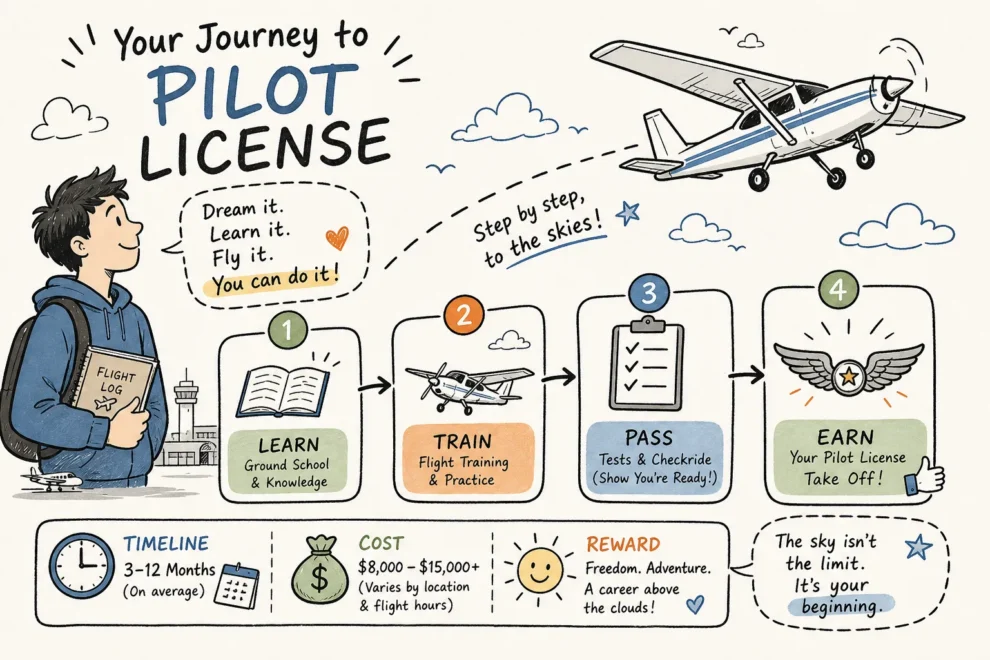
Part 61 is the most common route for US student pilots. There’s no rigid curriculum requirement, you train at your own pace with any certificated flight instructor, and the minimum is 40 total hours. Part 141 schools follow an FAA-approved structured syllabus with slightly lower minimums at 35 hours, but they require formal enrollment and progression through defined stages. Part 141 works well for full-time students who want a structured environment; Part 61 suits most people training around work schedules. The right choice depends on your schedule and learning style.
Required Flight Hours and Milestones
Within those 40 Part 61 hours, the FAA mandates specific elements: at least 20 hours with an instructor, 10 hours of solo flight, 3 hours of night flying, 3 hours under simulated instrument conditions (using a view-limiting hood, not actual clouds), and cross-country training including a solo cross-country of at least 150 nautical miles. These aren’t optional, they appear on your logbook endorsements and the examiner will verify them. Most students realistically finish between 55 and 70 total hours, not at the 40-hour minimum.
Full-time training, flying four or five days a week, typically wraps up in 8 to 12 weeks. Part-time training around a job usually takes 4 to 6 months, and often longer when weather or scheduling creates gaps. Consistency matters more than intensity. When you let two or three weeks pass between flights, you spend the next session relearning what you already knew, which adds hours and cost directly.
What Flight Training Realistically Costs in 2026
The honest answer most guides avoid giving: earning your private pilot license in the US in 2026 costs most students between $14,000 and $18,000. Efficient training with minimal gaps and good aircraft availability can come in around $10,000 to $13,000. Training in a high-cost metro area, or with significant scheduling interruptions, can push the total to $20,000 or more.
Aircraft rental is the single largest cost driver. Wet rental rates for a Cessna 172 or comparable trainer run approximately $140 to $220 per hour nationally, with an average around $176 based on current school listings. At 60 flight hours, that’s $8,400 to $13,200 in aircraft time alone. Instructor fees add roughly $50 to $90 per hour for dual instruction time, amounting to another $2,500 to $3,500 across training. Schools in major cities like New York or Los Angeles consistently land near the top of those ranges.
The remaining costs add up more than most students anticipate. Here’s a realistic breakdown of the supplemental expenses:
- FAA knowledge test fee: ~$175
- Checkride with an FAA Designated Pilot Examiner: $600, $1,000, depending on examiner and location
- Ground school and study materials: $300, $800
- Headset, kneeboard, and basic gear: $200, $600 if you purchase rather than rent from the school
Tallying everything, the realistic budget for a US student in 2026 breaks into three tiers: $10,000, $13,000 on the efficient low end, $14,000, $18,000 for most students, and $20,000 or more in high-cost environments.
Preparing for the Written Test and Checkride When Getting a Pilot License
Two formal testing milestones stand between you and your certificate, and most students underestimate how much preparation the knowledge test actually requires. It’s not something you can cram the night before.
The FAA Knowledge Test
The FAA private pilot knowledge test contains 60 multiple-choice questions covering regulations, weather interpretation, navigation, aircraft systems, and aeronautical decision-making. You need a score of 70% or better to pass, though most students and instructors aim for 80% or higher as a practical buffer. Sporty’s test prep, the FAA’s own Pilot’s Handbook of Aeronautical Knowledge (PHAK), and apps like the Private Pilot Test Prep mobile app are the most widely used study tools. Expect several weeks of focused ground study before you feel genuinely ready, the amount varies by background, but don’t underestimate it. You must pass the knowledge test before you can schedule the checkride. See the FAA’s official guidance on the knowledge test for details: FAA knowledge testing requirements.
The Checkride: Oral Exam and Flight Test
The checkride has two distinct parts conducted by an FAA Designated Pilot Examiner: an oral exam and a flight test. The oral portion can be lengthy, often an hour or more, and covers regulations, weather decision-making, aircraft systems, and cross-country planning. The flight portion evaluates your actual maneuvers: takeoffs and landings, slow flight and stalls (the ones most students find humbling), steep turns, ground reference maneuvers, emergency procedures (see V1: The Point of No Return, Why Pilots Must Fly Even if a Motor Explodes, aviationstream.com), and navigation. Your instructor will conduct mock checkrides with you in the weeks before the real one. No good instructor submits a student to an examiner before they’re genuinely ready.
Your Next Steps Once You Hold That Certificate
Earning your private pilot license (also called a pilot certificate by the FAA) is a beginning, not a finish line. New certificated pilots are legal to fly but not yet experienced pilots. The first 50 to 100 hours after certification are when real judgment develops: flying in different weather conditions, operating into unfamiliar airports, and carrying passengers who are trusting you. Per 14 CFR § 61.57, the FAA requires 3 takeoffs and landings every 90 days to carry passengers, and those must be in the same category and class of aircraft. For carrying passengers at night, those must be full-stop landings performed between one hour after sunset and one hour before sunrise. A flight review with a CFI every 24 calendar months is also required. Many new private pilots begin working toward an instrument rating shortly after, which meaningfully expands where and when you can fly.
As your training builds toward the checkride and beyond, staying informed becomes part of the pilot mindset. Regulations evolve, new technologies emerge, and the aviation industry keeps changing. Aviation Stream covers that ground, from general aviation trends and aircraft technology (see Quick Facts | Episode 1: Aircraft Testing Process, aviationstream.com) to eVTOL developments, airshow coverage, and military aviation history, making it a useful resource for student pilots and certificated flyers alike.
The Path Is Clear Once It’s Laid Out
Learning how to get a pilot license can look overwhelming from the outside. The actual path, though, is straightforward once it’s laid out in sequence:
- Choose your certificate type, private pilot for almost everyone
- Get your FAA medical certificate
- Obtain your student pilot certificate through IACRA
- Find a flight school and a CFI you trust
- Commit to consistent training sessions
- Study seriously for the knowledge test
- Prepare thoroughly for the checkride
The biggest variable in this process isn’t aptitude or natural ability, it’s consistency and follow-through. Students who maintain a regular training schedule and avoid long gaps between flights tend to complete their certificate. The ones who don’t usually let those gaps stretch too long until momentum fades entirely.
The single best next action right now is to schedule a discovery flight at a local flight school. It’s a one-hour introductory lesson available at nearly every school in the country, typically priced in the low-to-mid hundreds of dollars depending on your region. It answers the question of whether flying is really for you faster than any amount of research. If you’re serious about how to get a pilot license in the US, book that flight, show up, and see how it feels to have your hands on the controls for the first time.
Did you know AviationStream.com has a YouTube channel? Check out TheAeroGraphyOfficial and subscribe to watch fun, highly engaging aviation Shorts!