American Airlines Flight 587
Two months after 9/11, an Airbus A300 lost its vertical stabilizer after take-off from JFK and crashed in Queens. The NTSB traced it to large, alternating rudder inputs.
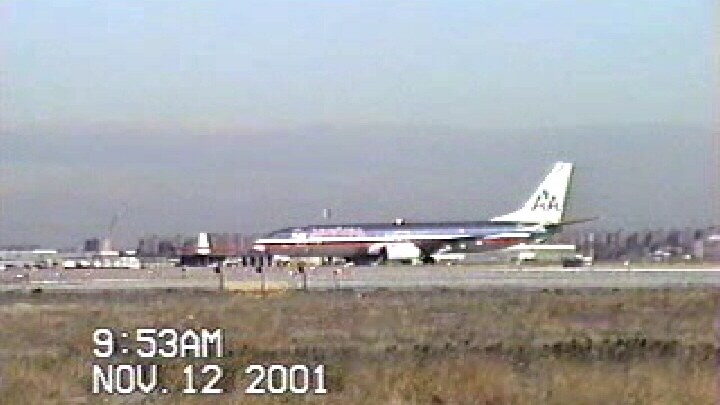
American Airlines Flight 587 was an Airbus A300 that crashed into the Belle Harbor neighbourhood of Queens, New York, on 12 November 2001, less than two minutes after taking off from JFK for Santo Domingo. The aircraft’s vertical stabilizer and rudder broke away, followed by both engines. All 260 people on board and five people on the ground died. Coming two months after the 11 September attacks, the crash was first feared to be terrorism; the investigation found something very different.
Flight 587 at a glance
- Date: Monday 12 November 2001, 09:16 local time
- Aircraft: Airbus A300B4-605R
- Route: New York JFK to Santo Domingo, Dominican Republic
- On board: 251 passengers and 9 crew
- Fatalities: 265, including five on the ground
- Place: Belle Harbor, Rockaway Peninsula, Queens, New York
- Investigation: US National Transportation Safety Board (NTSB)
What happened
Flight 587 took off about two minutes behind a Japan Airlines Boeing 747. As it climbed and turned over Jamaica Bay, it crossed the wake of the larger jet twice. Wake turbulence like this is common and usually means a few seconds of bumps.
The first officer, who was flying, responded to the second encounter with a series of full, rapid rudder pedal movements from one side to the other, together with large wheel inputs. Each reversal swung the aircraft’s tail sideways, and the side loads on the fin built up with each swing. Within seven seconds the loads exceeded what the structure was designed to carry and the composite vertical stabilizer snapped off its mounting lugs. The aircraft became uncontrollable, the engines separated under the side forces, and it fell into a residential street.
Why it happened
The NTSB examined the composite tail closely and found that it had failed only after being loaded well beyond its certified strength. The cause lay in how the rudder was used.
The board’s probable cause was the first officer’s unnecessary and excessive rudder pedal inputs. Two factors contributed. At higher speeds the A300-600’s rudder pedals needed very little force and travel to reach full deflection, making it easy to overcontrol. And American Airlines’ advanced aircraft manoeuvring training had, in the board’s view, encouraged pilots to use rudder to recover from upsets and had given an unrealistic picture of wake encounters in the simulator. Many pilots also believed that full control inputs were always safe below manoeuvring speed; the investigation showed that repeated full reversals of the rudder are not.
What changed after Flight 587
- Training. Airlines and manufacturers rewrote guidance on upset recovery. Pilots are now taught that the rudder is not the primary tool for rolling an airliner, and that rapid, alternating rudder inputs can break the tail even at moderate speeds.
- Manoeuvring speed explained. Regulators clarified that staying below manoeuvring speed protects against a single full input, not against a sequence of reversals.
- Rudder systems. Rudder pedal sensitivity on the A300-600 and A310 was studied, and Airbus later offered a modified rudder control system for these types.
You can read more about the aircraft type in our Airbus A300-600R entry.
Remembering the victims
Most passengers were Dominican Americans travelling home to family. Every year on 12 November, relatives gather at the memorial in Rockaway Park, Queens, where the names of the victims are inscribed.
Sources
NTSB Aircraft Accident Report NTSB/AAR-04/04, In-Flight Separation of Vertical Stabilizer, American Airlines Flight 587, Airbus A300-605R (2004).
Related Historical Aviation Accidents Events
More significant events from aviation history
Assassination of Juvénal Habyarimana and Cyprien Ntaryamira: The 1994 Aircraft Shootdown in Rwanda
🗓 6 April, 1994 📍 Presidential Palace gardens, near Kigali International Airport, Kigali, Rwanda, 1°58′32″S 30°10′26″E / 1.9756°S 30.1739°E / -1.9756; 30.1739 ★★★★☆ Read full story →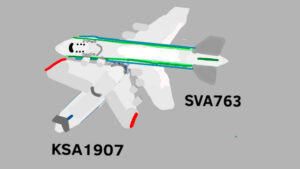
1996 Charkhi Dadri Collision: The Deadliest Mid-Air Crash
🗓 12 November, 1996 📍 Charkhi Dadri, Haryana, India, 28°33′38″N 76°18′15″E / 28.56056°N 76.30417°E / 28.56056; 76.30417 ★★★★☆ Read full story →
United Airlines Flight 736: The Crash That Changed Aviation
🗓 21 April, 1958 📍 Clark County, Nevada, United States ★★★★☆ Read full story →
The Tragedy of Lauda Air Flight 004
🗓 26 May, 1991 📍 Phu Toei National Park, Suphan Buri province, Thailand, 14°56′48″N 99°27′10″E / 14.94667°N 99.45278°E / 14.94667; 99.45278 ★★★☆☆ Read full story →