






Last Updated: 4 months ago
Quick Definition
In aviation and aerodynamics, lift is the upward mechanical force generated by a solid object moving through a fluid medium, such as air. It acts perpendicular to the oncoming airflow and directly opposes the downward force of gravity (weight). Consequently, it is the primary aerodynamic force that allows fixed-wing aircraft, helicopters, and even birds to overcome gravity and achieve sustained flight.
How Does Lift Work?
Aerospace engineers use two primary physical principles to explain the generation of aerodynamic lift: Bernoulli’s Principle and Newton’s Third Law of Motion. Both occur simultaneously to keep an aircraft in the sky.
First, Bernoulli’s Principle addresses the pressure differential created by the wing’s shape (airfoil). As an aircraft moves forward, the wing geometry and angle of attack cause airflow over the upper surface to accelerate. This increase in velocity causes a decrease in static pressure above the wing. Meanwhile, The pressure differential between the upper and lower surfaces generates a net upward aerodynamic force known as lift.
Second, Newton’s Third Law of Motion (action and reaction) addresses the physical deflection of air. The wing sits at a slight upward angle, known as the Angle of Attack (AoA). As the wing strikes the oncoming air, it physically deflects the airflow downward, creating a phenomenon called “downwash.” The equal and opposite reaction to this downward push is an upward force acting on the wing.
Mathematically, engineers calculate this force using the standard lift equation:
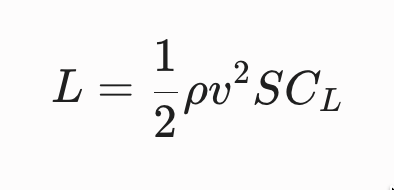
Where:
- L represents the total lift force.
- ρ (rho) represents the air density.
- v represents the true airspeed of the aircraft.
- S represents the total planform area of the wing.
- CL represents the coefficient of lift (determined by airfoil shape and angle of attack).
Major Factors Influencing Lift
| Factor | Variable | Impact on Flight |
|---|---|---|
| Airspeed | v | Lift increases exponentially with the square of the velocity; doubling airspeed quadruples the lift. |
| Angle of Attack | AoA | Increasing the angle increases lift up to a critical point, after which the airflow separates and the wing stalls. |
| Air Density | ρ | Denser air at lower altitudes or colder temperatures generates significantly more lift than thin, warm air. |
| Wing Area | S | Larger wings physically interact with more air molecules, generating higher total lifting capacity. |
| Airfoil Shape | CL | High-camber (curved) wings and deployed flaps increase the lift coefficient for low-speed operations. |
Types of Lift
| Type | Characteristics | Common Use |
|---|---|---|
| Aerodynamic | Generated dynamically by the rapid motion of an airfoil through the air | Airplanes, helicopters, and gliders |
| Aerostatic | Generated by buoyancy when an object is filled with a gas lighter than the surrounding air | Hot air balloons, zeppelins, and blimps |
| Translational | Additional aerodynamic lift gained by a helicopter transitioning from a hover into forward flight | Rotary-wing aviation |
The Four Forces of Flight
| Force | Direction |
|---|---|
| Lift | Upward |
| Weight | Downward |
| Thrust | Forward |
| Drag | Rearward |
Why Is Lift Important in Aviation?
This aerodynamic force defines the absolute operational capabilities and performance envelope of every aircraft. First, the maximum lifting capacity dictates the aircraft’s Maximum Takeoff Weight (MTOW). Therefore, it directly controls how much cargo, fuel, and passenger weight an airline can safely transport.
Furthermore, it governs the maneuverability of the aircraft. When a pilot initiates a turn, they bank the wings. Consequently, the lift vector tilts inward, horizontally pulling the aircraft around the corner. Without this horizontal component of lift, airplanes would be unable to change direction in flight.
Maintaining this force is the ultimate safety priority for flight crews. If the aircraft flies too slowly or exceeds the critical angle of attack, the smooth airflow detaches from the wing, resulting in an aerodynamic stall. When a stall occurs, lift is abruptly lost, and the aircraft rapidly loses altitude. Therefore, pilots rely on airspeed indicators and stall warning systems to ensure they maintain sufficient airflow at all times.
Interesting Facts
- An airplane can fly upside down because the pilot adjusts the angle of attack to deflect air downward toward the ground, generating lift regardless of the wing’s physical curvature.
- At takeoff, a fully loaded Boeing 747 must generate lift approximately equal to its total weight, which can exceed 800,000 pounds.
- As an aircraft climbs to cruising altitudes (e.g., 35,000 feet), the air density (ρ) drops significantly. To maintain the same amount of lift, the aircraft must fly much faster.
- During supersonic flight (faster than the speed of sound), lift is generated primarily by complex shockwaves rather than standard subsonic pressure differentials.
Frequently Asked Questions (FAQ)
What is aerodynamic lift? It is the upward force created by the movement of an aircraft’s wings through the air, which counteracts the downward pull of gravity.
Does a wing need a curved top to generate lift? No. While a curved (cambered) top makes a wing highly efficient, a perfectly flat wing can still fly if it has a positive angle of attack to deflect air downward. This is how paper airplanes fly.
What happens if an airplane loses lift? The airplane enters an aerodynamic stall. Gravity takes over, and the aircraft begins to fall until the pilot lowers the nose to regain airspeed and reattach the airflow over the wings.
How do pilots increase lift during landing? Pilots extend flaps and slats on the wings. This temporarily increases both the surface area (S) and the curvature of the wing (CL), allowing the aircraft to generate high lift at very slow speeds.
Key Takeaways
- Lift is the fundamental upward force that opposes weight and makes flight possible.
- It is generated by a combination of pressure differentials (Bernoulli) and flow deflection (Newton).
- The total force depends on airspeed, air density, wing area, and the angle of attack.
- Loss of lift results in an aerodynamic stall, a critical condition requiring immediate pilot recovery.
- Flaps and slats mechanically alter the wing to increase lift during low-speed takeoffs and landings.
AUTHORITATIVE REFERENCES
- Federal Aviation Administration (FAA) – Pilot’s Handbook of Aeronautical Knowledge (FAA-H-8083-25B), Chapter 4: Principles of Flight.