








Last Updated: 4 months ago
← Back to Aircraft Database| General Characteristics | |
| Type | Civil and Commercial Aircraft |
|---|---|
| National Origin | United States |
| Manufacturer | Cessna Textron Aviation |
| Status | In production |
| First Flight | May 17, 2020 |
| Introduction | May 9, 2022 |
| Primary Users | FedEx Feeder |
| Number Built | 41 (January 2025) |
| Capacity & Dimensions | |
| Typical Seating | 19 passengers/5,000 lb (2,268 kg) payload (commuter) or 3×LD3s/6,000 lb (2,722 kg) payload (cargo) |
| Overall Length | 55 ft 1 in (16.80 m) |
| Wing Span | 72 ft 3 in (22.02 m) |
| Wing Area | 441.0 sq ft (40.97 m) |
| Overall Height | 20 ft 8 in (6.30 m) |
| Weights, Powerplant & Performance | |
| MTOW | 19,000 lb (8,618 kg) |
| OEW | 12,325 lb (5,591 kg) , Freighter: 11,000 lb (4,990 kg) |
| Fuel Capacity | 4,826 lb (2,189 kg) / 720 gal (2,725 L) |
| Engines | 2 × Pratt & Whitney Canada PT6A-65SC turboprop, 1,110 hp (830 kW) each |
| Propeller | 4-bladed McCauley Blackmac aluminum, auto feathering, reverse |
| Typical Cruise Speed | 210 kn (240 mph, 390 km/h) maximum |
| Range | 920 nmi (1,060 mi, 1,700 km) |
| Takeoff Distance | 3,660 ft (1,116 m) |
| Service Ceiling | 25,000 ft (7,600 m) |
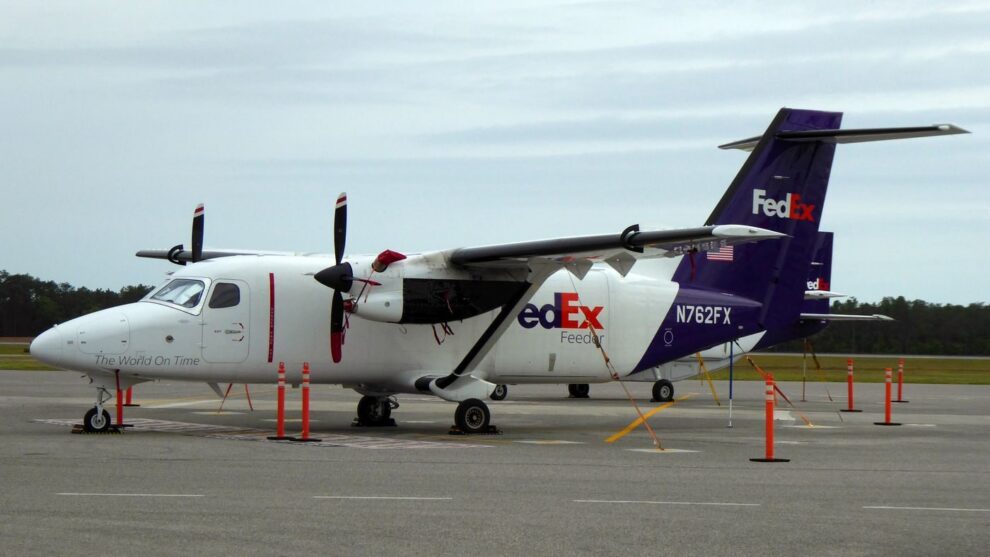
The Cessna SkyCourier is a clean-sheet twin-engine utility turboprop designed for high-utilization cargo, passenger and special mission operations. Textron Aviation developed the aircraft to give operators a rugged, simple and efficient platform for short-haul routes, remote airfields and demanding daily schedules.
The aircraft is officially known as the Cessna 408 SkyCourier. It uses a high-wing layout, fixed landing gear and two Pratt & Whitney Canada PT6A-65SC turboprop engines. As a result, it combines practical loading capability with dependable turboprop performance.
The Cessna SkyCourier first flew on May 17, 2020, and received FAA type certification in March 2022. Textron Aviation delivered the first production aircraft to FedEx Express on May 9, 2022. Since then, the aircraft has served as a modern utility platform for freight, commuter passenger service and special mission work.
Cessna SkyCourier General Characteristics
| Feature | Specification |
|---|---|
| Aircraft Type | Twin-engine utility turboprop aircraft |
| Main Category | Civil and Commercial Aircraft |
| Additional Category | Special-Purpose Aircraft |
| Manufacturer | Cessna Textron Aviation |
| Model | Cessna 408 SkyCourier |
| National Origin | United States |
| First Flight | May 17, 2020 |
| FAA Type Certification | March 2022 |
| First Delivery | May 9, 2022, to FedEx Express |
| Primary Roles | Cargo, passenger and special mission operations |
| Status | In production and in service |
The aircraft was not developed as a luxury business turboprop. Instead, Textron designed it as a hard-working utility aircraft. Therefore, its layout focuses on payload, fast turnaround, easy loading and practical maintenance access.
SkyCourier Cargo and Passenger Variants
The Cessna SkyCourier comes in both freighter and passenger versions. The freighter variant can carry up to 6,000 lb of payload and can fit three LD3 shipping containers. This feature makes it especially attractive for express cargo operators that need containerized freight capability on smaller routes.
The passenger variant can carry up to 19 occupants. It includes large cabin windows, separate crew and passenger doors, and a cabin designed for short-haul commuter operations. In addition, both versions offer single-point refueling, which helps reduce turnaround time between flights.
| Feature | Passenger Variant | Freighter Variant |
|---|---|---|
| Maximum Occupants | 19 | Cargo configuration |
| Maximum Payload | About 5,175 lb | Up to 6,000 lb |
| Cargo Containers | Not primary role | Up to three LD3 containers |
| Typical Mission | Commuter and regional passenger service | Express freight and feeder cargo |
| Cabin Concept | Passenger cabin with large windows | Flat-floor cargo cabin |
This flexibility is one of the aircraft’s biggest strengths. For example, an operator can use the passenger version for remote communities, regional connections or workforce transport. Meanwhile, cargo operators can use the freighter version to connect smaller markets with larger logistics networks.
Cessna SkyCourier Dimensions
| Feature | Specification |
|---|---|
| Length | 55 ft 1 in / 16.8 m |
| Height | 20 ft 8 in / 6.3 m |
| Wingspan | 72 ft 3 in / 22.02 m |
| Wing Area | 441 sq ft / 40.97 m² |
| Wheelbase | 19 ft 11 in / 6.07 m |
| Tread | 12 ft 4 in / 3.76 m |
| Cabin Height | 71 in / 1.80 m |
| Cabin Width | 74 in / 1.88 m |
| Cabin Length | 23 ft 4 in / 7.11 m |
The high-wing design gives the aircraft good ground clearance and practical loading advantages. Moreover, the fixed landing gear reduces mechanical complexity and supports operations from remote or less-developed airfields. Because of this layout, the SkyCourier fits operators that value reliability and quick turnarounds more than maximum cruise speed.
Cessna SkyCourier Engines and Performance
The aircraft uses two Pratt & Whitney Canada PT6A-65SC turboprop engines. Each engine produces 1,110 shp and drives a McCauley four-blade aluminum propeller. This engine and propeller combination gives the aircraft the power needed for heavy payload operations.
| Feature | Specification |
|---|---|
| Engines | 2 × Pratt & Whitney Canada PT6A-65SC turboprops |
| Power Rating | 1,110 shp / 828 kW per engine |
| Propellers | McCauley 4-blade aluminum propellers |
| Maximum Cruise Speed | 210 ktas / 389 km/h |
| Maximum Range | 920 nautical miles / 1,704 km |
| Maximum Operating Altitude | 25,000 ft / 7,620 m |
| Takeoff Field Length | 3,580 ft / 1,091 m |
| Landing Distance | 2,540 ft / 774 m |
| Stall Speed | 74 kcas / 137 km/h |
The Cessna SkyCourier does not try to compete with fast business aircraft. Instead, it prioritizes payload, durability and operating economy. Therefore, its performance figures make sense for feeder cargo routes, regional services and special mission work.
Weights and Fuel Capacity
| Feature | Specification |
|---|---|
| Maximum Ramp Weight | 19,070 lb / 8,650 kg |
| Maximum Takeoff Weight | 19,000 lb / 8,618 kg |
| Maximum Landing Weight | 18,600 lb / 8,437 kg |
| Basic Empty Weight | 12,725 lb / 5,772 kg |
| Useful Load | 6,345 lb / 2,878 kg |
| Passenger Variant Maximum Payload | 5,175 lb / 2,347 kg |
| Freighter Payload Capability | Up to 6,000 lb / 2,722 kg |
| Usable Fuel Weight | 4,826 lb / 2,189 kg |
| Usable Fuel Volume | 720 gal / 2,725 L |
These figures show the aircraft’s practical utility focus. The SkyCourier can carry meaningful payload while still operating from relatively short runways. In addition, the large cabin and simple loading arrangement help operators keep aircraft utilization high.
Avionics and Operating Features
The Cessna SkyCourier uses Garmin G1000 NXi avionics. This modern flight deck gives crews digital displays, improved situational awareness and a familiar interface for many turboprop pilots. In addition, the aircraft includes systems that support efficient day-to-day operations.
The freighter version has a large cargo door and a flat-floor cabin. Therefore, loading bulky freight becomes easier. The aircraft also offers single-point pressure refueling, which helps operators reduce ground time. Meanwhile, fixed landing gear and rugged systems support operations in challenging environments.
Because of these features, the aircraft works well for operators that fly many short sectors each day. It can load, fly, unload and repeat with minimal complexity.
Why Operators Choose the SkyCourier
Operators choose the Cessna SkyCourier because it fills a specific market need. Many cargo routes do not require a large jet, yet they still need containerized freight capability and reliable payload performance. The SkyCourier answers that need with a simple twin-turboprop platform.
Passenger operators may also find the aircraft useful. Its 19-seat cabin suits commuter routes, island services, remote communities and regional connections. Moreover, the aircraft can support special mission roles when operators need a rugged and adaptable platform.
The aircraft also benefits from Cessna and Textron Aviation support. This matters because utility aircraft often operate in demanding conditions, where maintenance access, parts availability and manufacturer support can affect dispatch reliability.
Operational Role
The SkyCourier mainly serves short-haul cargo, passenger and special mission operations. FedEx Express became the launch customer for the freighter version, which shows the aircraft’s strong connection with feeder cargo networks. However, the passenger version gives the platform wider use beyond freight.
The aircraft can also support humanitarian missions, government operations, remote logistics and utility transport. In these roles, its high-wing design, payload capability and fixed landing gear provide practical advantages.
Although the aircraft is modern, its design philosophy is straightforward. It focuses on work rather than luxury. As a result, the Cessna SkyCourier stands out as a modern utility aircraft built for real operational demands.
Comparison with Smaller Cessna Turboprops
Compared with aircraft such as the Cessna Caravan, the SkyCourier offers more payload, two engines and a larger cabin. Therefore, it can handle missions that require more capacity or twin-engine performance.
The Caravan remains useful for smaller loads and simpler operations. However, the Cessna SkyCourier provides a larger platform for operators that need more cargo volume, more seats and greater utility. Because of this, the two aircraft can serve different parts of a regional or utility fleet.
Frequently Asked Questions
What is the Cessna SkyCourier used for?
The aircraft serves cargo, passenger and special mission operations. Operators can use it for express freight, commuter routes, remote transport and utility missions.
How many passengers can the SkyCourier carry?
The passenger variant can carry up to 19 occupants.
How much cargo can the freighter version carry?
The freighter version can carry up to 6,000 lb of payload and can fit three LD3 shipping containers.
What engines does the Cessna SkyCourier use?
The aircraft uses two Pratt & Whitney Canada PT6A-65SC turboprop engines.
What is the range of the SkyCourier?
The aircraft has a maximum range of about 920 nautical miles, depending on configuration and operating conditions.
Cessna SkyCourier Summary
The Cessna SkyCourier is a modern twin-engine utility turboprop designed for cargo, passenger and special mission work. With its high-wing layout, fixed landing gear, PT6A-65SC engines, 19-passenger option, 6,000 lb freighter payload capability and 920 nautical mile range, it offers a practical solution for operators that need reliable short-haul performance and strong daily productivity.
Did you knowAviationStream.com has a YouTube channel? Check out TheAeroGraphyOfficial and subscribe to watch fun, highly engaging aviation Shorts!