







Last Updated: 4 months ago
← Back to Aircraft Database| General Characteristics | |
| Type | Special-Purpose Aircraft |
|---|---|
| National Origin | Canada |
| Manufacturer | Canadair, De Havilland Aircraft Company |
| Variants | Canadair CL-415 |
| Status | In service |
| First Flight | 23 October 1967 |
| Introduction | 1969 |
| Primary Users | Canada Greece , Spain , United States |
| Number Built | 125 |
| Capacity & Dimensions | |
| Cockpit Crew | Two |
| Typical Seating | 5,910 L (1,561.3 US gal; 1,300.0 imp gal) in two fuel tanks, of eight cells each, in the wings |
| Overall Length | 19.82 m (65 ft 0 in) |
| Wing Span | 28.6 m (93 ft 10 in) |
| Wing Area | 100.33 m (1,079.9 sq ft) |
| Overall Height | 8.92 m (29 ft 3 in) |
| Weights, Powerplant & Performance | |
| MTOW | 19,731 kg (43,499 lb) on land, 17,100 kg (37,700 lb) on water |
| OEW | 12,160 kg (26,808 lb) |
| Engines | 2 × Pratt & Whitney R-2800-83AM 18-cylinder air-cooled radial piston engines, 1,566 kW (2,100 hp) each |
| Propeller | 3-bladed Hamilton Standard Hydromatic constant-speed fully feathering propeller |
| Typical Cruise Speed | 291 km/h (181 mph, 157 kn) at 18,595 kg (40,995 lb) and 3,050 m (10,000 ft) |
| Range | 2,094 km (1,301 mi, 1,131 nmi) with 1,587 kg (3,499 lb) payload at long-range cruise power |
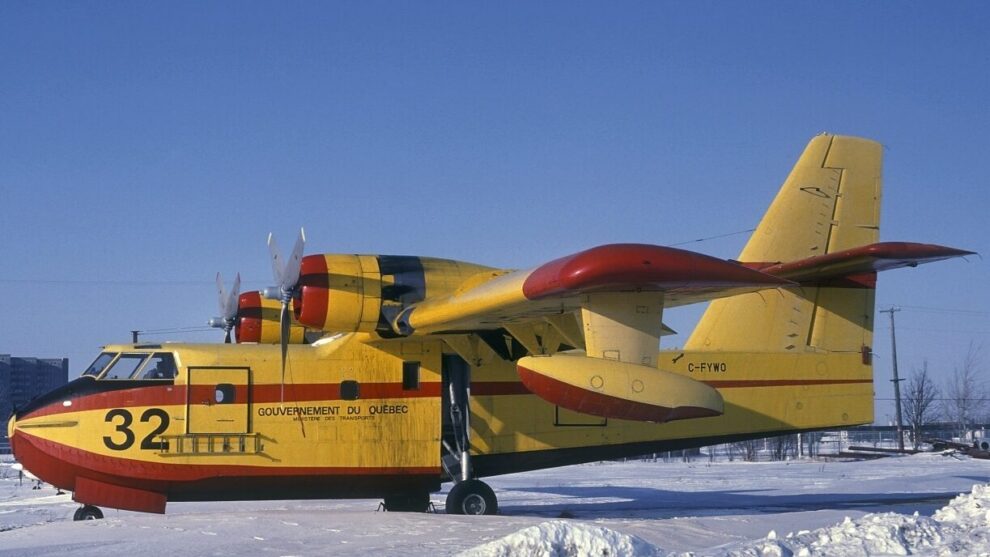
The Canadair CL-215T is a turboprop conversion of the original piston-powered Canadair CL-215. It keeps the rugged amphibious firefighting design of the CL-215, yet it replaces the older radial engines with more modern turboprop power. As a result, the aircraft offers better performance, improved handling and stronger operational capability during aerial firefighting missions.
The aircraft belongs to the famous Canadair water bomber family, which includes the CL-215, CL-215T and CL-415. However, the Canadair CL-215T has its own identity. It is not simply a CL-415, and it is not a standard piston CL-215. Instead, it sits between them as a turbine-powered conversion that helped shape the development of the later CL-415.
The first CL-215T prototype flew on June 8, 1989. Canadair initially converted two aircraft to turbine configuration for development and technical demonstration. Later, retrofit kits allowed existing piston-powered CL-215 aircraft to move closer to the new standard. Therefore, the CL-215T became an important bridge between the original scooper and the more advanced CL-415.
Canadair CL-215T General Characteristics
| Feature | Specification |
|---|---|
| Aircraft Type | Amphibious turboprop firefighting aircraft |
| Main Category | Special-Purpose Aircraft |
| Additional Category | Civil and Commercial Aircraft |
| Manufacturer | Canadair |
| Later Program Links | Bombardier, Viking Air, De Havilland Canada |
| National Origin | Canada |
| First Flight | June 8, 1989 |
| Developed From | Canadair CL-215 |
| Related Aircraft | Canadair CL-415 |
| Primary Role | Aerial firefighting and water bombing |
| Crew | Two pilots |
| Status | In service with selected firefighting operators |
The Canadair CL-215T keeps the same basic mission as the original CL-215. It can land on water, scoop water through retractable probes, climb away and drop the load over a wildfire. However, its turboprop engines and conversion improvements give it better performance than the piston-powered aircraft.
CL-215T Turbine Conversion
The biggest change in the CL-215T conversion is the engine installation. The original CL-215 uses Pratt & Whitney R-2800 radial piston engines. In contrast, the Canadair CL-215T uses two Pratt & Whitney Canada PW123AF turboprop engines.
This change improves power response and climb performance. In addition, the conversion can include winglets, finlets, avionics upgrades, power-assisted flight controls and electrical system improvements. These updates help the aircraft operate more effectively in demanding wildfire conditions.
The conversion also influenced the CL-415 program. Many improvements that appeared on the CL-215T later became part of the CL-415 design. Therefore, the CL-215T is historically important because it helped move the Canadair firefighting aircraft family from piston power to turboprop performance.
Canadair CL-215T Dimensions
| Feature | Specification |
|---|---|
| Wingspan | 93 ft 11 in / 28.63 m |
| Length | 65 ft 1 in / 19.84 m |
| Height | 29 ft 5 in / 8.97 m |
| Wing Layout | High-wing amphibious configuration |
| Hull Type | Flying boat hull |
| Landing Gear | Retractable amphibious landing gear |
| Engine Layout | Two wing-mounted turboprops |
The aircraft’s high-wing layout keeps the engines and propellers away from water spray during scooping operations. Meanwhile, the flying boat hull allows the aircraft to operate directly from lakes, rivers and suitable coastal waters. Because of this design, the CL-215T can reload water close to a fire instead of returning to an airport after every drop.
Engines and Performance
The Canadair CL-215T uses two Pratt & Whitney Canada PW123AF turboprop engines. These engines give the aircraft a clear performance advantage over the original radial-engine CL-215. Moreover, the turboprop configuration gives the aircraft a more modern operating profile while keeping the proven amphibious airframe.
| Feature | Specification |
|---|---|
| Engines | 2 × Pratt & Whitney Canada PW123AF turboprops |
| Engine Type | Turboprop |
| Power | About 2,380 hp per engine |
| Cruise Speed | 333 km/h / 180 kt |
| Takeoff Speed | 177 km/h / 95 kt |
| Water Pickup Speed | 150 km/h / 80 kt |
| Drop Speed | 194 km/h / 105 kt |
| Rate of Climb | About 1,800 ft/min |
| Maximum Takeoff Weight from Land | 43,500 lb / 19,731 kg |
| Maximum Takeoff Weight from Water | 37,700 lb / 17,101 kg |
| Empty Weight | About 26,595 lb / 12,063 kg |
These figures show why the turbine conversion mattered. The aircraft retained the CL-215’s firefighting concept, but it gained stronger performance. Consequently, the CL-215T became more capable during repeated scooping, climbing and dropping cycles.
Water and Foam System
| Feature | Specification |
|---|---|
| Water Tanks | Two internal 600-imperial-gallon tanks |
| Total Water Capacity | About 1,200 imperial gallons / 1,441 US gallons / 5,455 litres |
| Scooping Time | About 8–10 seconds |
| Dump Time | About 2 seconds |
| Effective Drop Length | About 328 ft / 100 m |
| Bomb Doors | Two bomb doors |
| Foam System | Pilot-selected foam injection system |
| Foam Reservoir | About 90 imperial gallons / 108 US gallons |
The Canadair CL-215T can scoop water very quickly from a suitable water surface. After the tanks fill, the crew climbs toward the fire and releases the water through bomb doors under the fuselage. This cycle allows the aircraft to deliver repeated drops during one mission.
The foam injection system adds another layer of flexibility. Pilots can select foam volume before the drop, and the system injects foam into the tanks before release. Therefore, the aircraft can support different firefighting strategies depending on terrain, fire intensity and ground crew requirements.
Firefighting Mission Profile
The CL-215T works best when a wildfire sits near a lake, river, reservoir or coastline. During a mission, the aircraft approaches the water, extends its scooping probes and fills the tanks while moving across the surface. Then, it climbs away and flies toward the fire zone.
This method saves time because the aircraft does not need to return to an airport for every water load. As a result, it can deliver a high number of drops during a relatively short operating period. In suitable conditions, a CL-215T can perform many water pickups and drops during a single firefighting mission.
The aircraft often works with other firefighting assets. Helicopters may handle precise drops, land-based tankers may drop retardant, and ground crews contain the fire line. Meanwhile, the Canadair CL-215T provides fast water delivery where a nearby water source makes scooping practical.
Why the CL-215T Was Developed
Canadair developed the CL-215T concept because many operators wanted better performance from the proven CL-215 airframe. The original CL-215 had already shown the value of a purpose-built amphibious water bomber. However, its radial piston engines reflected an earlier generation of aircraft technology.
The turbine conversion solved that issue. It gave operators a way to modernize existing CL-215 aircraft without immediately buying a new CL-415. In addition, the CL-215T helped test and validate improvements that later shaped the CL-415.
This made the CL-215T especially useful for operators that already owned CL-215 fleets. They could keep the familiar amphibious firefighting platform while gaining more modern turboprop performance. Consequently, the aircraft became a practical upgrade path for selected firefighting agencies.
Comparison with the CL-215 and CL-415
The Canadair CL-215T sits between the CL-215 and CL-415. Compared with the CL-215, it offers turboprop engines, improved performance and several modernization features. However, compared with the CL-415, it usually lacks the full EFIS flight deck and four-door bomb bay arrangement.
The CL-215 is the original piston-powered scooper. The CL-215T is the turbine conversion. The CL-415 is the later new-production turboprop development. Therefore, each model has a different place in the Canadair firefighting aircraft family.
This distinction is important for aviation databases. Although the three aircraft look similar, their engines, systems and operational details differ. Because of that, the Canadair CL-215T deserves a separate entry from both the CL-215 and the CL-415.
Operational Role
The CL-215T mainly serves government and specialized firefighting operators. It supports wildfire suppression by delivering repeated water drops over fire zones. In addition, its amphibious design allows it to operate in areas where water sources are closer than suitable runways.
The aircraft can also support related missions such as maritime patrol, search and rescue support, utility flying and emergency response, depending on operator configuration. Nevertheless, its main identity remains aerial firefighting.
Today, the CL-215T continues to interest operators because it combines the proven CL-215 airframe with turbine performance. While newer aircraft may offer more advanced systems, the CL-215T remains an important part of the Canadair water bomber story.
Frequently Asked Questions
What is the Canadair CL-215T?
The Canadair CL-215T is a turboprop conversion of the piston-powered Canadair CL-215 amphibious firefighting aircraft.
Is the CL-215T the same as the CL-415?
No. The CL-215T is a converted CL-215, while the CL-415 is a later new-production turboprop firefighting aircraft.
What engines does the Canadair CL-215T use?
The aircraft uses two Pratt & Whitney Canada PW123AF turboprop engines.
How much water can the CL-215T carry?
The aircraft can carry about 5,455 litres of water, depending on configuration and source reference.
How fast can it scoop water?
The CL-215T can fill its tanks in about 8–10 seconds under suitable water and operating conditions.
Canadair CL-215T Summary
The Canadair CL-215T is an important transition model in the Canadair firefighting aircraft family. It keeps the proven amphibious design of the CL-215 but adds Pratt & Whitney Canada turboprop engines and modernization improvements. With its fast scooping ability, two internal water tanks, strong firefighting role and direct link to the later CL-415, the CL-215T remains a significant aircraft in aerial wildfire response history.
Did you know AviationStream.com has a YouTube channel? Check out TheAeroGraphyOfficial and subscribe to watch fun, highly engaging aviation Shorts!