







| General Characteristics | |
| Type | Military Aircraft |
|---|---|
| National Origin | United States |
| Manufacturer | North American Aviation |
| Capacity & Dimensions | |
| Weights, Powerplant & Performance | |
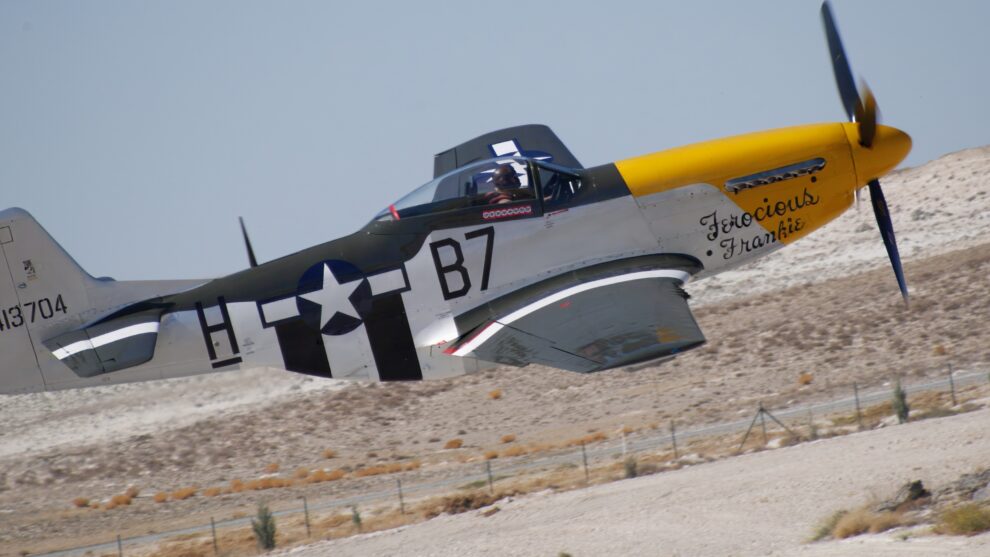
The P-51D Mustang is one of the most famous fighter aircraft of World War II. North American Aviation developed the Mustang family as a fast, long-range fighter, and the D model became the most recognized version. As a result, the aircraft remains one of the most iconic piston-engine fighters in aviation history.
The P-51D Mustang combined speed, range, maneuverability and firepower in a single airframe. It served mainly as a long-range escort fighter, protecting Allied bombers during deep missions over Europe. However, it also performed fighter-bomber, strafing and reconnaissance-related missions.
The aircraft gained much of its reputation after receiving the Packard-built Rolls-Royce Merlin engine. This engine gave the Mustang excellent high-altitude performance, which made it especially valuable for bomber escort missions. Therefore, the P-51D became a major factor in the air war over Europe.
P-51D Mustang General Characteristics
| Feature | Specification |
|---|---|
| Aircraft Type | Single-seat piston-engine fighter aircraft |
| Main Category | Military Aircraft |
| Additional Category | Special-Purpose Aircraft |
| Manufacturer | North American Aviation |
| National Origin | United States |
| Aircraft Family | North American P-51 Mustang |
| Variant | P-51D Mustang |
| First Mustang Flight | October 1940 |
| Main Role | Long-range escort fighter |
| Secondary Roles | Fighter-bomber, strafing and reconnaissance support |
| Crew | One pilot |
| Status | Retired from military service, many preserved as warbirds |
The P-51D Mustang is best known for its bubble canopy, which improved pilot visibility compared with earlier Mustang variants. In addition, the D model carried six .50-caliber machine guns instead of the four guns found on some earlier versions. These improvements made the aircraft more effective in air combat and ground attack missions.
Mustang Design and Development
The Mustang began as a response to British interest in a new fighter aircraft. North American Aviation proposed a new design instead of simply building another existing fighter under license. Consequently, the early Mustang reached flight testing very quickly and showed strong speed and handling potential.
Early Allison-powered Mustangs performed well at lower altitudes, but they lacked the high-altitude performance needed for escort missions over Europe. Later, engineers fitted the aircraft with Merlin engines. This change transformed the Mustang into a powerful long-range, high-altitude fighter.
The P-51D Mustang represented the most famous step in that development. It added the bubble canopy, improved gunsight, better armament arrangement and a more recognizable profile. Therefore, many people picture the D model when they think of the Mustang.
P-51D Mustang Dimensions
| Feature | Specification |
|---|---|
| Length | 32 ft 3 in / 9.83 m |
| Wingspan | 37 ft / 11.28 m |
| Height | 13 ft 8 in / 4.17 m |
| Wing Layout | Low-wing configuration |
| Landing Gear | Retractable tailwheel landing gear |
| Canopy Type | Bubble canopy |
| Propeller | Four-blade propeller |
The aircraft’s low-wing design and streamlined fuselage helped it reach high speed for a piston-engine fighter. Moreover, the bubble canopy gave pilots much better visibility during air combat. This mattered because situational awareness often decided the outcome of fighter engagements.
The P-51D Mustang also had a clean aerodynamic shape. Its radiator installation and laminar-flow wing design contributed to its performance. As a result, the aircraft combined long range with high speed more effectively than many earlier fighters.
Engine and Performance
The P-51D Mustang used a Packard-built Rolls-Royce Merlin V-1650 engine. This liquid-cooled V-12 engine gave the aircraft strong high-altitude performance and helped turn the Mustang into a successful escort fighter.
| Feature | Specification |
|---|---|
| Engine | Packard-built Rolls-Royce Merlin V-1650 |
| Engine Type | Liquid-cooled supercharged V-12 piston engine |
| Power Output | About 1,695 hp |
| Maximum Speed | About 437 mph |
| Cruising Speed | About 275 mph |
| Range | About 1,000 miles |
| Service Ceiling | About 41,900 ft |
| Maximum Weight | About 12,100 lb |
The Merlin engine made a major difference to the Mustang’s combat value. It allowed the aircraft to perform well at the altitudes where bomber escort missions took place. Therefore, the P-51D could accompany heavy bombers deep into enemy territory and still fight effectively when attacked.
Although the aircraft was fast, it was not only a speed machine. Its range, handling and firepower made it a balanced fighter. Consequently, it became one of the most respected aircraft of the war.
Armament and Combat Capability
| Feature | Specification |
|---|---|
| Fixed Guns | Six .50-caliber machine guns |
| External Stores | Rockets or bombs, depending on mission |
| Bomb Load | Up to about 2,000 lb in selected configurations |
| Rocket Load | Up to 10 × 5-inch rockets in selected configurations |
| Primary Combat Role | Escort fighter and air superiority support |
| Secondary Combat Role | Ground attack and fighter-bomber missions |
The six .50-caliber machine guns gave the P-51D strong firepower for air-to-air combat. In addition, the aircraft could carry bombs or rockets for ground attack missions. This flexibility helped the Mustang serve beyond pure escort duties.
During escort missions, the aircraft protected bomber formations from enemy fighters. Meanwhile, on the return flight or during dedicated attack missions, pilots could strafe airfields, vehicles and other ground targets. As a result, the P-51D became a versatile combat aircraft rather than a single-purpose fighter.
Why the P-51D Mustang Became Famous
The P-51D Mustang became famous because it solved one of the most serious problems faced by Allied bomber forces: long-range fighter escort. Earlier fighters often lacked the range to protect bombers during the entire mission. Therefore, bombers could become vulnerable deep inside enemy airspace.
With its long range and strong high-altitude performance, the Mustang could escort bombers much farther. This changed the balance of the air war. In addition, the aircraft could fight enemy interceptors effectively when they attacked bomber formations.
The P-51D also arrived at the right moment. By 1944, Allied air forces needed a fighter that could support large-scale bombing campaigns, ground attack missions and air superiority operations. The Mustang met those needs and became one of the defining aircraft of the final phase of World War II in Europe.
Operational Role
The P-51D Mustang served mainly with the United States Army Air Forces during World War II. It also operated in multiple theaters, including Europe and the Pacific. In Europe, it became especially important for escorting bombers during deep raids.
The aircraft also served after World War II. When the United States Air Force adopted the “F” fighter designation, many Mustangs became known as F-51s. During the Korean War, the aircraft returned to combat as a ground attack aircraft. However, jet fighters gradually replaced piston-engine aircraft in frontline service.
Today, many P-51D Mustangs survive as museum aircraft and airworthy warbirds. Aviation enthusiasts value the type for its history, sound, performance and elegant design. Therefore, the Mustang remains one of the most popular aircraft at airshows around the world.
Comparison with Earlier Mustang Variants
The P-51D Mustang improved on earlier Mustang versions in several important ways. The bubble canopy gave better visibility, while the six-gun armament increased firepower. In addition, the simplified ammunition feed system helped reduce gun jams.
Earlier P-51B and P-51C models already offered excellent performance with Merlin engines. However, the D model became more recognizable and more numerous. Therefore, it often represents the definitive Mustang version in aviation history.
The P-51H later offered even higher speed, but it arrived too late to see frontline combat in World War II. Because of that, the P-51D remains the most famous combat Mustang variant.
Frequently Asked Questions
What is the P-51D Mustang?
The P-51D Mustang is a single-seat, piston-engine World War II fighter aircraft built by North American Aviation.
What engine does the P-51D Mustang use?
The aircraft uses a Packard-built Rolls-Royce Merlin V-1650 liquid-cooled V-12 engine.
How fast is the P-51D Mustang?
The P-51D Mustang has a maximum speed of about 437 mph.
Why is the P-51D Mustang famous?
It became famous for its long-range bomber escort role, strong speed, good maneuverability and effective firepower during World War II.
How many guns did the P-51D Mustang have?
The P-51D carried six .50-caliber machine guns.
P-51D Mustang Summary
The P-51D Mustang is one of the most important fighter aircraft of World War II. With its Merlin engine, bubble canopy, long range, six .50-caliber machine guns and excellent performance, it became a highly effective escort fighter and fighter-bomber. Although jet aircraft eventually replaced it, the P-51D remains one of the most admired warbirds in aviation history.
Did you know AviationStream.com has a YouTube channel? Check out TheAeroGraphyOfficial and subscribe to watch fun, highly engaging aviation Shorts!