






Last Updated: 3 days ago
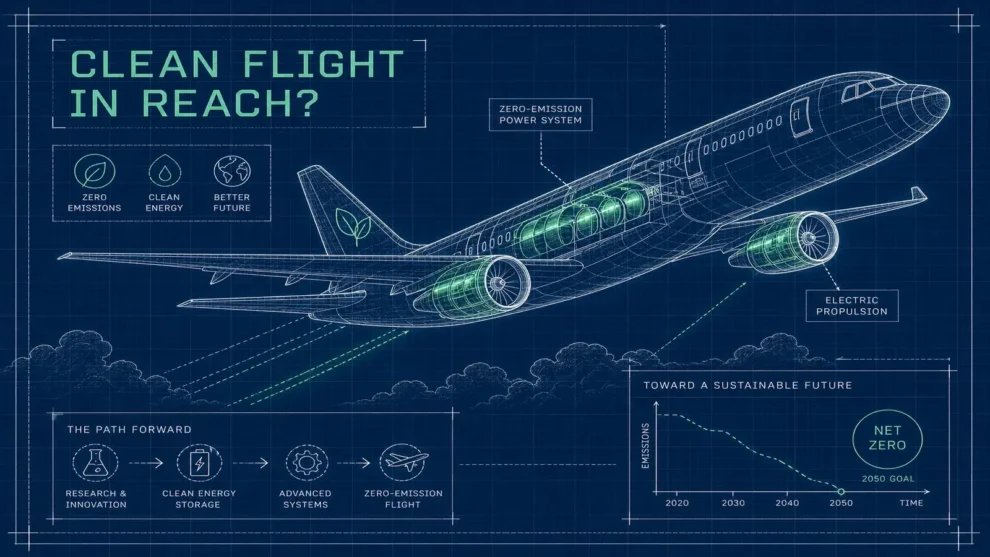
Aviation accounts for roughly 2, 3% of global CO2 emissions depending on the dataset, which is why the push for zero emission aircraft has moved from research papers to real hardware. That number is small enough to overlook and large enough to matter enormously at scale. This article is not about sustainable aviation fuels. SAF still burns carbon, just less of it. The conversation here is about aircraft that produce no CO2 at all during flight.
At Aviation Stream, we’ve tracked the eVTOL certification race and the electric propulsion buildout from early prototype to FAA bid. The story around emission-free flight is bigger than any single company. Before picking a winner, it helps to understand the full picture: the three competing technology paths, the physics that constrain them, who is closest, what is blocking them, and what the US timeline actually looks like.
What zero emission aircraft actually means in practice
The term “zero emission aircraft” covers three distinct technologies, each operating on a different principle. They share the goal of eliminating CO2 but differ sharply in energy source, range potential, and readiness level.
Hydrogen combustion: a familiar engine running on a different fuel
Hydrogen combustion uses modified gas turbines that burn H2 instead of kerosene. The combustion process generates direct thrust through hot gas expansion, the same physics as a conventional turbofan, with no CO2 produced. NOx emissions remain a concern, though low-NOx combustors can reduce them by roughly 70% compared to kerosene engines. This path is the most viable for larger aircraft and longer routes because the basic engine architecture is already familiar to manufacturers. Regulators, however, still need to develop hydrogen-specific certification standards; existing frameworks under 14 CFR Parts 23, 25, and 33 were never designed with hydrogen combustion in mind, as the FAA’s December 2024 Hydrogen-Fueled Aircraft Safety and Certification Roadmap explicitly acknowledges.
Hydrogen fuel cells: electricity from chemistry, water from the exhaust
In a hydrogen fuel cell aircraft, hydrogen reacts with oxygen inside a fuel cell stack through an electrochemical process, generating electricity that drives electric motors. The only exhaust byproduct is water vapor. Airbus selected this approach for its ZEROe program targeting regional jets up to 100 passengers, and ZeroAvia is the leading propulsion developer building certification-ready fuel cell systems. The appeal is clean chemistry: no combustion, no carbon, no NOx from the power generation process itself.
Battery-electric: the cleanest idea with the hardest constraint
Battery-electric aircraft store energy in high-capacity cells and power electric motors directly. If charged from renewable electricity, the operation is genuinely emission-free. The problem is physics. Current lithium-ion batteries deliver roughly 9 MJ/kg, while jet fuel delivers 43 MJ/kg. That roughly 50-to-1 gap by mass means battery-electric aircraft are practical today only for short-haul, small-cabin operations, and even there the economics are tight.
The energy density problem that defines the whole race
Understanding why these timelines keep slipping requires understanding the underlying physics. The numbers are not ambiguous, and the industry can’t engineer around them by simply working harder or faster.
Jet fuel vs. liquid hydrogen: the weight-versus-volume trade-off
Liquid hydrogen offers impressive specific energy: roughly 120 MJ/kg compared to jet fuel’s 43 MJ/kg. On a per-kilogram basis, hydrogen fuel is lighter. The problem is volumetric density. Jet fuel stores 34.7 MJ per liter; liquid hydrogen stores only 8.5 MJ per liter, meaning a hydrogen airplane needs 4.5 times more storage volume for the same energy content. Cryogenic tanks operating at -253°C are heavy, complex, and large, and their weight often negates much of the fuel weight advantage. Hydrogen airplane designs require fundamentally redesigned fuselages or blended-wing bodies to absorb that volume without destroying aerodynamic efficiency.
Why batteries still can’t power a commercial flight
Aviation-grade lithium-ion batteries currently deliver roughly 250 Wh/kg, with the best aviation-specific prototype cells reaching 400 Wh/kg. To match the energy in an A320’s fuel load using today’s best batteries, the pack would weigh approximately 2 million kg, the aircraft itself weighs a fraction of that. For batteries to become viable beyond short regional hops, the industry needs cells reaching 4,000 Wh/kg, sixteen times today’s best performance. That projection is widely cited in industry roadmaps, though no consensus timeline pinpoints exactly when it arrives. Battery-electric aircraft will scale upward as cell technology improves, but large commercial flights on batteries alone remain unlikely in the near term, most projections place viability well beyond 2040 and possibly after 2050.
Zero emission aircraft programs closest to commercial reality
Three programs define where the industry actually stands in 2026. Each has made real progress. Each has also missed timelines.
Airbus ZEROe: the biggest program, now delayed by roughly 5, 10 years
Airbus originally targeted 2035 for entry into service of a hydrogen-powered commercial aircraft. By early 2025, that target shifted to 2040, 2045, driven by low technology readiness and scarce green hydrogen supply. The program’s hydrogen systems reached Technology Readiness Level 3 in late 2025, and a 1.2 MW fuel-cell powertrain prototype is under construction in Ottobrunn, Germany. The A380 has been confirmed as the hydrogen flight demonstrator, with first flight testing expected in late 2026. The program is real, the hardware is being built, and the goalposts have moved significantly.
ZeroAvia: certifying the propulsion stack before the airframe
ZeroAvia is pursuing FAA and UK CAA certification for its 600-kW ZA600 hydrogen-electric propulsion system. The FAA published 33 special conditions for the ZA601 electric engine core, effective March 18, 2026, establishing the certification basis for the first time. Full ZA600 powertrain certification is now targeted for around 2029, with the Airbus ZEROe propulsion down-select decision expected in 2026, 2027. ZeroAvia’s strategy of certifying the propulsion system first and letting airframers integrate second is a pragmatic path through a regulatory environment that has no existing rules for hydrogen fuel cell planes.
JetZero: proving aerodynamics before committing to hydrogen
JetZero’s blended-wing-body demonstrator is scheduled to fly in 2027 using SAF rather than hydrogen. The company made a deliberate call: validate the airframe efficiency first, because hydrogen infrastructure and technology aren’t ready to support a 2035 hydrogen airplane. The long-term hydrogen commercial target remains on the roadmap, but the near-term focus is aerodynamic proof of concept. The efficiency gains from a blended-wing body matter enormously for any propulsion type, so the 2027 flight test will produce data the whole industry needs regardless of which fuel eventually powers the aircraft.
The infrastructure gap airports can’t ignore
A certified hydrogen aircraft needs somewhere to refuel. That infrastructure doesn’t exist at scale anywhere in the United States today, and building it will take longer and cost more than industry roadmaps currently project.
A basic Tier 1 hydrogen airport setup covering storage and distribution costs roughly 7.2 million euros per airport. A full setup including on-site liquefaction and pipeline connections reaches 33 million euros or more, with global airport infrastructure rollout projected at 37 billion euros total. Cryogenic tanks operating at -253°C require significant land separation from terminals, specialized piping, and trained ground crews. As of mid-2026, Hartsfield-Jackson Atlanta International Airport is the only US airport with an active hydrogen infrastructure feasibility study, conducted in partnership with Delta Air Lines, Airbus, and Plug Power.
Battery aircraft avoid cryogenic fuel handling, but the electricity demand is equally challenging. A large hub airport could require 3.5 to 4.5 GW of grid capacity by 2050 to support an electrified short-haul fleet, compared to the 50 to 90 MW most airports draw today. The infrastructure challenge is different from hydrogen, but it’s equally real. Neither path is ready to scale without sustained investment at the airport, utility, and government level simultaneously.
Certification and safety: the regulatory wall in the way
Engineering a working hydrogen aircraft is hard. Certifying it is a separate problem with its own decade-long timeline, and the two clocks run independently of each other.
In December 2024, the FAA published its Hydrogen-Fueled Aircraft Safety and Certification Roadmap, explicitly acknowledging that existing airworthiness standards under 14 CFR Parts 23, 25, and 33 were never designed for hydrogen combustion or fuel cells. The roadmap identifies hydrogen’s wide flammability range, low ignition energy, and leak behavior as the primary safety design drivers. Formal certification standards for hydrogen gas turbines are not expected until 2036. Until then, manufacturers must negotiate Special Conditions on a case-by-case basis, which extends timelines and adds cost to every program in the pipeline.
EASA published Special Conditions SC E-19 to address electric and hybrid propulsion systems, but SC E-19 explicitly does not cover hydrogen. Hydrogen aircraft require separate special conditions drafted from scratch. EASA held its first international workshop on hydrogen aircraft certification in December 2024, a signal that the formal regulatory framework is still being constructed from the ground up.
Where the US stands and what to watch through 2030
By 2030, the US will not see commercial hydrogen-powered aircraft in scheduled service. What it will see is ZeroAvia completing its ZA600 certification process and pursuing regional turboprop conversions, the Airbus A380 demonstrator wrapping up its hydrogen flight test program, and JetZero’s blended-wing demonstrator producing efficiency data from its 2027 flight campaign. Battery-electric progress will continue in the eVTOL space, where companies like Joby Aviation and Archer are already navigating the same FAA certification framework that hydrogen developers are now entering.
The realistic first commercial zero emission aircraft in the US will be a regional hydrogen-electric turboprop on routes under 500 miles, likely entering service between 2030 and 2035 if ZeroAvia’s certification proceeds without major delays. Narrow-body and wide-body decarbonized aviation is a post-2040 story.
At Aviation Stream, we cover this space as it develops: certification news, airshow debuts, propulsion milestones, and the full eVTOL ecosystem that connects directly to this story. The gap between a working prototype and a certified commercial flight is where the real story lives, and it’s where we focus our attention.
The honest answer to a big question about zero emission aircraft
So how close are zero emission aircraft to commercial reality? The technology is proven at small scale, the physics are well understood, and the leading companies are building real hardware and navigating real regulatory processes. What’s missing is the green hydrogen supply chain, the airport infrastructure, the regulatory framework, and the airframe redesigns needed to absorb these fuels at commercial scale. Those gaps won’t close in three years.
For regional hydrogen-electric turboprops, this is a 2030, 2035 story. For narrow-body and wide-body jets, it’s post-2040 at the earliest. The milestones that will determine whether those timelines hold, or slip another five years, are ZeroAvia’s FAA certification outcome, the Airbus A380 hydrogen demonstrator results, and JetZero’s 2027 blended-wing flight test.
Zero-emission aviation is coming. The question is simply which decade.