





Last Updated: 3 days ago
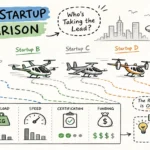
Dozens of eVTOL companies launched this decade with glossy renderings, confident investor decks, and timelines that made commercial air taxis sound imminent. The reality in 2026 looks different. Certification takes longer than anyone publicly admits, cash burns faster than it raises, and the FAA operates on its own calendar regardless of how many pre-orders a startup has announced. This eVTOL startup comparison cuts through that noise by ranking the leading players across four axes that actually matter: funding runway, FAA and EASA certification progress, verified flight performance, and commercial partnership quality. The air taxi race is real, but the field is thinning fast.
Aviation Stream has published dedicated profiles on Joby, Archer, Lilium, Wisk, and other major players for readers who want company-level depth. What follows is the comparative read that puts them all in the same frame. By the end, you’ll have a clear, data-grounded view of who’s winning, who’s coasting on borrowed time, and who still has a legitimate shot at relevance.
eVTOL startup comparison: funding runway and the brutal financial reality separating survivors from stragglers
Achieving FAA type certification costs hundreds of millions of dollars and takes years longer than most startups projected at founding. The companies that survive this process aren’t necessarily the ones with the best aircraft. They’re the ones that raised enough capital before the window tightened and burn at a rate that doesn’t outrun their timeline to revenue. Air taxi startup funding, in other words, is as decisive a variable as engineering talent.
Joby and Archer lead the capital table by a wide margin
Joby Aviation leads all eVTOL companies with $2.2 billion or more in total funding, and its Q1 2026 balance sheet showed $2.5 billion in cash, cash equivalents, and short-term investments. Management has guided toward $340 million to $370 million in cash use for just the first half of 2026, implying a quarterly eVTOL cash burn in the $170 million to $185 million range. That’s a serious number, but it also reflects a company deep inside the most expensive phase of FAA certification, not burning cash without a destination.
Archer sits at $1.5 billion or more in total funding, backed by United Airlines equity investment and Stellantis participation. That combination of capital and strategic validation is meaningful. United Airlines doesn’t write equity checks into companies it doesn’t expect to operate with. Stellantis brings manufacturing credibility that most pure-play aerospace startups lack entirely.
The middle tier faces a tighter squeeze
BETA Technologies has raised $800 million or more in a quieter but consistent fundraising progression that hasn’t required the same headline rounds as its peers. Eve Air Mobility sits at $500 million or more, with the structural backstop of Embraer as its parent company, which matters more than the dollar figure alone. Vertical Aerospace has raised $450 million or more, and Lilium comes in at approximately $376 million, with an important caveat: Lilium’s funding history includes a restructuring event, which makes the raw total less reliable as a proxy for actual runway.
The honest read on the middle tier is that raw funding totals tell you less than quarterly burn rates do. A company that raised $500 million three years ago and has spent aggressively since then may have less runway than a company that raised $300 million recently and operates lean. Without current burn rate data, large headline funding numbers can actively mislead. This is the key risk variable that analysts and investors tracking this sector need to keep anchored to actual financial filings, not press release totals.
Certification status: where each company actually sits on the FAA and EASA ladder
Most coverage of eVTOL conflates “flight testing” with regulatory approval, and that conflation significantly distorts the competitive picture. A company can fly its prototype every week and still be years from putting a paying passenger in a seat. Certification is where hype meets the FAA’s timeline, and the FAA doesn’t negotiate. Any serious eVTOL startup comparison has to treat certification stage as the single most consequential variable after cash runway.
EHang’s type cert win and why it doesn’t directly translate to U.S. operations
EHang holds the distinction of being the only major eVTOL manufacturer to achieve full type certification, receiving it from China’s Civil Aviation Administration for its EH216-S. The company has moved into commercial demonstration flights and begun mass production, which is a genuine milestone in the global eVTOL race. The limitation is jurisdiction: CAAC certification doesn’t transfer to FAA or EASA authority, and EHang’s pathway to U.S. commercial operations would require a separate FAA certification process, a multi-year undertaking that has not formally begun. For readers tracking the U.S. market, EHang’s win is an important proof point about what’s achievable, but it is not a near-term competitive threat in American skies.
Joby and Archer’s FAA progress: deep in the process, not at the finish line
Joby is the most advanced U.S. program by FAA certification progress. It completed Stage 3 of the FAA certification process in 2023, entered Stage 4, and as of early 2026 was in conforming-aircraft flight testing with FAA pilots expected to begin for-credit testing later in 2026. The FAA has issued Joby’s final airworthiness criteria and approved its propulsion certification plan. That’s a meaningful stack of completed milestones, even without a confirmed type certificate date.
Archer has its final FAA airworthiness criteria in place for the Midnight aircraft and holds a Part 135 Air Carrier and Operator Certificate. That second item is significant: it means Archer is structured to begin commercial operations the moment type certification clears, without needing a separate regulatory approval process for operations. Archer hasn’t yet reached the for-credit TIA testing stage that Joby entered in 2026, but it is the second most advanced U.S. program by most measures. For additional reporting on Archer’s test progress, see the company’s update on Archer’s Midnight Flight Test Program Reaches Record Heights.
The EASA field: what Design Organization Approval actually means
Lilium’s receipt of EASA Design Organization Approval is a credential worth understanding correctly. DOA confirms that an organization is qualified to design aircraft and hold type certificates under EASA’s SC-VTOL rules. It is not type certification itself. It’s a regulatory pre-qualification that positions a company to pursue certification, not evidence that certification has been achieved.
The FAA and EASA have made meaningful progress on harmonizing their eVTOL certification standards, which is structurally positive for the sector. Companies building toward both markets benefit from aligned frameworks rather than duplicated processes. For readers who want a deeper analysis of how the two agencies are aligning criteria, Vertical Aerospace’s industry coverage and commentary on EASA and FAA eVTOL certification standards is a useful resource. For European players like Vertical Aerospace, that harmonization creates a cleaner path to U.S. market entry once certification clears in their home jurisdiction.
eVTOL specs comparison: separating verified performance from marketing claims
Spec sheets and flight test data are not the same thing. Most eVTOL companies publish impressive range and speed figures, but verified performance tied to an actual test flight is a significantly higher standard. The honest summary of where the industry sits in 2026: flight milestones are real and documented, but complete verified eVTOL specs disclosures remain sparse across the board. Treating claimed performance figures as confirmed capability is one of the most common analytical mistakes in coverage of this sector.
Which companies have completed full-scale flight testing
Eve Air Mobility completed the first flight of a full-scale uncrewed eVTOL prototype, initiating its formal flight-test phase. Archer’s Midnight has flown in piloted configuration, with the earlier Maker prototype completing wing-borne transition, a technically significant aerodynamic milestone. Joby has completed its pre-production flight test program. Vertical Aerospace completed what it describes as the world’s first airport-to-airport piloted flight by a full-scale eVTOL. AutoFlight completed an inaugural cross-Yangtze River flight with its Prosperity aircraft, a notable international benchmark. Each of these is a real, documented milestone; what varies is how much verified performance data each company has published alongside the confirmation that a flight occurred. For a company press account of Eve’s first full-scale prototype flight, see the announcement that Eve Air Mobility completed the first flight of a full-scale eVTOL prototype.
What the verified performance numbers actually show
Archer’s Midnight is the most transparent about flight-test performance data. Confirmed test results include a 55-mile piloted flight completed in 31 minutes at speeds exceeding 126 mph, with separate test patterns reaching nearly 150 mph. Published specs describe a five-seat configuration with a range of up to 60 miles and a cruise speed of 150 mph. Eve’s publicly referenced range concept of approximately 60 miles is the clearest benchmark from that program, though it reflects the aircraft’s intended capability rather than a completed test result.
For most other companies, the public record confirms that flight testing occurred without publishing range, cruise speed, and payload as a verified set. That data gap is worth holding onto as a smart baseline of skepticism when evaluating any company’s performance claims. The spec sheet tells you what a company is aiming for; the flight data tells you what the aircraft has actually done. Aviation Stream’s video examination of pilot decision-making under extreme circumstances also helps readers understand operational risk; see V1: The Point of No Return, Why Pilots Must Fly Even if a Motor Explodes, aviationstream.com for that perspective.
Partnerships and purchase agreements: who has real commercial traction vs. letters of intent
The eVTOL sector has never had a shortage of announced partnerships. It has had a consistent shortage of binding agreements that carry financial consequence. Sorting real commercial traction from public relations activity is one of the more useful exercises in any eVTOL startup comparison.
Airline, defense, and operator deals that signal genuine market confidence
Archer’s partnership stack is among the most commercially credible in the field. United Airlines holds an equity position, not just a purchase agreement. Stellantis brings manufacturing investment. The exclusive partnership with Anduril for a hybrid VTOL defense application adds a revenue channel that has nothing to do with FAA certification timelines for commercial air taxis. Multi-sector commercial intent backed by equity investment is a materially different signal than a memorandum of understanding.
Joby’s partnership with Toyota goes beyond capital. Toyota has committed $894 million including a $500 million additional investment in 2024, and the relationship includes active transfer of Toyota Production System expertise along with key powertrain and actuation component supply. Joby’s partnership with Delta Air Lines covers commercial distribution. That combination of manufacturing depth and airline distribution is a genuine commercial architecture, not a marketing alignment. Coverage of Joby’s production ramp and Toyota collaboration is summarized in reporting on Joby getting a manufacturing boost from Toyota.
BETA Technologies and Surf Air Mobility have announced a purchase agreement covering the first commercial electric passenger service, a deal that carries the weight of an actual aircraft supply commitment rather than a letter of intent. A specific aircraft count and delivery schedule have not been publicly disclosed, which limits how precisely this can be compared to deals with published order books.
Vertiport infrastructure and ground-side readiness
Aircraft certification gets most of the attention, but commercial eVTOL operations require ground infrastructure that doesn’t yet exist at commercial scale. UrbanV’s partnership with Signature Aviation to develop vertiport networks across major U.S. states is one of the clearest infrastructure plays currently documented. Integrating vertiport facilities into existing private aviation terminals is a practical approach that uses established real estate rather than building from scratch.
Companies without vertiport partnerships in place are further from commercial reality than their aircraft progress alone suggests. An aircraft that achieves type certification in 2027 can’t generate revenue without somewhere to land. Aviation Stream’s coverage of urban air mobility infrastructure goes deeper on this ground-side challenge for readers who want the full picture on what it takes to run an actual air taxi operation. For further context on how a single operational error can cascade into program-level cost, see One Wrong Move on Takeoff Costs $400 Million, aviationstream.com.
Commercial timelines: eVTOL startup comparison across the 2026, 2029 window
The synthesis of funding runway, certification progress, flight data, and commercial partnerships produces a forward-looking picture that is realistic rather than promotional. Most eVTOL companies have published optimistic timelines. Most of those timelines have already slipped. What follows is a ground-level read of where things actually stand in 2026.
The realistic 2026 to 2028 commercial window
Joby targeted commercial launch in the 2025 to 2026 window and remains the most likely first mover in the U.S. market based on its FAA certification stage and capital position. Archer is structured to move immediately upon type certification, with its Part 135 certificate already issued. These two companies represent the near-term commercial contenders; most other players are realistically targeting 2027 to 2029, with some programs likely to slip further as certification complexity exceeds initial projections. Wisk, which is pursuing autonomous passenger operations, has indicated targets around 2027 to 2028, though autonomous certification adds a layer of regulatory complexity that crewed programs don’t carry.
Manufacturing scalability: the bottleneck nobody talks about enough
Type certification gets the headlines, but manufacturing scale is the constraint that determines whether a certified aircraft can actually build a business. Joby’s factory currently produces approximately one aircraft per month, with a target of four per month by 2027 and a longer-term goal of 500 aircraft per year once California and Ohio facilities are fully operational. The Toyota partnership is central to that ramp: it provides production system expertise that no aerospace-focused startup could replicate independently.
Supply-chain depth matters as much as production rate targets. Companies with single-source components, no dual-source strategy for critical parts, and limited certified manufacturing partners carry scalability risk that their aircraft certification progress doesn’t reflect. The companies that reach commercial certification and then can’t build meaningful volumes fast enough will find that first-mover status evaporates quickly when a competitor catches up on both fronts simultaneously.
The 2026 eVTOL rankings: a clear verdict on who matters and who’s watching from the sideline
Balanced summaries that give every company credit for “strong progress” aren’t useful for anyone trying to make a decision. The data across funding, certification, performance, and commercial traction is clear enough in 2026 to make a real call on where each company sits.
Tier one: the most likely to reach commercial operations
Joby and Archer are the two U.S. companies with the strongest case for near-term commercial operations. Their capital depth, FAA certification advancement, and commercial partnership quality separate them from the rest of the field in a way that isn’t marginal. EHang earns a tier-one position within China’s market specifically, where its active type certificate and commercial demonstration program are real, even if its U.S. pathway remains a separate and unresolved regulatory process.
Tier two: credible contenders with meaningful execution risk
BETA Technologies has raised capital consistently and quietly, with a real aircraft purchase agreement in place through the Surf Air Mobility deal. Vertical Aerospace has completed meaningful flight milestones and holds EASA-facing organizational credentials. Eve Air Mobility’s relationship with Embraer gives it structural durability that pure-play startups lack: access to engineering depth, supply chain relationships, and a parent company that has certified commercial aircraft before.
These companies have legitimate programs and real progress. The honest risk assessment is that their paths to commercial operations are longer and less certain than Joby’s and Archer’s, and capital constraints could tighten before revenue arrives.
Who’s on thin ice and why it matters for the broader sector
Companies with thinner funding profiles, slower certification traction, and no binding commercial agreements face existential questions that press releases about flight milestones don’t resolve. Consolidation and washout in this sector aren’t catastrophes: they’re how capital-intensive technology industries normalize after an initial wave of optimistic entrants. The companies that exit or restructure create acquisition targets for better-capitalized players and clarify which technical approaches actually work under regulatory scrutiny.
The picture in 2026 is no longer speculative for readers following this sector through investment decisions, research interest, or pure aviation enthusiasm. The data tells a clear enough story to rank these companies meaningfully, and that ranking will update with real velocity over the next 18 to 24 months as certification decisions land.
The air taxi race is entering its most decisive phase
The eVTOL sector in 2026 is no longer a field of equal possibilities. Funding depth, FAA certification advancement, verified flight data, and commercial partnership quality now separate companies into tiers with real distance between them. Joby and Archer are running hardest toward a commercial finish line that is within sight. The middle tier has genuine aircraft and genuine deals but faces a timeline that leaves less room for setbacks. The rest face harder questions about whether capital and certification velocity can converge before the runway runs out.
The variables that matter most over the next 18 months are straightforward to track: type certification decisions, quarterly burn rate filings, manufacturing ramp milestones, and vertiport infrastructure announcements. They’re just rarely assembled in one place with a clear verdict attached, which is exactly what this eVTOL startup comparison set out to do.
Aviation Stream covers each of these companies in dedicated profiles updated as milestones land, from certification filings to new funding rounds to operational launches. If you’re running the capital math or tracking where the industry is heading, that’s where the analysis continues. For a short Q&A-style primer on current industry questions, see Aviation Question #5, aviationstream.com.