







Last Updated: 4 days ago
Nine thousand, five hundred and thirty-four nautical miles. Block times stretching past 18 and a half hours. Singapore Airlines flights SQ23 and SQ24 between Singapore Changi (SIN) and New York (JFK) completely defy the traditional limits of commercial aviation. To conquer this ultra-long-haul marathon, Airbus didn’t just bolt larger fuel tanks onto an existing airframe. They engineered a highly optimized, digitally supreme machine. The true secret to this globe-spanning magic lies deep within the A350-900ULR avionics.
Let’s peel back the carbon-fiber reinforced polymer (CFRP) skin and dive straight into the electrical architectures, processing modules, and fluid management systems making these 19-hour jumps possible.
The Brains Behind the Brawn: Integrated Modular Avionics
Older generations of long-haul aircraft like the Boeing 747-400 or early A330s relied heavily on a federated architecture. Every single aircraft function—from landing gear extension to cabin temperature control—required its own dedicated Line Replaceable Unit (LRU) processing box. That meant miles of heavy, complex copper wiring weaving through the fuselage.
The A350-900ULR avionics suite utilizes a cutting-edge Integrated Modular Avionics (IMA) concept. This architecture consolidates computing power into fewer, highly robust Core Processing Input/Output Modules (CPIOMs). These modules share computing resources to run multiple aircraft applications simultaneously over a unified network.
Data blazes through the aircraft via the Avionics Full-Duplex Switched Ethernet (AFDX) network, built on the ARINC 664 Part 7 standard. Offering bandwidth up to 100 Mbit/s, this fiber-optic and ethernet-based backbone replaces traditional point-to-point wiring. By sharing processing resources and utilizing AFDX, Airbus stripped out nearly 800 kilograms of wiring and hardware. Shaving off 800 kilograms of dead weight directly translates to extended range and reduced fuel burn on a grueling 18-hour sector.
Fuel Management: Pushing the 165,000-Liter Limit
Achieving a 9,700-nautical-mile range often means sacrificing cargo space for massive auxiliary tanks in older jets. Airbus engineers took a much smarter, space-saving route. The ULR carries an astonishing 165,000 liters (about 43,588 gallons) of Jet A-1, exactly 24,000 liters more than the standard A350-900.
The Center Wing Box Trick
They unlocked this volumetric increase without adding new external tanks. By modifying the existing plumbing, relocating fuel sensors, and redesigning the vent systems in the center wing box, they utilized every cubic inch of available space.
To manage this massive sloshing energy, the Fuel Quantity Management System (FQMS) relies on an array of highly sensitive capacitance probes. Throughout the cruise over the Pacific or Atlantic, the system actively commands transfer pumps. It moves fuel between the inner, outer, and trim tanks to maintain an optimal Center of Gravity (CG). Keeping the CG slightly aft reduces downward aerodynamic drag on the horizontal stabilizer—a brilliant efficiency trick saving hundreds of pounds of fuel over the course of the journey.
Powering the A350-900ULR Avionics: Variable Frequency Generators
All those advanced computers require a massive, steady supply of electricity. Power is primarily generated by four 100kVA Variable Frequency Generators (VFGs), with two driven by each of the massive Rolls-Royce Trent XWB-84 engines.
Unlike older Constant Speed Drives (CSDs) that mechanically maintain an exact 400 Hz electrical frequency, the A350’s VFGs allow the frequency to vary between 360 and 800 Hz depending on engine spool speeds. Solid-state electronic controllers down the line condition this raw 115/200V AC power for the sensitive systems. The elimination of heavy, mechanical constant-speed gearboxes serves as another critical weight-saving measure.

The Glass Command Center
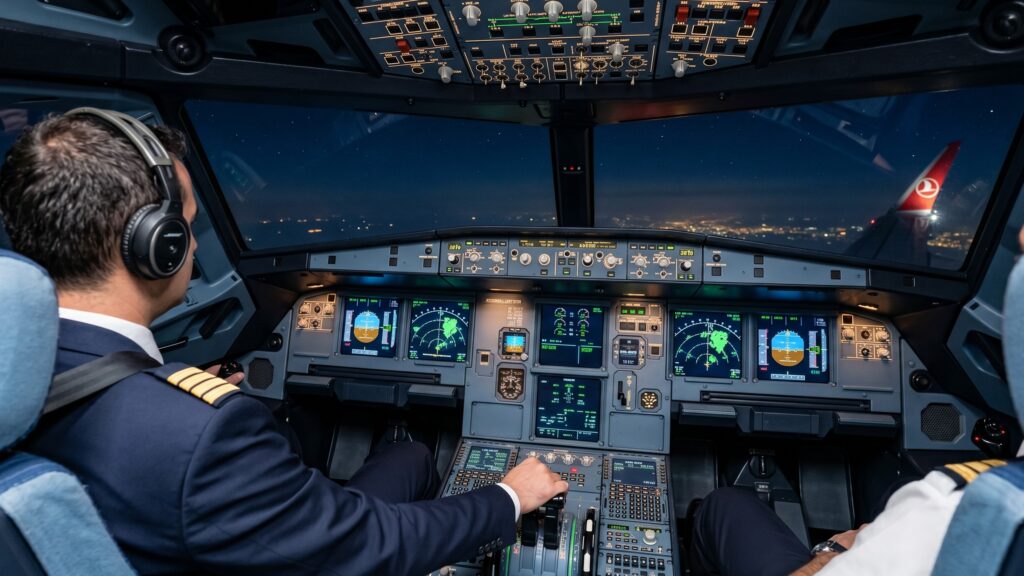
Stepping into the flight deck reveals a masterclass in human-machine interface. Six identical 15-inch LCD displays dominate the panel, driven by the Thales interactive Display System (iDS). Pilots interface with the A350-900ULR avionics via intuitive Keyboard and Cursor Control Units (KCCUs).
On a flight crossing multiple weather systems, polar regions, and incredibly complex airspaces, situational awareness dictates survival. Key features of this glass cockpit include:
- On-board Airport Navigation System (OANS): Provides a precise, moving 2D map of taxiways at JFK or Changi, preventing runway incursions during fatigued post-flight taxiing.
- Runway Overrun Prevention System (ROPS): Continuously calculates aircraft weight, approach speed, and weather data to ensure the aircraft can stop within the remaining runway length.
- Vertical Display (VD): Gives the crew a vertical profile of the flight path, terrain, and weather cells, crucial for dodging towering cumulonimbus clouds over the equator.
Comparing the Titans: Standard vs. ULR
| System / Specification | Standard A350-900 | A350-900ULR |
| Max Takeoff Weight (MTOW) | 268 Tonnes | 280 Tonnes |
| Max Fuel Capacity | 141,000 Liters | 165,000 Liters |
| Maximum Range | 8,100 nm | 9,700 nm |
| Aerodynamics | Standard Sharklets | Extended, twisted winglets |
| Forward Cargo | Standard ULD Loading | Frequently deactivated / empty to save weight |
Keeping the Pilots in the Loop: Fly-By-Wire Mastery
Deep inside the main equipment bay beneath the cockpit floor sit the true masters of the flight envelope: three Flight Control Primary Computers (FCPCs) and three Flight Control Secondary Computers (FCSCs). Operating on a dedicated 28V DC electrical architecture for extreme redundancy, these computers translate the pilot’s sidestick inputs into precise hydraulic and electrical actuator commands.
During an 18-hour sector, the autopilot manages the vast majority of the route. The Flight Management System (FMS) calculates step-climbs with pinpoint accuracy. As the Trent XWB engines burn off the 130-tonne fuel load, the aircraft becomes progressively lighter. The system continuously evaluates optimal cruise altitudes, commanding gradual climbs from FL310 all the way up to FL410, slicing through thinner, more efficient air to stretch every drop of fuel.
Frequently Asked Questions (FAQ)
1. Does the A350-900ULR have rest areas for the crew on such long flights?
Absolutely. Due to strict crew duty limits, the ULR features an expanded Flight Crew Rest Compartment (FCRC) above the front cabin and a separate resting area for flight attendants at the rear. SQ operates these ultra-long flights with two Captains and two First Officers.
2. Can the ULR carry heavy cargo along with passengers?
To achieve the 9,500 nm range within the 280-tonne MTOW limit, payload must be tightly controlled. Singapore Airlines configures these jets with only Premium Economy and Business Class seats. The cargo hold is usually restricted to passenger baggage, with little to no commercial cargo loaded.
3. What engines power this specific variant?
The aircraft relies exclusively on two Rolls-Royce Trent XWB-84 turbofans. These powerplants produce 84,000 pounds of thrust each and boast one of the lowest specific fuel consumption (SFC) rates in the commercial aviation industry.
Over to You, Aviation Geeks!
What do you think is the most impressive piece of engineering hidden within the A350-900ULR avionics bay? Have you ever endured the 18-plus hour marathon on SQ23 or SQ24? Drop your experiences, avgeek thoughts, or technical questions in the comments below—let’s talk airplanes!
Did you know AviationStream.com has a YouTube channel? Check out TheAeroGraphyOfficial and subscribe to watch fun, highly engaging aviation Shorts!