






Last Updated: 3 days ago
Aviation safety is a history written in lessons learned. Before the turn of the millennium, fuel tank flammability relied heavily on minimizing ignition sources. That paradigm shifted entirely following tragic incidents that exposed the vulnerability of heated fuel vapors. Today, modern engineering tackles the problem at its chemical root by removing the oxygen necessary for combustion. At the forefront of this technology is the A350 Nitrogen Generation System, formally known as the On-Board Inert Gas Generation System (OBIGGS). This invisible shield ensures that the aircraft’s center and wing tanks remain inert, regardless of the flight phase.

The Chemistry of Fuel Tank Inerting
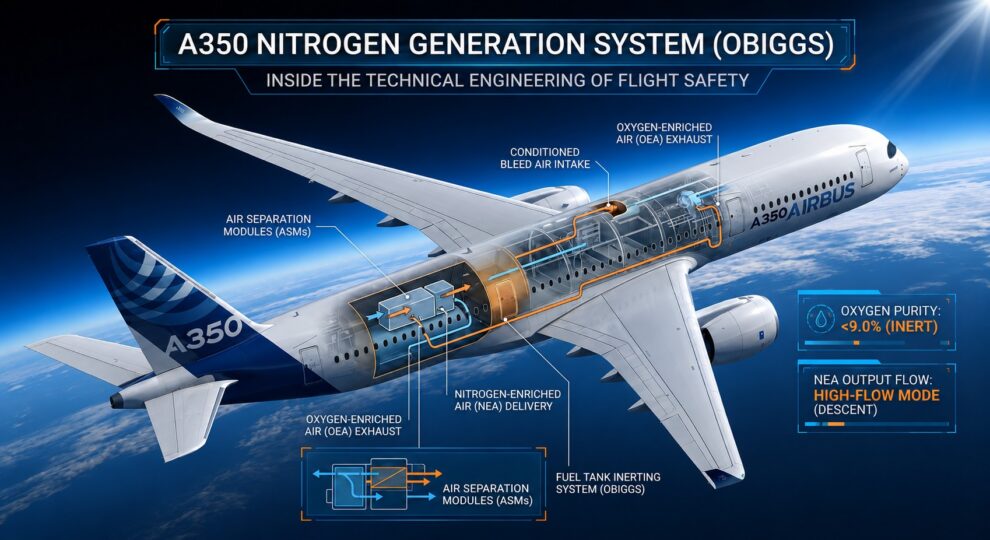
The core philosophy of the A350 Nitrogen Generation System is elegant yet highly complex. To prevent a spark from igniting fuel vapors, you must drop the oxygen concentration inside the ullage (the empty space above the liquid fuel) below a critical threshold. For commercial aviation, that magic number is 9%. Below 9% oxygen, jet fuel vapor simply cannot ignite.
Let’s trace the journey of air through this mechanical marvel. The system borrows high-pressure, high-temperature bleed air from the Rolls-Royce Trent XWB engines or the Auxiliary Power Unit (APU). This raw air is far too hot and turbulent to be processed right away. It passes through a dedicated conditioning network featuring ozone converters and a sophisticated heat exchanger. The heat exchanger utilizes cold ram air scooped from the outside environment to cool the bleed air down to an optimal operating temperature—typically around 70°C to 85°C (158°F to 185°F)—which is the sweet spot for the filtration process.
The Heart of the Machine: Air Separation Modules
Once conditioned, the air enters the true powerhouse of the OBIGGS: the Air Separation Modules (ASMs). These cylindrical canisters look unassuming from the outside, but inside they house thousands of microscopic hollow-fiber membranes.
Here is the exact sequence of the separation process:
- Entry: Conditioned bleed air is forced into the ASM fibers under high pressure.
- Permeation: The walls of these hollow fibers act as a selective filter. Oxygen and water vapor molecules are physically smaller and permeate through the fiber walls at a rapid rate.
- Exhaust: The extracted oxygen-rich air (Oxygen Enriched Air, or OEA) is dumped overboard safely through dedicated fuselage vents.
- Delivery: The larger nitrogen molecules remain trapped inside the hollow fibers, traveling all the way through to become Nitrogen Enriched Air (NEA).
This NEA is then pumped directly into the A350’s center and wing fuel tanks. As fuel is consumed by the Trent XWB engines, the system continuously fills the expanding ullage with nitrogen, ensuring the environment remains chemically inert.
Comparing Generations: Why the A350 Excels
Legacy systems often relied on passive venting or heavy, pressurized Halon suppression bottles. Modern airliners shifted to active inerting, but early iterations were bulky and notoriously maintenance-heavy. The A350 Nitrogen Generation System introduces a massive leap in efficiency.
| System Metric | Pre-OBIGGS Era (Passive) | Early OBIGGS (1st Gen) | A350 OBIGGS Architecture |
| Primary Defense | Ignition source elimination | Active inerting via heavy ASMs | Lightweight ASMs with dual-flow control |
| Weight Penalty | Minimal (but higher risk) | Significant payload impact | Optimized materials, lower overall weight |
| Oxygen Threshold | Ambient (~21%) | ~12% | Strictly maintained < 9% |
| Maintenance Focus | Wiring inspections | Frequent filter replacements | Extended ASM lifespan, predictive monitoring |
Operational Nuances and Dual Lines
The A350 takes redundancy seriously. The distribution manifold relies on a dual-line architecture managed by intelligent flow control valves. High-flow modes are automatically triggered during critical phases like descent. When an aircraft descends rapidly, the changing atmospheric pressure forces ambient air (which is roughly 21% oxygen) into the fuel tank vents. To counter this aggressive influx, the A350 Nitrogen Generation System ramps up its output, pushing massive volumes of NEA into the tanks to maintain the critical sub-9% ratio.
For those delving into the intricacies of fuel management, understanding the [Internal Link: avionics architecture interfacing with OBIGGS] is just as crucial as the pneumatic hardware itself. The Core Processing Input/Output Modules (CPIOMs) constantly monitor pressures, temperatures, and valve positions, feeding real-time data back to the flight deck without requiring manual pilot input.
The A350 Nitrogen Generation System is a quiet guardian. It has no moving parts in its core ASMs, relies purely on molecular physics, and runs seamlessly in the background. It represents the pinnacle of proactive aviation safety—stopping a fire before the ingredients even exist.
Frequently Asked Questions (FAQ)
1. Does the A350 Nitrogen Generation System run continuously?
Yes, the system operates constantly from the moment the engines (or APU) supply bleed air. It adjusts its flow rate based on the flight phase, peaking during descent to counter ambient air rushing into the fuel tank vents.
2. What happens if the OBIGGS fails mid-flight?
Aircraft are designed with immense redundancy. While the OBIGGS adds a massive layer of safety by inerting the tanks, the primary defense against fuel tank explosions remains the strict elimination of ignition sources (like frayed wiring or static buildup). A failure triggers a maintenance alert, and the aircraft can still fly safely under specific Minimum Equipment List (MEL) operational restrictions until repaired.
3. Are the Air Separation Modules heavy?
Early ASMs were notoriously heavy and degraded quickly. The modern iterations used in the A350 utilize advanced polymer membranes that drastically cut weight while extending operational longevity, minimizing the payload penalty for airlines.
Join the Discussion
Have you ever worked on pneumatic systems or studied the evolution of fuel tank inerting? Which Airbus A350 system fascinates you the most? Drop your thoughts in the comments below and let’s keep the technical discussion going!
Did you know AviationStream.com has a YouTube channel? Check out TheAeroGraphyOfficial and subscribe to watch fun, highly engaging aviation Shorts!