







Last Updated: 4 months ago
← Back to Aircraft Database| General Characteristics | |
| Type | Military Aircraft, Special-Purpose Aircraft |
|---|---|
| National Origin | Ukraine |
| Manufacturer | Antonov |
| Variants | An-22, Amphibious An-22, An-22A, An-22PZ |
| Status | Retired |
| First Flight | 27 February 1965 |
| Introduction | 1967 |
| Primary Users | Russian Aerospace Forces Aeroflot, Antonov Airlines |
| Number Built | 68 |
| Developed From | N/A |
| Capacity & Dimensions | |
| Cockpit Crew | Two |
| Typical Seating | 28–29 pax |
| Max Seating | 80,000 kg (176,370 lb) maximum payload capacity |
| Overall Length | 57.92 m (190 ft 0 in) |
| Wing Span | 64.4 m (211 ft 3 in) |
| Wing Sweep | 0° |
| Wing Area | 345 m² (3,710 sq ft) |
| Overall Height | Overall Height: 12.53 m (41 ft 1 in) |
| Weights, Powerplant & Performance | |
| MTOW | 114,000 kg (251,327 lb) |
The Antonov An-22 is one of the most remarkable heavy transport aircraft ever built. Known by the name “Antei,” it became famous for its enormous size, four powerful turboprop engines and ability to carry heavy cargo into remote areas. As a result, the aircraft earned a special place in military transport aviation history.
Antonov developed the aircraft during the Soviet era to move large military equipment, vehicles and oversized cargo. However, the An-22 did more than serve military logistics. It also supported civilian cargo work, industrial transport and special heavy-lift missions in areas where ordinary transport aircraft could not operate easily.
The Antonov An-22 first flew on February 27, 1965. At the time, it was the largest transport aircraft in the world and the largest turboprop aircraft ever built. Moreover, its wide cargo hold, high-wing layout and rough-field capability made it especially valuable for carrying heavy loads to remote regions.
Antonov An-22 General Characteristics
| Feature | Specification |
|---|---|
| Aircraft Type | Heavy military transport aircraft |
| Main Category | Military Aircraft |
| Additional Category | Special-Purpose Aircraft |
| Manufacturer | Antonov |
| National Origin | Soviet Union / Ukraine aviation lineage |
| Country Category | Ukraine |
| First Flight | February 27, 1965 |
| Production Period | 1965–1976 |
| Number Built | 66 aircraft |
| Nickname | Antei / Antheus |
| ICAO Code | AN22 |
| Primary Role | Heavy cargo and military transport |
| Crew | Typically 5–6 crew members |
| Status | Mostly retired, with very limited remaining operation historically reported |
The aircraft uses a high-wing configuration, a large rear loading ramp and a spacious cargo hold. Therefore, it can carry heavy vehicles, machinery and oversized cargo more easily than many earlier transport aircraft. In addition, its landing gear and wing design support operations from less-developed airfields.
An-22 Heavy Transport Role
The An-22 was designed to solve a major military logistics problem. Armies needed to move large vehicles and heavy equipment quickly across long distances. Rail and sea transport could carry heavy loads, but they were often slower and less flexible. Therefore, a large military airlifter offered a major advantage.
The aircraft could transport cargo that smaller aircraft could not handle. It also gave operators the ability to reach remote areas without fully developed runway infrastructure. As a result, the Antonov An-22 became useful for strategic airlift, humanitarian support, industrial transport and military deployment.
Its cargo role also connected it with later Antonov giants. The An-22 helped transport large components for aircraft such as the An-124 Ruslan and An-225 Mriya. This made it important not only as a transport aircraft, but also as part of Antonov’s own heavy aircraft development story.
Antonov An-22 Dimensions
| Feature | Specification |
|---|---|
| Length | 57.84 m |
| Wingspan | 64.40 m |
| Height | 12.54 m |
| Wing Area | 345 m² |
| Wing Layout | High-wing configuration |
| Tail Design | Twin-fin tail arrangement |
| Landing Gear | Multi-wheel retractable landing gear |
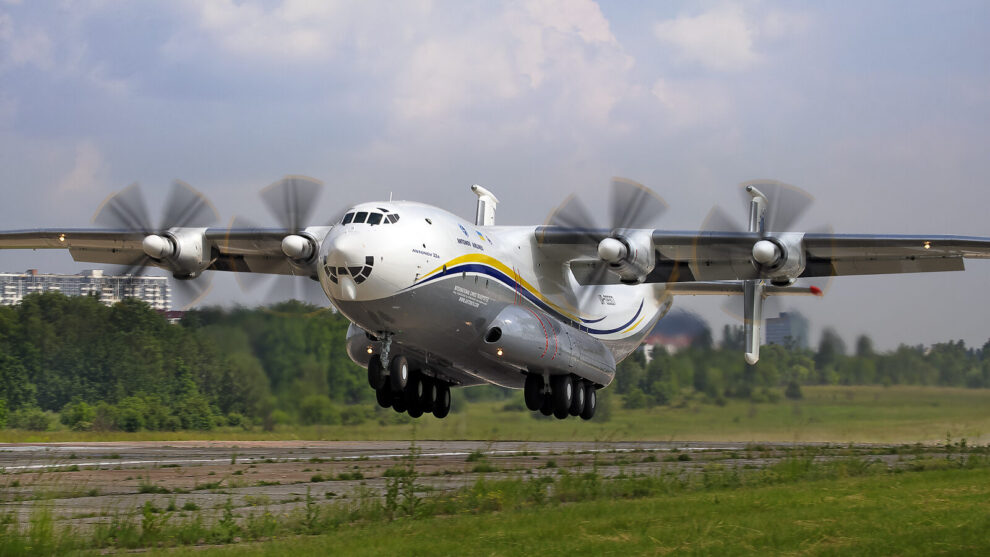
The aircraft’s dimensions explain why it made such a strong impression at international air shows. Its wingspan is larger than many jet airliners, while its fuselage provides a large internal cargo volume. However, the high-wing layout also serves a practical purpose. It keeps the engines and propellers high above the ground and gives the cargo area more useful space.
The twin-fin tail helps provide stability while keeping the rear loading area clear. In addition, the wide fuselage and rear ramp allow the aircraft to load vehicles and heavy equipment directly. Consequently, the An-22 became a practical solution for oversized cargo missions.
Antonov An-22 Engines and Performance
The Antonov An-22 uses four Kuznetsov NK-12MA turboprop engines. Each engine drives large contra-rotating propellers, which give the aircraft its distinctive sound and appearance. These propellers are among the most recognizable features of the aircraft.
| Feature | Specification |
|---|---|
| Engines | 4 × Kuznetsov NK-12MA turboprop engines |
| Propellers | Contra-rotating multi-blade propellers |
| Power | About 15,000 shp per engine |
| Cruise Speed | About 580 km/h |
| Maximum True Airspeed | About 400 kt, depending on profile |
| Operational Range | About 5,225 km |
| Service Ceiling | About 9,100 m |
| Maximum Takeoff Weight | About 250,000 kg |
| Typical Maximum Payload | About 80,000 kg |
The NK-12 engine family gave the aircraft enormous turboprop power. Although jet transports later became more common for strategic airlift, the An-22 showed that turboprop aircraft could still carry very large loads. Moreover, turboprop efficiency helped the aircraft operate over long distances while carrying heavy cargo.
The aircraft’s contra-rotating propellers also helped convert engine power into useful thrust. However, they produced a very distinctive acoustic signature. For many aviation enthusiasts, that sound became part of the An-22’s identity.
Cargo Capacity and Loading System
| Feature | Specification |
|---|---|
| Maximum Payload | About 80,000 kg |
| Cargo Role | Heavy vehicles, machinery, military equipment and oversized loads |
| Cargo Access | Rear loading ramp |
| Cargo Hold Type | Large wide-body cargo compartment |
| Passenger Capability | Limited passenger carriage depending on configuration |
The Antonov An-22 was not designed like a normal passenger aircraft. Instead, it focused on cargo volume, payload and loading flexibility. Its rear ramp allows heavy equipment to enter the cargo hold more directly. Therefore, the aircraft can support missions that require fast loading and unloading of vehicles or large equipment.
The aircraft also broke several payload and altitude records. These achievements proved the strength of its design and helped build its global reputation. In addition, the An-22 showed that a very large turboprop transport could combine heavy-lift capability with operational flexibility.
Why the An-22 Was Built
Antonov developed the An-22 because existing transport aircraft could not fully meet Soviet heavy-lift requirements. The military needed an aircraft that could carry large loads over long distances and still operate from less-prepared airfields. Therefore, the An-22 filled a gap between smaller tactical transports and later super-heavy airlifters.
The aircraft also supported operations in remote regions. In the Soviet Union, many industrial and military sites sat far from major transport hubs. Because of this, an aircraft with heavy cargo capacity and rough-field capability offered major practical value.
The Antonov An-22 also became a technological stepping stone. Its design experience helped Antonov move toward even larger aircraft, including the An-124 and An-225. Consequently, the An-22 became an important part of the Antonov heavy transport lineage.
Operational History
The An-22 appeared internationally at the 1965 Paris Air Show and created a major impression because of its size. At that time, few aircraft could match its combination of payload, wingspan and turboprop power. In addition, it set numerous world records in speed, altitude and carrying capacity.
In service, operators used the aircraft for military transport, oversized cargo, relief missions and special industrial loads. The aircraft could move equipment to remote locations, support military deployments and carry large aircraft components. Meanwhile, its ability to operate from unpaved runways increased its usefulness in difficult environments.
Although later jet-powered aircraft such as the An-124 replaced it in many heavy-lift roles, the An-22 remained important for decades. Its long service life shows the strength of the original design and the continuing need for specialized heavy transport aircraft.
Comparison with Later Antonov Transports
The Antonov An-22 came before the An-124 Ruslan and An-225 Mriya. Compared with those later aircraft, it is smaller and uses turboprop engines instead of turbofan engines. However, the An-22 still holds a unique position because it was the world’s largest turboprop aircraft.
The An-124 offered greater payload and jet-powered strategic lift capability. The An-225 then pushed the heavy transport concept even further. Nevertheless, the An-22 helped establish Antonov’s reputation for building very large cargo aircraft. Therefore, it deserves a separate place in any aircraft database.
Frequently Asked Questions
What is the Antonov An-22 used for?
The aircraft was mainly used for heavy military transport, oversized cargo movement and special airlift missions.
Is the An-22 the largest turboprop aircraft?
Yes. The Antonov An-22 is widely recognized as the world’s largest turboprop aircraft.
What engines does the Antonov An-22 use?
The aircraft uses four Kuznetsov NK-12MA turboprop engines with contra-rotating propellers.
How much cargo can the An-22 carry?
The aircraft can carry a typical maximum payload of about 80,000 kg, depending on mission conditions and configuration.
Is the An-22 still flying?
Most aircraft have retired. However, a very small number remained active into the modern era, mainly in specialized cargo or military-related roles.
Antonov An-22 Summary
The Antonov An-22 is a giant four-engine turboprop military transport aircraft designed for heavy cargo missions. With its high-wing layout, wide cargo hold, rear loading ramp, Kuznetsov NK-12MA engines and rough-field capability, it became one of the most distinctive transport aircraft ever built. Although later Antonov aircraft surpassed it in size and payload, the An-22 remains a landmark in heavy-lift aviation history.
Did you know AviationStream.com has a YouTube channel? Check out TheAeroGraphyOfficial and subscribe to watch fun, highly engaging aviation Shorts!