








Last Updated: 4 months ago
← Back to Aircraft Database| General Characteristics | |
| Type | Civil and Commercial Aircraft |
|---|---|
| National Origin | United States |
| Manufacturer | Boeing |
| Variants | Boeing 737 MAX 7, Boeing 737 MAX 8, Boeing 737 MAX 9 |
| Status | In service |
| First Flight | January 29, 2016; 10 years ago (2016-01-29) |
| Introduction | May 22, 2017, with Malindo Air |
| Primary Users | Southwest Airlines, Ryanair, United Airlines, Alaska Airlines |
| Number Built | 2,200 as of February 2026 |
| Developed From | Boeing 737 Next Generation |
| Capacity & Dimensions | |
| Cockpit Crew | 2 |
| Typical Seating | 193 (16J + 177Y) |
| Max Seating | 220 |
| Overall Length | 138 ft 4 in (42.16 m) |
| Wing Span | 117 ft 10 in (35.92 m) |
| Wing Sweep | 25.02° |
| Wing Area | 1,370 sq ft (127 m²) |
| Overall Height | 40 ft 4 in (12.3 m) |
| Weights, Powerplant & Performance | |
| MTOW | 194,700 lb (88,300 kg) |
| OEW | 105,800 lb (47,990 kg) |
| Fuel Capacity | 6,853 US gal (25,941 L) |
| Engines | 2 x CFM International LEAP-1B |
| Max. Thrust | 29,317 lbf (130.41 kN) |
| Typical Cruise Speed | 839 km/h (453 kn) at altitude |
| Max. Speed | Mach 0.82 |
| Range | 3,300 nmi (6,100 km; 3,800 mi) |
| Takeoff Distance | 8,500 ft (2,600 m) (at SL, ISA, MTOW) |
| Service Ceiling | 41,000 ft (12,500 m) |
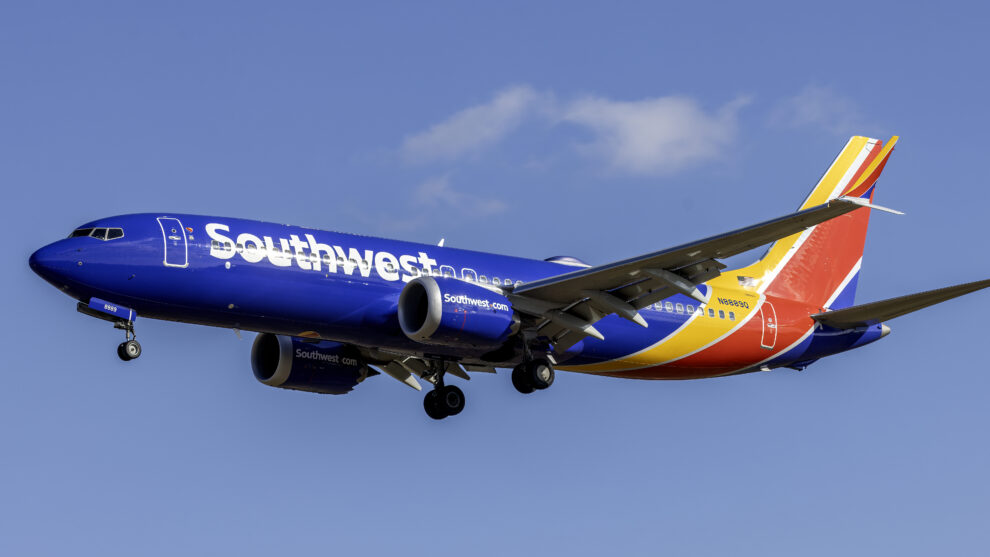
The Boeing 737 MAX 9 is a stretched member of the Boeing 737 MAX family. It gives airlines more seating capacity than the 737 MAX 8 while keeping the same modern single-aisle platform, CFM International LEAP-1B engines and advanced winglet design.
Boeing developed the 737 MAX family to improve fuel efficiency, range and operating economics compared with earlier 737 generations. Therefore, the Boeing 737 MAX 9 became an option for airlines that needed extra seats on growing routes without moving to a larger aircraft category.
The Boeing 737 MAX 9 first flew on April 13, 2017, and the first delivery took place in March 2018. The aircraft fits between the smaller 737 MAX 8 and the larger 737 MAX 10. As a result, it serves airlines that need more capacity than the core MAX 8 but do not require the maximum seating of the MAX 10.
Boeing 737 MAX 9 General Characteristics
| Feature | Specification |
|---|---|
| Aircraft Type | Narrow-body twin-engine jet airliner |
| Main Category | Civil and Commercial Aircraft |
| Additional Category | Narrow-body airliner |
| Manufacturer | Boeing Commercial Airplanes |
| National Origin | United States |
| Aircraft Family | Boeing 737 MAX |
| Variant | Boeing 737 MAX 9 / Boeing 737-9 |
| First Flight | April 13, 2017 |
| First Delivery | March 21, 2018 |
| Launch Operator | Thai Lion Air / Lion Air Group |
| Cockpit Crew | Two pilots |
| ICAO Code | B39M |
| Primary Role | Short- and medium-haul passenger transport |
| Status | In production and in airline service |
The Boeing 737 MAX 9 belongs to the fourth generation of the Boeing 737 family. It keeps the familiar 737 single-aisle layout, but it adds newer engines, updated aerodynamics and modern flight deck improvements. In addition, it shares strong commonality with other 737 MAX variants, which helps airlines simplify crew training, maintenance and fleet planning.
737 MAX 9 Cabin and Seating
The Boeing 737 MAX 9 offers more cabin capacity than the 737 MAX 8. Boeing lists 175–195 seats in a two-class configuration and up to 220 seats in a maximum layout. Therefore, airlines can use the aircraft on routes where demand is growing but a larger aircraft may not be necessary.
| Feature | Specification |
|---|---|
| Typical Two-Class Seating | 175–195 passengers |
| Maximum Seating | 220 passengers |
| Cabin Type | Single-aisle narrow-body cabin |
| Typical Economy Layout | Six-abreast seating |
| Cabin Concept | Boeing Sky Interior-style single-aisle cabin |
| Typical Use | Domestic, regional and medium-haul routes |
The cabin layout depends on the airline. Some carriers use a two-class configuration with premium and economy seating. Others use a denser single-class or high-capacity layout. As a result, the aircraft can support network airlines, leisure operators and low-cost carriers.
Because the Boeing 737 MAX 9 carries more passengers than the MAX 8, it helps airlines reduce seat-mile cost on busy routes. However, it still keeps the airport compatibility and operating logic of the 737 family. This combination makes the aircraft useful for high-frequency routes and growing city pairs.
Boeing 737 MAX 9 Dimensions
The 737 MAX 9 uses a longer fuselage than the 737 MAX 8. This extra length gives the aircraft more seating capacity while keeping the same wingspan as other MAX family members.
| Feature | Specification |
|---|---|
| Overall Length | 42.1 m / 138 ft 2 in |
| Wingspan | 35.9 m / 117 ft 10 in |
| Overall Height | 12.3 m / 40 ft 4 in |
| Fuselage Type | Stretched narrow-body fuselage |
| Wing Layout | Low-wing swept configuration |
| Wingtip Design | Boeing Advanced Technology winglets |
| Engine Layout | Two underwing turbofan engines |
The aircraft’s longer fuselage is the easiest way to distinguish it from the 737 MAX 8. In addition, the MAX family’s split-tip Advanced Technology winglets help improve aerodynamic efficiency. These winglets became one of the most recognizable visual features of the 737 MAX generation.
Although the Boeing 737 MAX 9 is longer than the MAX 8, it remains smaller than the MAX 10. Therefore, it occupies a middle position within the larger-capacity side of the MAX family.
Engines and Performance
The Boeing 737 MAX 9 uses two CFM International LEAP-1B turbofan engines. These engines are a major difference between the MAX family and the previous 737 Next Generation aircraft. They offer improved fuel efficiency and lower noise compared with older CFM56-powered 737 NG models.
| Feature | Specification |
|---|---|
| Engines | 2 × CFM International LEAP-1B turbofan engines |
| Engine Type | High-bypass turbofan |
| Maximum Takeoff Weight | 88,310 kg / 194,700 lb |
| Range | Up to 3,300 nautical miles / 6,110 km |
| Maximum Operating Speed | About Mach 0.82 |
| Typical Cruise Speed | About Mach 0.79 |
| Number of Engines | Two |
| Typical Mission | Short- and medium-haul airline routes |
The aircraft offers enough range for many domestic, regional and medium-haul international missions. Therefore, airlines can use it on transcontinental routes, busy regional sectors and selected longer single-aisle services.
Moreover, the LEAP-1B engine and MAX winglet combination support lower fuel use compared with earlier 737 generations. This helps airlines improve operating economics, especially when the aircraft flies with strong passenger loads.
Why Airlines Choose the 737 MAX 9
Airlines choose the Boeing 737 MAX 9 because it offers more seats than the 737 MAX 8 while keeping single-aisle efficiency. It can increase capacity on routes that are too busy for smaller aircraft but may not need the larger MAX 10.
The aircraft also supports fleet commonality. Airlines operating other 737 MAX variants can use similar pilot training, maintenance procedures, spare parts planning and ground handling processes. Consequently, the MAX 9 can join an existing 737 fleet without requiring a completely new aircraft type.
In addition, the aircraft can help operators manage airport slot limits. If an airport has limited takeoff and landing slots, adding seats to each flight can be more practical than adding extra frequencies. Therefore, the Boeing 737 MAX 9 can be useful on high-demand routes where capacity matters.
Operational Role
The Boeing 737 MAX 9 mainly serves short- and medium-haul passenger routes. Airlines use it on domestic trunk routes, regional international flights, leisure markets and longer single-aisle missions. Its range and capacity allow it to cover many routes that earlier 737 models served, while offering improved efficiency.
The aircraft also fits low-cost and network carrier models. A low-cost airline may use a high-density layout to maximize seat count. Meanwhile, a full-service airline may configure the aircraft with first class, extra-legroom economy and standard economy seating.
Because of this flexibility, the Boeing 737 MAX 9 can operate across different airline business models. It is not limited to one type of route or carrier. Instead, it gives airlines a larger single-aisle aircraft for markets that need extra capacity.
Comparison with the 737 MAX 8
The Boeing 737 MAX 9 is longer than the 737 MAX 8 and carries more passengers. The MAX 8 is often seen as the most versatile member of the family, while the MAX 9 focuses more on additional capacity.
The 737 MAX 8 offers slightly longer range and lower capacity. In contrast, the MAX 9 offers up to 220 seats and a range of up to 3,300 nautical miles. Therefore, airlines usually choose between them based on route demand, payload needs and fleet strategy.
Both aircraft use the same LEAP-1B engine family and share the same MAX design philosophy. As a result, they can operate together efficiently in the same airline fleet.
Comparison with the 737 MAX 10
The 737 MAX 10 is larger than the Boeing 737 MAX 9 and offers the highest passenger capacity in the MAX family. However, the MAX 9 still provides strong capacity while being shorter than the MAX 10.
The MAX 10 fits routes where airlines want the largest possible 737 MAX cabin. The MAX 9 fits routes where airlines need more seats than the MAX 8 but prefer a slightly smaller aircraft than the MAX 10. Consequently, both aircraft serve different capacity points within the same single-aisle family.
This family structure helps Boeing offer airlines several aircraft sizes with common systems and similar operational logic.
Frequently Asked Questions
What is the Boeing 737 MAX 9?
The Boeing 737 MAX 9 is a stretched narrow-body jet airliner and a larger member of the Boeing 737 MAX family.
How many passengers can the 737 MAX 9 carry?
Boeing lists 175–195 seats in a two-class layout and up to 220 seats in a maximum seating configuration.
What engines does the Boeing 737 MAX 9 use?
The aircraft uses two CFM International LEAP-1B turbofan engines.
What is the range of the 737 MAX 9?
The aircraft has a range of up to 3,300 nautical miles, or about 6,110 kilometres.
Is the 737 MAX 9 larger than the MAX 8?
Yes. The Boeing 737 MAX 9 has a longer fuselage and higher passenger capacity than the 737 MAX 8.
Boeing 737 MAX 9 Summary
The Boeing 737 MAX 9 is a stretched member of the 737 MAX family designed for higher-capacity short- and medium-haul airline routes. With up to 220 seats, CFM International LEAP-1B engines, 3,300 nautical miles of range and strong commonality with other 737 MAX variants, it gives airlines a practical way to add capacity while staying within the familiar Boeing 737 single-aisle platform.
First Flight & Early Testing – Boeing 737 MAX 9
The Boeing 737 MAX is a series of narrow-body aircraft developed by Boeing Commercial Airplanes as the fourth generation of the Boeing 737. It succeeds the Boeing 737 Next Generation and incorporates more efficient CFM International LEAP engines, aerodynamic improvements such as split-tip winglets, and structural modifications. The program was announced in August 2011, the first flight took place in January 2016, and the aircraft was certified by the U.S. Federal Aviation Administration (FAA) in March 2017. The first delivery, a MAX 8, was made to Malindo Air in May 2017. (Source: Wikipedia)
Design & Development – Boeing 737 MAX 9
The 737 MAX series includes four main variants—the MAX 7, MAX 8, MAX 9, and MAX 10—with increasing fuselage length and seating capacity. Boeing also developed a high-density version, the MAX 8-200, launched by Ryanair. The aircraft typically seats 138 to 204 passengers in a two-class configuration and has a range of 3,300 to 3,850 nautical miles [nmi] (6,110 to 7,130 km; 3,800 to 4,430 mi). As of February 2026[update], Boeing has delivered 2,200 aircraft and held orders for 4,845 more. The MAX 8 is the most widely ordered variant, while the MAX 7 and MAX 10 have not yet received FAA certification, and the agency has not provided a timeline for their approval. Its primary competitor is the Airbus A320neo family, which occupies a similar market segment. (Source: Wikipedia)
Operators & Users
Two fatal accidents, Lion Air Flight 610 in October 2018 and Ethiopian Airlines Flight 302 in March 2019, led to the global grounding of the 737 MAX fleet from March 2019 to November 2020. The crashes were linked to the Maneuvering Characteristics Augmentation System (MCAS), which activated erroneously due to faulty angle of attack sensor data. Investigations revealed that Boeing had not adequately disclosed MCAS to operators and identified shortcomings in the FAA’s certification process. The incidents caused significant reputational and financial damage to Boeing, including billions of dollars in legal settlements, fines, and cancelled orders. (Source: Wikipedia)