Boeing 747-300 Stretched Upper Deck
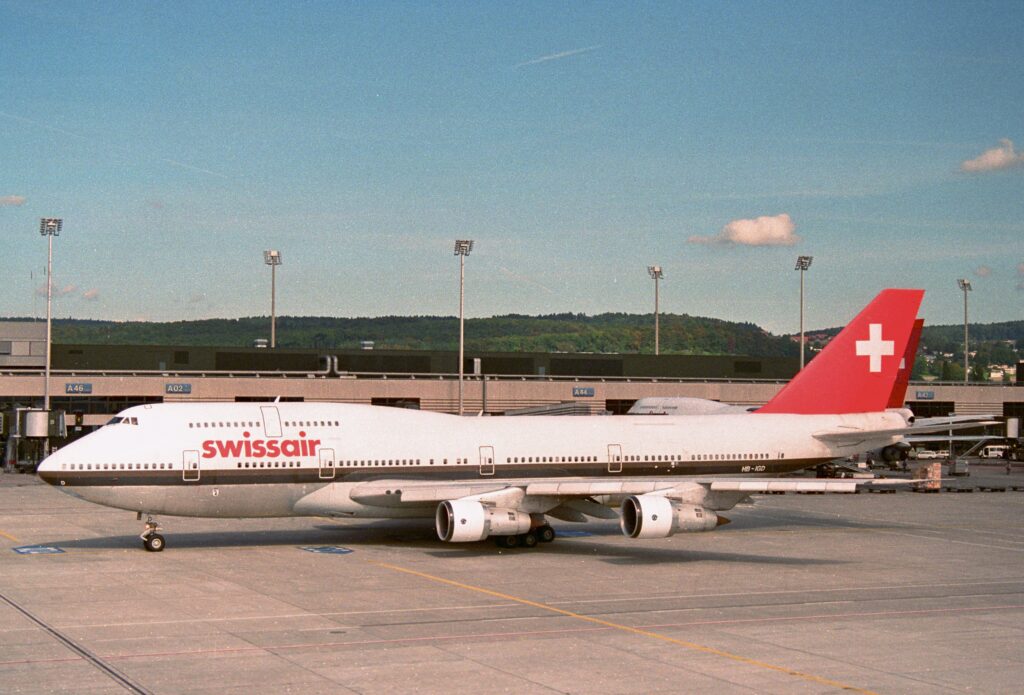
The Boeing 747-300 introduced the stretched upper deck that became the hallmark of later 747s. It first flew on 5 October 1982, entered service with Swissair in 1983, and 81 were delivered before the 747-400 replaced it.
| General Characteristics | |
| Type | Wide-body jet airliner, Civil and Commercial Aircraft |
|---|---|
| National Origin | United States |
| Manufacturer | Boeing |
| Variants | 747-300, 747-300M (combi), 747-300SR (short range) |
| Status | Out of production (1982–1990); retired from passenger service |
| First Flight | 5 October 1982 |
| Introduction | March 1983 with Swissair (first delivery 23 March 1983) |
| Primary Users | Swissair (launch customer), Qantas, Singapore Airlines, Japan Airlines, KLM (historical) |
| Number Built | 81 (56 747-300, 21 747-300M, 4 747-300SR) |
| Developed From | Boeing 747-200 |
| Capacity & Dimensions | |
| Cockpit Crew | Three (two pilots and a flight engineer) |
| Typical Seating | 400 (Boeing typical layout) |
| Overall Length | 70.66 m (231 ft 10 in) |
| Wing Span | 59.64 m (195 ft 8 in) |
| Wing Sweep | 37.5° |
| Wing Area | 511 m² (5,500 sq ft) |
| Weights, Powerplant & Performance | |
| MTOW | 351.5–377.8 t (775,000–833,000 lb) |
| OEW | 174.3–182.7 t (384,240–402,700 lb) |
| Fuel Capacity | 196,970–198,390 L (52,035–52,410 US gal) |
| Engines | 4 × Pratt & Whitney JT9D, Rolls-Royce RB211-524 or General Electric CF6-80C2 turbofans |
| Max. Thrust | 206–253 kN (46,300–56,900 lbf) each |
| Typical Cruise Speed | Mach 0.85 |
| Range | 11,720 km (6,330 nmi) with 400 passengers and baggage |
| Takeoff Distance | 3,320 m (10,900 ft) |
The Boeing 747-300 was the last of the “classic” three-crew Boeing 747s and the first to be built with the stretched upper deck that later became the hallmark of the 747-400 and 747-8. The upper deck is 7.11 m (23 ft 4 in) longer than on the 747-200, which added room for dozens of extra seats. The 747-300 first flew on 5 October 1982, and Swissair received the first one on 23 March 1983.
A Bigger Upper Deck
On the first 747s, the upper deck behind the cockpit was a small lounge reached by a spiral staircase. Airlines soon turned it into a premium cabin and wanted more of it. Boeing’s answer was the stretched upper deck (SUD), which extends the hump back towards the wing. On the 747-300, it came with two emergency exit doors on the upper deck and a new straight staircase, which takes less floor space than the old spiral stair and frees room for more seats both upstairs and on the main deck.
With these changes, Boeing’s typical layout rose from 366 seats on the 747-200B to 400 seats on the 747-300. The stretched upper deck was also offered as a retrofit: KLM had ten of its 747-200s converted between 1984 and 1986, and the modified aircraft are often mistaken for 747-300s.
Aerodynamics and Engines
Minor aerodynamic changes raised the cruise speed: the 747-300 cruises at Mach 0.85, compared with Mach 0.84 for the 747-100 and -200. The maximum take-off weight stayed in the same range as the 747-200B, from 351.5 to 377.8 t (775,000 to 833,000 lb), but the empty weight is a little higher at 174.3 to 182.7 t (384,240 to 402,700 lb).
Airlines could choose Pratt & Whitney JT9D or Rolls-Royce RB211-524 engines, as on the 747-200, or the newer General Electric CF6-80C2, with up to 253 kN (56,900 lbf) of thrust each. Boeing gives a range of 11,720 km (6,330 nmi) with 400 passengers and their baggage, slightly less than the 747-200B because of the extra weight and seats.
The flight deck still uses three crew: two pilots and a flight engineer. The wing, landing gear and systems are the same as on the 747-200, including the four hydraulic systems and the 16-wheel main landing gear.
Versions and Customers
Swissair placed the first order on 11 June 1980. Boeing delivered 81 aircraft of the 747-300 series: 56 passenger aircraft, 21 747-300M combis, which carry freight behind a partition at the rear of the main deck, and four 747-300SR short-range aircraft for Japanese domestic routes. Customers included Swissair, Qantas, Singapore Airlines, KLM, Japan Airlines and Sabena. The last 747-300 was delivered to Sabena in September 1990.
The 747-300M combi suited airlines such as KLM and Swissair, which could move the partition on the main deck and change the split between passengers and freight to match the season. The four 747-300SR aircraft went to Japan Airlines, which used them with a very high number of seats on busy domestic routes, where their strengthened structure was built for many short flights a day.
A Short Production Run
The 747-300 sold far fewer copies than the 747-200 because it was overtaken almost at once. In 1985, only two years after it entered service, Boeing announced the 747-400, which combined the same stretched upper deck with a longer wing and winglets, more efficient engines and a two-crew glass cockpit without a flight engineer. Airlines that wanted new 747s switched to the -400.
Many 747-300s nevertheless flew for 25 years or more. Qantas, Singapore Airlines and Japan Airlines used them on long-haul and regional routes into the 2000s, and several were later converted into freighters. Like other classic 747s, they have now left passenger service.
Sources
- Boeing: airport planning documents (ACAPS), including the 747-100/-200/-300/-SP
- Wikipedia: Boeing 747 variants (used to check delivery figures)
Start the discussion
Commenting on this aircraft: Boeing 747-300 Stretched Upper Deck